Department of Biological Sciences, Institute of Molecular Plant Sciences, University of Edinburgh, Edinburgh, United Kingdom.
PLoS One. 2010 Dec 16;5(12):e15589. doi: 10.1371/journal.pone.0015589.
A number of studies have previously demonstrated that "goodness of fit" is insufficient in reliably classifying the credibility of a biological model. Robustness and/or sensitivity analysis is commonly employed as a secondary method for evaluating the suitability of a particular model. The results of such analyses invariably depend on the particular parameter set tested, yet many parameter values for biological models are uncertain.
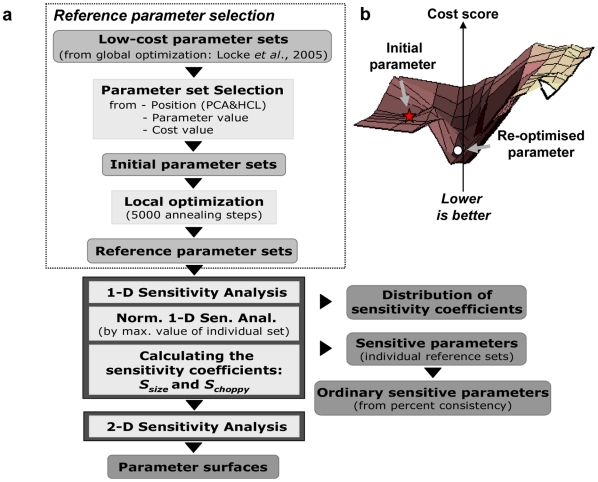
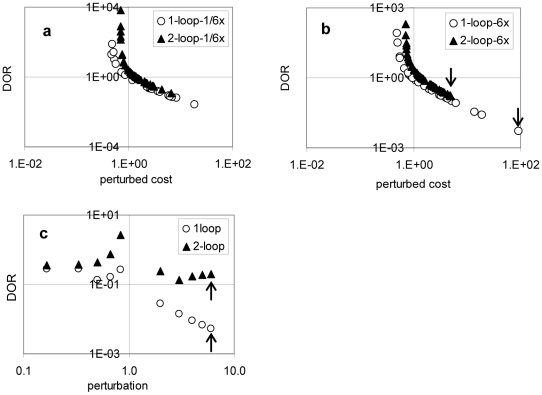
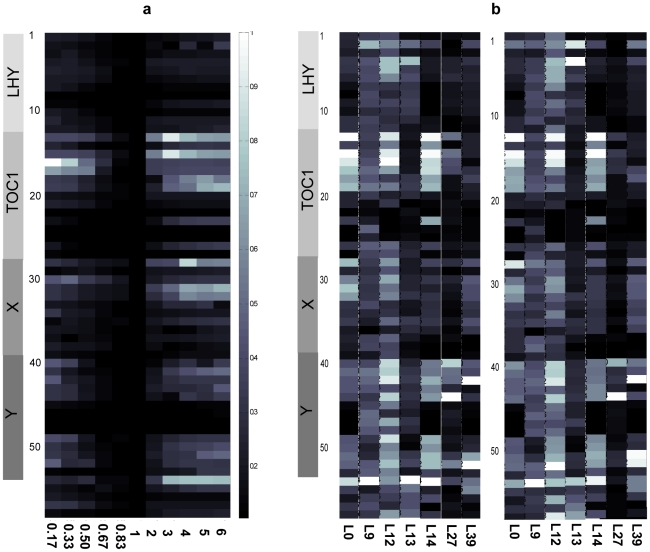
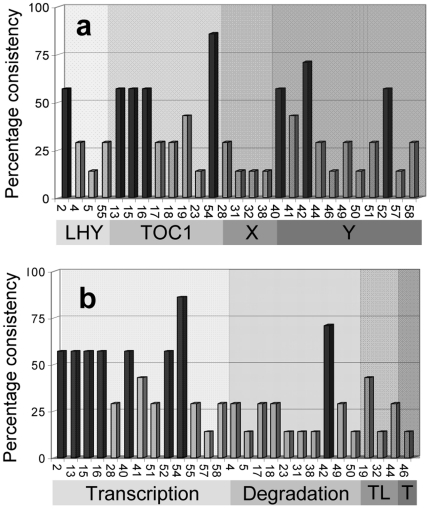
Here, we propose a novel robustness analysis that aims to determine the "common robustness" of the model with multiple, biologically plausible parameter sets, rather than the local robustness for a particular parameter set. Our method is applied to two published models of the Arabidopsis circadian clock (the one-loop [1] and two-loop [2] models). The results reinforce current findings suggesting the greater reliability of the two-loop model and pinpoint the crucial role of TOC1 in the circadian network.
Consistent Robustness Analysis can indicate both the relative plausibility of different models and also the critical components and processes controlling each model.
先前的多项研究表明,“适配度”不足以可靠地对生物模型的可信度进行分类。稳健性和/或敏感性分析通常被用作评估特定模型适用性的次要方法。此类分析的结果始终取决于所测试的特定参数集,但许多生物模型的参数值是不确定的。
在这里,我们提出了一种新的稳健性分析方法,旨在确定具有多个生物学合理参数集的模型的“常见稳健性”,而不是针对特定参数集的局部稳健性。我们的方法应用于两个已发表的拟南芥生物钟模型(单环[1]和双环[2]模型)。结果证实了当前的研究结果,即双环模型具有更高的可靠性,并指出 TOC1 在生物钟网络中的关键作用。
一致稳健性分析可以指示不同模型的相对合理性,以及控制每个模型的关键组件和过程。