Department of Pharmacology and Toxicology, Michigan State University, East Lansing, MI 48824, USA.
Neuroscience. 2011 Mar 17;177:335-46. doi: 10.1016/j.neuroscience.2010.12.039. Epub 2010 Dec 25.
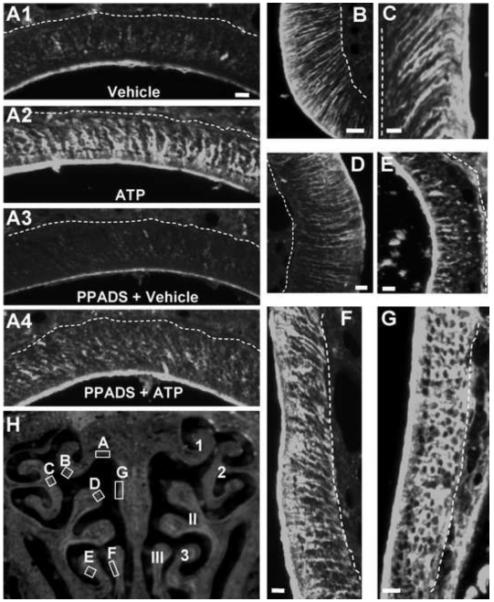
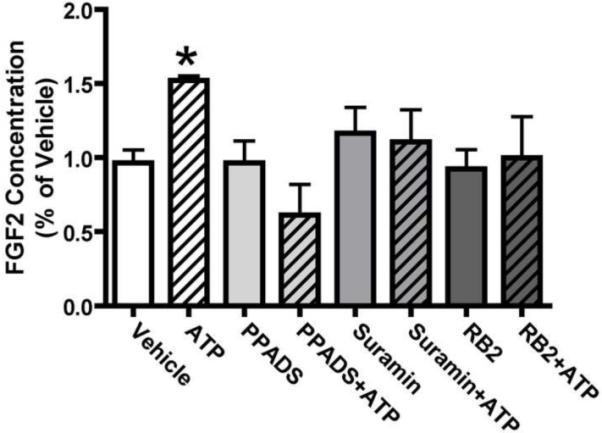
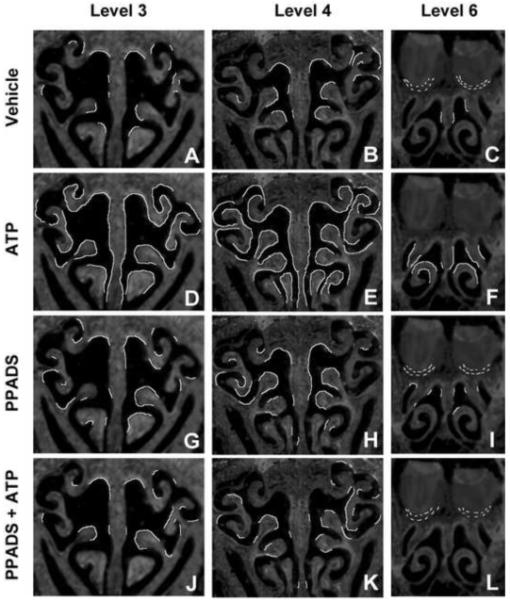
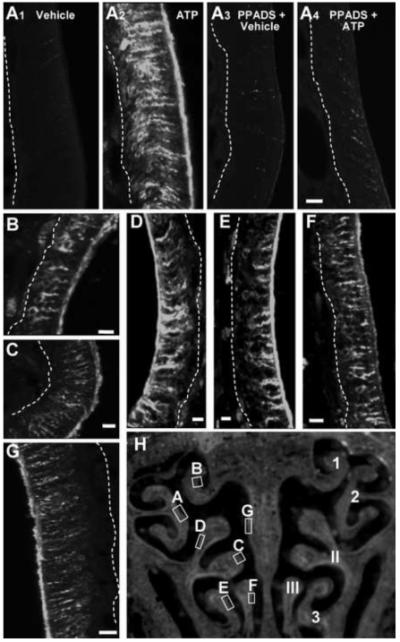
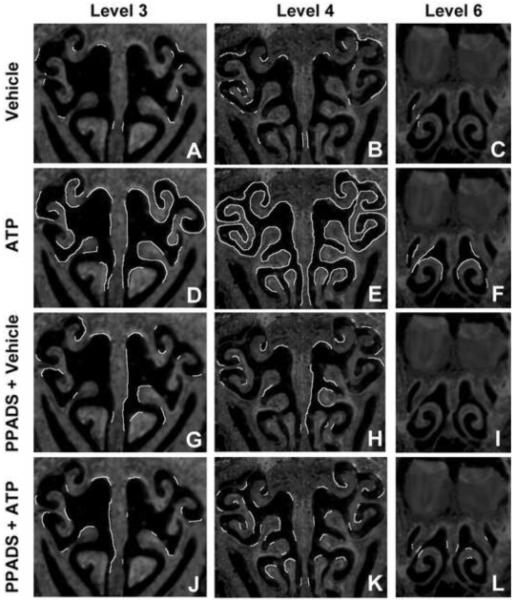
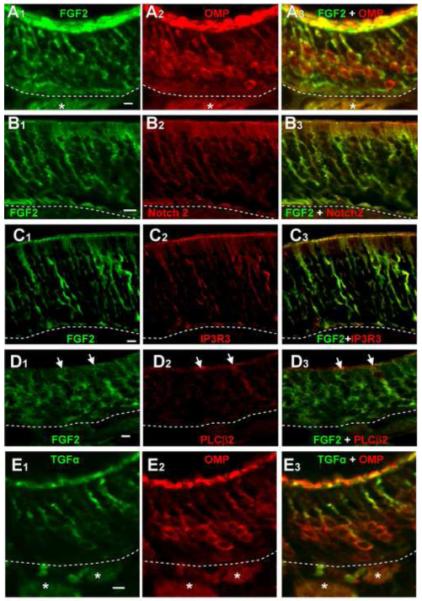
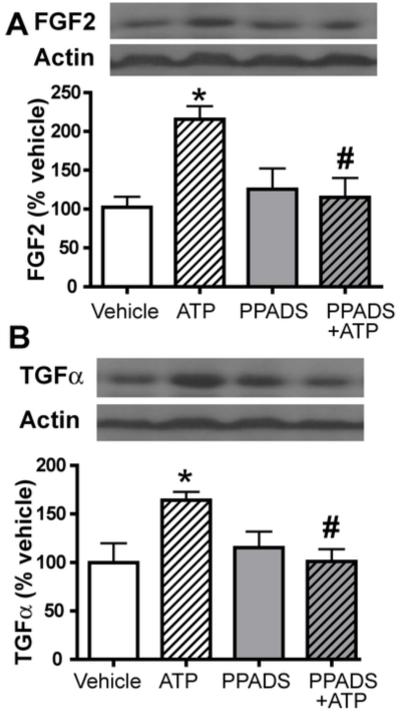
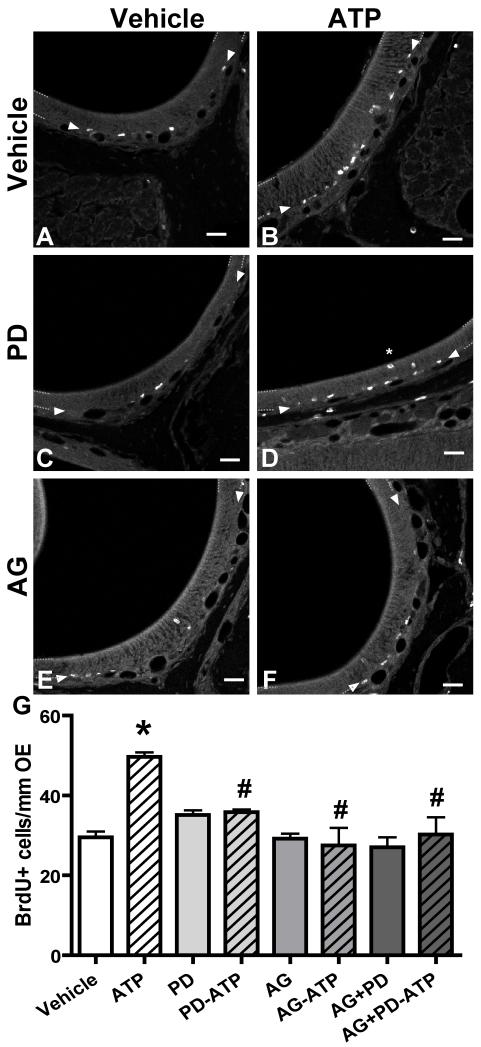
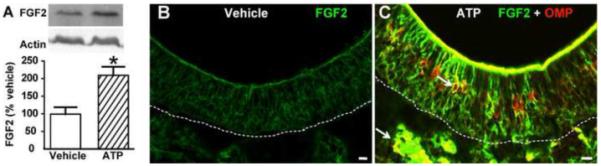
Multiple neurotrophic factors play a role in proliferation, differentiation and survival in the olfactory epithelium (OE); however, the signaling cascade has not been fully elucidated. We tested the hypotheses that ATP induces the synthesis and secretion of two neurotrophic factors, fibroblast growth factor 2 (FGF2) and transforming growth factor alpha (TGFα), and that these neurotrophic factors have a role in inducing proliferation. Protein levels of FGF2 and TGFα were increased 20 h post-intranasal instillation of ATP compared to vehicle control in adult Swiss Webster mice. Pre-intranasal treatment with purinergic receptor antagonist pyridoxal-phosphate-6-azophenyl-20,40-disulfonic acid (PPADS) significantly blocked this ATP-induced increase, indicating that upregulation of FGF2 and TGFα expression is mediated by purinergic receptor activation. However, in neonatal mouse, intranasal instillation of ATP significantly increased the protein levels of FGF2, but not TGFα. Likewise, ATP evoked the secretion of FGF2, but not TGFα, from neonatal mouse olfactory epithelial slices and PPADS significantly blocked ATP-evoked FGF2 release. To determine the role of FGF2 and TGFα in inducing proliferation, 5-bromo-2-deoxyuridine (BrdU) incorporation was examined in adult olfactory epithelium. Intranasal treatment with FGF receptor inhibitor PD173074 or epidermal growth factor receptor inhibitor AG1478 following ATP instillation significantly blocked ATP-induced BrdU incorporation. Collectively, these data demonstrate that ATP induces proliferation in adult mouse olfactory epithelium by promoting FGF2 and TGFα synthesis and activation of their receptors. These data suggest that different mechanisms regulate neurogenesis in neonatal and adult OE, and FGF2 and TGFα may have different roles throughout development.
多种神经营养因子在嗅上皮(OE)的增殖、分化和存活中发挥作用;然而,信号级联尚未完全阐明。我们检验了以下假设:ATP 诱导两种神经营养因子,成纤维细胞生长因子 2(FGF2)和转化生长因子 α(TGFα)的合成和分泌,并且这些神经营养因子在诱导增殖中起作用。与载体对照相比,成年瑞士 Webster 小鼠鼻腔内给予 ATP 20 小时后,FGF2 和 TGFα 的蛋白水平增加。鼻内给予嘌呤能受体拮抗剂吡哆醛-6-偶氮苯-20,40-二磺酸(PPADS)预处理可显著阻断这种 ATP 诱导的增加,表明 FGF2 和 TGFα 表达的上调是由嘌呤能受体激活介导的。然而,在新生小鼠中,鼻腔内给予 ATP 可显著增加 FGF2 的蛋白水平,但不增加 TGFα。同样,ATP 可从新生小鼠嗅上皮切片中诱导 FGF2 的分泌,但不诱导 TGFα,并且 PPADS 可显著阻断 ATP 诱导的 FGF2 释放。为了确定 FGF2 和 TGFα 在诱导增殖中的作用,在成年嗅上皮中检查了 5-溴-2-脱氧尿苷(BrdU)的掺入。ATP 滴注后,鼻腔内给予 FGF 受体抑制剂 PD173074 或表皮生长因子受体抑制剂 AG1478 可显著阻断 ATP 诱导的 BrdU 掺入。总之,这些数据表明,ATP 通过促进 FGF2 和 TGFα 的合成及其受体的激活,诱导成年小鼠嗅上皮增殖。这些数据表明,不同的机制调节新生和成年 OE 的神经发生,并且 FGF2 和 TGFα 在整个发育过程中可能具有不同的作用。