Quantitative Imaging Center (QIC), Department of Radiology, Boston University School of Medicine, 820 Harrison Avenue, FGH Building, 3rd Floor, Boston, MA 02118, USA.
Ann Rheum Dis. 2011 May;70(5):805-11. doi: 10.1136/ard.2010.139618. Epub 2010 Dec 27.
To introduce a comprehensive and reliable scoring system for the assessment of whole-knee joint synovitis based on contrast-enhanced (CE) MRI.
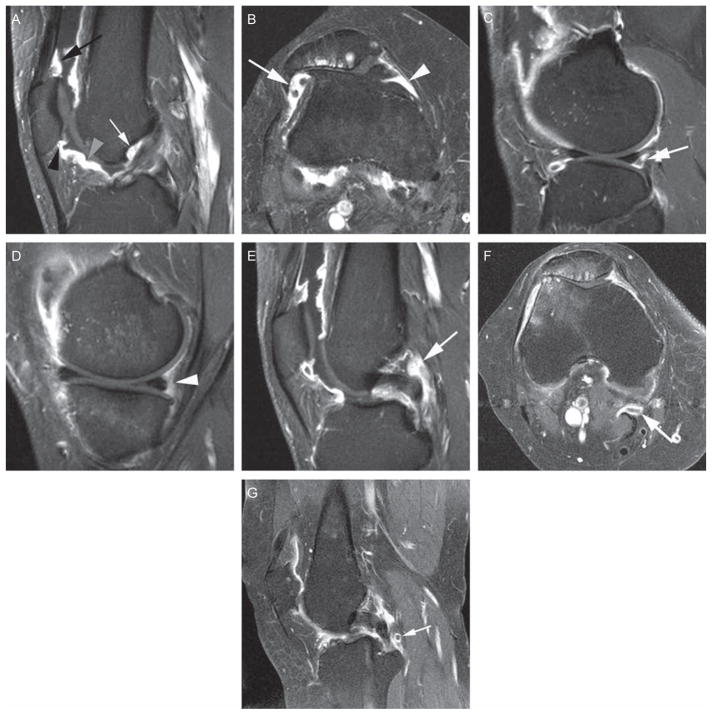
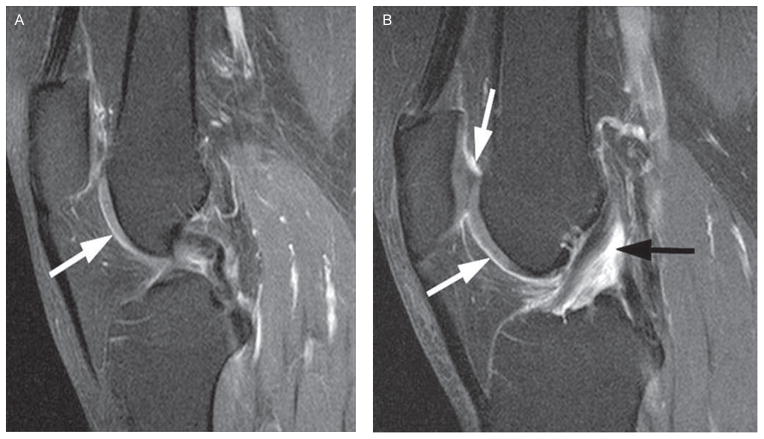
Multicenter Osteoarthritis Study (MOST) is a cohort study of people with, or at high risk of, knee osteoarthritis (OA). Subjects are an unselected subset of MOST who volunteered for CE-MRI. Synovitis was assessed at 11 sites of the joint. Synovial thickness was scored semiquantitatively: grade 0 (<2 mm), grade 1 (2-4 mm) and grade 2 (>4 mm) at each site. Two musculoskeletal radiologists performed the readings and inter- and intrareader reliability was evaluated. Whole-knee synovitis was assessed by summing the scores from all sites. The association of Western Ontario and McMaster Osteoarthritis Index pain score with this summed score and with the maximum synovitis grade for each site was assessed.
400 subjects were included (mean age 58.8±7.0 years, body mass index 29.5±4.9 kg/m(2), 46% women). For individual sites, intrareader reliability (weighted κ) was 0.67-1.00 for reader 1 and 0.60-1.00 for reader 2. Inter-reader agreement (κ) was 0.67-0.92. For the summed synovitis scores, intrareader reliability (intraclass correlation coefficient ( ICC)) was 0.98 and 0.96 for each reader and inter-reader agreement (ICC) was 0.94. Moderate to severe synovitis in the parapatellar subregion was associated with the higher maximum pain score (adjusted OR (95% CI), 2.8 (1.4 to 5.4) and 3.1 (1.2 to 7.9), respectively).
A comprehensive semiquantitative scoring system for the assessment of whole-knee synovitis is proposed. It is reliable and identifies knees with pain, and thus is a potentially powerful tool for synovitis assessment in epidemiological OA studies.
介绍一种基于对比增强磁共振成像(CE-MRI)的全面可靠的膝关节滑膜炎评分系统。
多中心骨关节炎研究(MOST)是一项针对膝关节骨关节炎(OA)患者或高危人群的队列研究。本研究受试者为 MOST 的一部分志愿者,他们自愿接受 CE-MRI 检查。在关节的 11 个部位评估滑膜炎。滑膜厚度采用半定量评分:每个部位的 0 级(<2mm)、1 级(2-4mm)和 2 级(>4mm)。两名肌肉骨骼放射科医生进行了阅读,并评估了读者间和读者内的可靠性。通过将所有部位的评分相加来评估全膝关节滑膜炎。评估了 Western Ontario 和 McMaster 骨关节炎指数疼痛评分与该总和评分以及每个部位最大滑膜炎分级之间的相关性。
共纳入 400 例受试者(平均年龄 58.8±7.0 岁,体重指数 29.5±4.9kg/m2,46%为女性)。对于各个部位,读者 1 的内读者可靠性(加权κ)为 0.67-1.00,读者 2 的内读者可靠性为 0.60-1.00。读者间一致性(κ)为 0.67-0.92。对于总和滑膜炎评分,每位读者的内读者可靠性(组内相关系数(ICC))为 0.98 和 0.96,读者间一致性(ICC)为 0.94。髌旁亚区中至重度滑膜炎与较高的最大疼痛评分相关(调整后的比值比(95%CI)分别为 2.8(1.4 至 5.4)和 3.1(1.2 至 7.9))。
提出了一种全面的膝关节滑膜炎半定量评分系统。该评分系统具有可靠性,能够识别出疼痛的膝关节,因此可能是流行病学 OA 研究中滑膜炎评估的有力工具。