Faculty of Infectious and Tropical Diseases, London School of Hygiene and Tropical Medicine, London, United Kingdom.
J Infect Dis. 2011 Feb 1;203(3):406-17. doi: 10.1093/infdis/jiq063. Epub 2010 Dec 27.
Previous studies have suggested that helminth infection exacerbates malaria, but few existing epidemiological studies adequately control for infection heterogeneities and confounding factors. In this study, we investigate spatial and household heterogeneities, predictors, and consequences of Plasmodium species and hookworm coinfection in rural communities in Uganda.
A cross-sectional study was conducted among 1770 individuals aged 0-88 years in 4 villages. We recorded demographic, socioeconomic, and microgeographic factors during household surveys. We determined malaria parasitemia and hemoglobin concentration and collected stool samples on 2 consecutive days. For data analysis, we used a hierarchical, spatially explicit Bayesian framework.
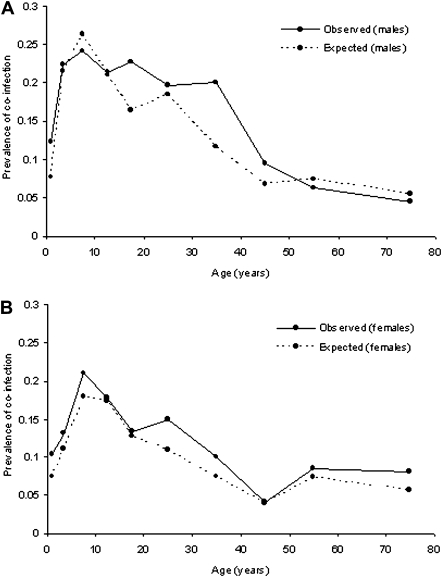
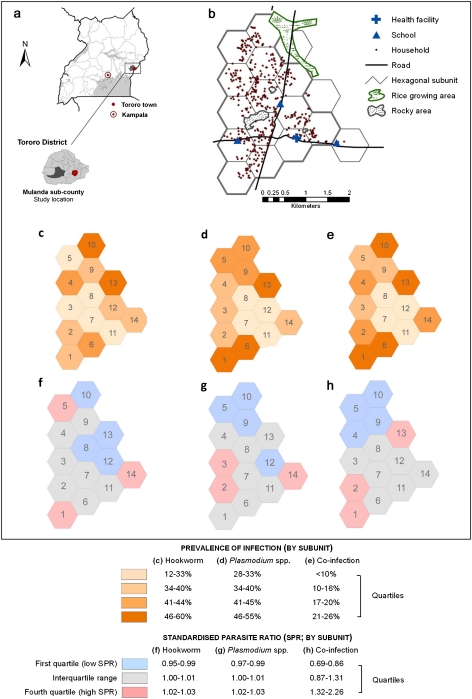
Prevalence of Plasmodium-hookworm coinfection was 15.5% overall and highest among school-aged children. We found strong evidence of spatial and household clustering of coinfection and an enduring positive association between Plasmodium-species and hookworm infection among preschool-aged children (odds ratio [OR], 2.36; 95% Bayesian credible interval [BCI], 1.26-4.30) and adults (OR, 2.09; 95% BCI, 1.35-3.16) but not among school-aged children. Coinfection was associated with lower hemoglobin level only among school-aged children.
Plasmodium-hookworm coinfection exhibits marked age dependency and significant spatial and household heterogeneity, and among preschool-aged children and adults, occurs more than would be expected by chance. Such heterogeneities provide insight into factors underlying observed patterns and the design of integrated control strategies.
先前的研究表明,寄生虫感染会加剧疟疾,但很少有现有的流行病学研究充分控制感染异质性和混杂因素。在这项研究中,我们调查了乌干达农村社区中疟原虫和钩虫混合感染的空间和家庭异质性、预测因素和后果。
对 4 个村庄的 1770 名 0-88 岁个体进行了横断面研究。我们在家庭调查中记录了人口统计学、社会经济和微观地理因素。我们连续两天记录了疟疾寄生虫血症和血红蛋白浓度,并采集了粪便样本。为了数据分析,我们使用了分层的、空间显式贝叶斯框架。
总体而言,疟原虫-钩虫混合感染的患病率为 15.5%,在学龄儿童中最高。我们发现混合感染存在强烈的空间和家庭聚集性证据,以及学龄前儿童(优势比 [OR],2.36;95%贝叶斯可信区间 [BCI],1.26-4.30)和成年人(OR,2.09;95%BCI,1.35-3.16)中疟原虫和钩虫感染之间持久的正相关关系,但在学龄儿童中没有。混合感染仅与学龄儿童的血红蛋白水平较低有关。
疟原虫-钩虫混合感染表现出明显的年龄依赖性和显著的空间和家庭异质性,在学龄前儿童和成年人中,其发生的频率超过了预期的随机水平。这种异质性提供了对观察到的模式背后因素的深入了解,并为综合控制策略的设计提供了依据。