Department of Microbiology and Immunology, Graduate School of Medicine, Osaka University, Suita, Osaka, Japan.
PLoS Pathog. 2010 Dec 16;6(12):e1001231. doi: 10.1371/journal.ppat.1001231.
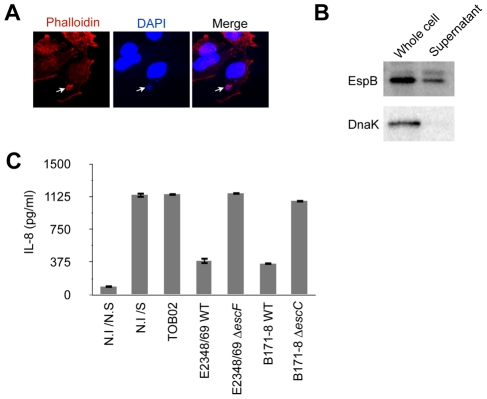
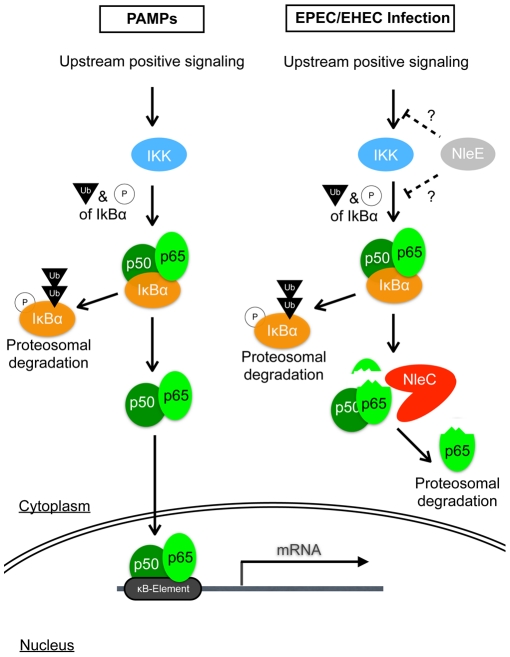
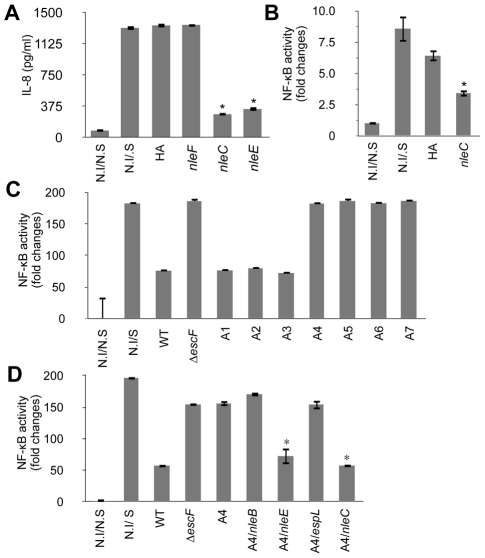
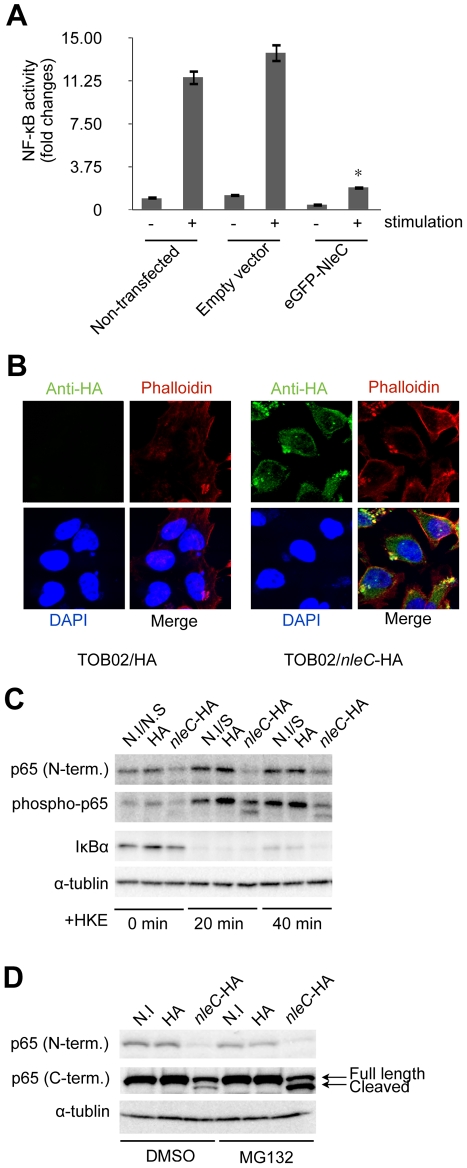
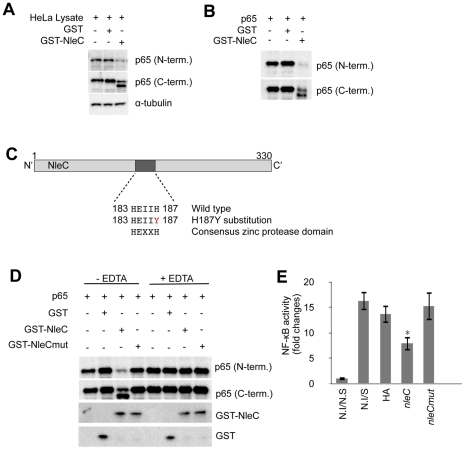
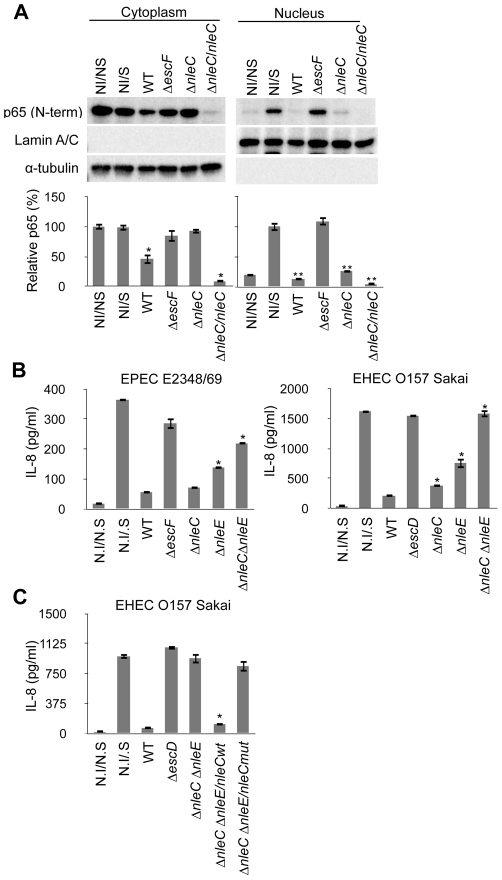
The NF-κB signaling pathway is central to the innate and adaptive immune responses. Upon their detection of pathogen-associated molecular patterns, Toll-like receptors on the cell surface initiate signal transduction and activate the NF-κB pathway, leading to the production of a wide array of inflammatory cytokines, in attempt to eradicate the invaders. As a countermeasure, pathogens have evolved ways to subvert and manipulate this system to their advantage. Enteropathogenic and enterohemorrhagic Escherichia coli (EPEC and EHEC) are closely related bacteria responsible for major food-borne diseases worldwide. Via a needle-like protein complex called the type three secretion system (T3SS), these pathogens deliver virulence factors directly to host cells and modify cellular functions, including by suppressing the inflammatory response. Using gain- and loss-of-function screenings, we identified two bacterial effectors, NleC and NleE, that down-regulate the NF-κB signal upon being injected into a host cell via the T3SS. A recent report showed that NleE inhibits NF-κB activation, although an NleE-deficient pathogen was still immune-suppressive, indicating that other anti-inflammatory effectors are involved. In agreement, our present results showed that NleC was also required to inhibit inflammation. We found that NleC is a zinc protease that disrupts NF-κB activation by the direct cleavage of NF-κB's p65 subunit in the cytoplasm, thereby decreasing the available p65 and reducing the total nuclear entry of active p65. More importantly, we showed that a mutant EPEC/EHEC lacking both NleC and NleE (ΔnleC ΔnleE) caused greater inflammatory response than bacteria carrying ΔnleC or ΔnleE alone. This effect was similar to that of a T3SS-defective mutant. In conclusion, we found that NleC is an anti-inflammatory bacterial zinc protease, and that the cooperative function of NleE and NleC disrupts the NF-κB pathway and accounts for most of the immune suppression caused by EHEC/EPEC.
NF-κB 信号通路是先天和适应性免疫反应的核心。细胞表面的 Toll 样受体在检测到病原体相关分子模式后,启动信号转导并激活 NF-κB 途径,导致产生广泛的炎症细胞因子,试图消灭侵略者。作为一种对策,病原体已经进化出了利用这种系统为自己谋利的方法。肠致病性和肠出血性大肠杆菌(EPEC 和 EHEC)是密切相关的细菌,它们在全球范围内导致主要的食源性疾病。这些病原体通过一种称为 III 型分泌系统(T3SS)的针状蛋白复合物,将毒力因子直接递送到宿主细胞,并改变细胞功能,包括抑制炎症反应。通过增益和失能筛选,我们鉴定出两种细菌效应子 NleC 和 NleE,它们通过 T3SS 注入宿主细胞后下调 NF-κB 信号。最近的一份报告显示,NleE 抑制 NF-κB 激活,尽管缺乏 NleE 的病原体仍然具有免疫抑制作用,这表明还涉及其他抗炎效应子。与我们的研究结果一致,NleC 也需要抑制炎症。我们发现 NleC 是一种锌蛋白酶,通过直接切割细胞质中的 NF-κB 的 p65 亚基,破坏 NF-κB 的激活,从而减少可用的 p65,并减少活性 p65 的总核内进入。更重要的是,我们表明,缺乏 NleC 和 NleE 的突变型 EPEC/EHEC(ΔnleC ΔnleE)引起的炎症反应比单独携带 ΔnleC 或 ΔnleE 的细菌更大。这种效应类似于 T3SS 缺陷突变体。总之,我们发现 NleC 是一种抗炎细菌锌蛋白酶,NleE 和 NleC 的协同功能破坏了 NF-κB 途径,解释了 EHEC/EPEC 引起的大部分免疫抑制。