Fox Chase Cancer Center, Philadelphia, Pennsylvania, United States of America.
PLoS One. 2010 Dec 20;5(12):e15784. doi: 10.1371/journal.pone.0015784.
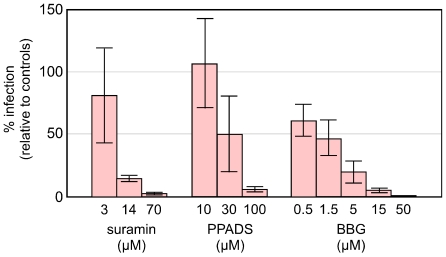
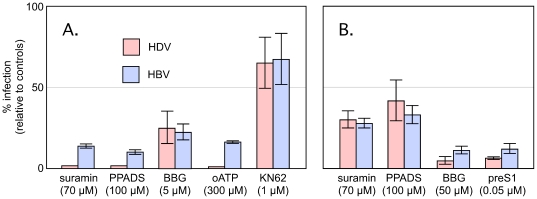
Hepatitis B virus (HBV) and hepatitis delta virus (HDV) are major sources of acute and chronic hepatitis. HDV requires the envelope proteins of HBV for the processes of assembly and infection of new cells. Both viruses are able to infect hepatocytes though previous studies have failed to determine the mechanism of entry into such cells. This study began with evidence that suramin, a symmetrical hexasulfated napthylurea, could block HDV entry into primary human hepatocytes (PHH) and was then extrapolated to incorporate findings of others that suramin is one of many compounds that can block activation of purinergic receptors. Thus other inhibitors, pyridoxal-phosphate-6-azophenyl-2',4'-disulfonate (PPADS) and brilliant blue G (BBG), both structurally unrelated to suramin, were tested and found to inhibit HDV and HBV infections of PHH. BBG, unlike suramin and PPADS, is known to be more specific for just one purinergic receptor, P2X7. These studies provide the first evidence that purinergic receptor functionality is necessary for virus entry. Furthermore, since P2X7 activation is known to be a major component of inflammatory responses, it is proposed that HDV and HBV attachment to susceptible cells, might also contribute to inflammation in the liver, that is, hepatitis.
乙型肝炎病毒 (HBV) 和丁型肝炎病毒 (HDV) 是急性和慢性肝炎的主要病因。HDV 需要 HBV 的包膜蛋白来完成其组装和感染新细胞的过程。尽管之前的研究未能确定进入这些细胞的机制,但这两种病毒都能够感染肝细胞。本研究的依据是,苏拉明,一种对称的六硫酸萘基脲,可以阻止 HDV 进入原代人肝细胞 (PHH),然后推断出苏拉明是可以阻断嘌呤能受体激活的许多化合物之一。因此,测试了其他抑制剂,即对碘苯脒-6-偶氮-2',4'-二磺酸酯 (PPADS) 和亮蓝 G (BBG),它们在结构上与苏拉明无关,结果发现它们可以抑制 PHH 中的 HDV 和 HBV 感染。与苏拉明和 PPADS 不同,BBG 已知只针对一种嘌呤能受体 P2X7。这些研究首次提供了嘌呤能受体功能对于病毒进入是必要的证据。此外,由于 P2X7 的激活是炎症反应的一个主要组成部分,因此可以认为 HDV 和 HBV 与易感细胞的附着也可能导致肝脏炎症,即肝炎。