INRA, UR1282, Infectiologie Animale et Santé Publique, Nouzilly, France.
PLoS One. 2010 Dec 20;5(12):e15302. doi: 10.1371/journal.pone.0015302.
The Salmonella genomic island 1 (SGI1) is a Salmonella enterica-derived integrative mobilizable element (IME) containing various complex multiple resistance integrons identified in several S. enterica serovars and in Proteus mirabilis. Previous studies have shown that SGI1 transfers horizontally by in trans mobilization in the presence of the IncA/C conjugative helper plasmid pR55.
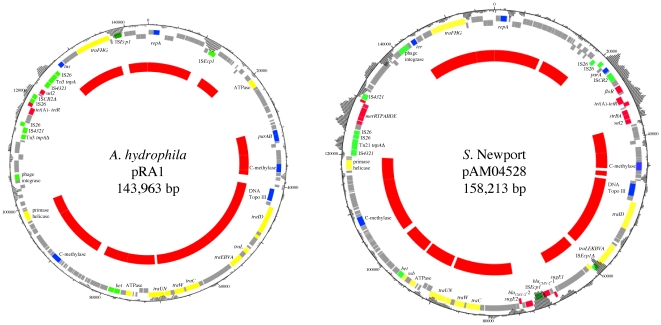
METHODOLOGY/PRINCIPAL FINDINGS: Here, we report the ability of different prevalent multidrug resistance (MDR) plasmids including extended-spectrum β-lactamase (ESBL) gene-carrying plasmids to mobilize the multidrug resistance genomic island SGI1. Through conjugation experiments, none of the 24 conjugative plasmids tested of the IncFI, FII, HI2, I1, L/M, N, P incompatibility groups were able to mobilize SGI1 at a detectable level (transfer frequency <10(-9)). In our collection, ESBL gene-carrying plasmids were mainly from the IncHI2 and I1 groups and thus were unable to mobilize SGI1. However, the horizontal transfer of SGI1 was shown to be specifically mediated by conjugative helper plasmids of the broad-host-range IncA/C incompatibility group. Several conjugative IncA/C MDR plasmids as well as the sequenced IncA/C reference plasmid pRA1 of 143,963 bp were shown to mobilize in trans SGI1 from a S. enterica donor to the Escherichia coli recipient strain. Depending on the IncA/C plasmid used, the conjugative transfer of SGI1 occurred at frequencies ranging from 10(-3) to 10(-6) transconjugants per donor. Of particular concern, some large IncA/C MDR plasmids carrying the extended-spectrum cephalosporinase bla(CMY-2) gene were shown to mobilize in trans SGI1.
CONCLUSIONS/SIGNIFICANCE: The ability of the IncA/C MDR plasmid family to mobilize SGI1 could contribute to its spread by horizontal transfer among enteric pathogens. Moreover, the increasing prevalence of IncA/C plasmids in MDR S. enterica isolates worldwide has potential implications for the epidemic success of the antibiotic resistance genomic island SGI1 and its close derivatives.
沙门氏菌基因组岛 1(SGI1)是一种沙门氏菌衍生的整合可移动元件(IME),其中包含多种复杂的多重耐药整合子,已在几种沙门氏菌血清型和奇异变形杆菌中发现。先前的研究表明,在 IncA/C 共轭辅助质粒 pR55 的存在下,SGI1 通过反式转导移动而水平转移。
方法/主要发现:在这里,我们报告了不同流行的多药耐药(MDR)质粒,包括携带扩展谱β-内酰胺酶(ESBL)基因的质粒,在转导水平上移动多药耐药基因组岛 SGI1 的能力。通过共轭实验,在测试的 24 种 conjugative 质粒中,没有一种属于 IncFI、FII、HI2、I1、L/M、N、P 不兼容性组的质粒能够以可检测的水平(转移频率<10(-9))移动 SGI1。在我们的收藏中,ESBL 基因携带的质粒主要来自 IncHI2 和 I1 组,因此无法移动 SGI1。然而,水平转移的 SGI1 被证明是由广泛宿主范围的 IncA/C 不兼容性组的共轭辅助质粒特异性介导的。几种共轭 IncA/C MDR 质粒以及测序的 IncA/C 参考质粒 pRA1(143963bp)被证明能够从沙门氏菌供体到大肠杆菌受体菌株中转导 SGI1。根据所用的 IncA/C 质粒,SGI1 的共轭转移频率范围为每供体 10(-3)至 10(-6)个转导子。值得关注的是,一些携带扩展谱头孢菌素酶 bla(CMY-2)基因的大型 IncA/C MDR 质粒被证明能够反式转导 SGI1。
结论/意义:IncA/C MDR 质粒家族移动 SGI1 的能力可能有助于其通过肠病原体之间的水平转移传播。此外,IncA/C 质粒在全球多重耐药沙门氏菌分离株中的流行率不断增加,这可能对抗生素耐药基因组岛 SGI1 及其密切衍生物的流行成功产生影响。