Department of Orthopaedic Surgery M and Institute of Sports Medicine, Bispebjerg Hospital, and Faculty of Health Sciences, Center of Healthy Ageing, University of Copenhagen, Copenhagen, Denmark.
PLoS One. 2010 Dec 20;5(12):e15606. doi: 10.1371/journal.pone.0015606.
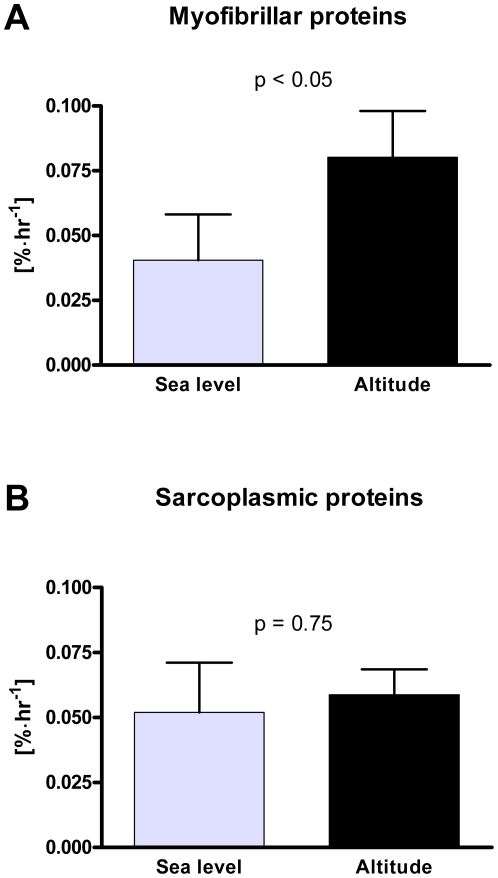
As a consequence to hypobaric hypoxic exposure skeletal muscle atrophy is often reported. The underlying mechanism has been suggested to involve a decrease in protein synthesis in order to conserve O(2). With the aim to challenge this hypothesis, we applied a primed, constant infusion of 1-(13)C-leucine in nine healthy male subjects at sea level and subsequently at high-altitude (4559 m) after 7-9 days of acclimatization. Physical activity levels and food and energy intake were controlled prior to the two experimental conditions with the aim to standardize these confounding factors. Blood samples and expired breath samples were collected hourly during the 4 hour trial and vastus lateralis muscle biopsies obtained at 1 and 4 hours after tracer priming in the overnight fasted state. Myofibrillar protein synthesis rate was doubled; 0.041±0.018 at sea-level to 0.080±0.018%⋅hr(-1) (p<0.05) when acclimatized to high altitude. The sarcoplasmic protein synthesis rate was in contrast unaffected by altitude exposure; 0.052±0.019 at sea-level to 0.059±0.010%⋅hr(-1) (p>0.05). Trends to increments in whole body protein kinetics were seen: Degradation rate elevated from 2.51±0.21 at sea level to 2.73±0.13 µmol⋅kg(-1)⋅min(-1) (p = 0.05) at high altitude and synthesis rate similar; 2.24±0.20 at sea level and 2.43±0.13 µmol⋅kg(-1)⋅min(-1) (p>0.05) at altitude. We conclude that whole body amino acid flux is increased due to an elevated protein turnover rate. Resting skeletal muscle myocontractile protein synthesis rate was concomitantly elevated by high-altitude induced hypoxia, whereas the sarcoplasmic protein synthesis rate was unaffected by hypoxia. These changed responses may lead to divergent adaptation over the course of prolonged exposure.
由于低气压缺氧暴露,骨骼肌萎缩经常被报道。其潜在机制被认为涉及蛋白质合成的减少,以节省氧气。为了挑战这一假说,我们在 9 名健康男性受试者中应用了 1-(13)C-亮氨酸的预输注和恒速输注,随后在适应高海拔(4559 米)7-9 天后进行。在进行这两个实验条件之前,控制了体力活动水平和食物及能量摄入,以标准化这些混杂因素。在禁食过夜的状态下,在 4 小时试验期间每小时采集血样和呼出的呼吸样本,并在示踪剂预输注后 1 小时和 4 小时采集股外侧肌活检。在适应高海拔后,肌原纤维蛋白合成率增加了一倍;从海平面的 0.041±0.018%·hr(-1)增加到 0.080±0.018%·hr(-1)(p<0.05)。相比之下,肌浆蛋白合成率不受海拔暴露的影响;从海平面的 0.052±0.019%·hr(-1)增加到 0.059±0.010%·hr(-1)(p>0.05)。观察到全身蛋白质动力学的增加趋势:降解率从海平面的 2.51±0.21µmol·kg(-1)·min(-1)增加到高海拔的 2.73±0.13µmol·kg(-1)·min(-1)(p=0.05),而合成率相似;海平面为 2.24±0.20µmol·kg(-1)·min(-1),高海拔为 2.43±0.13µmol·kg(-1)·min(-1)(p>0.05)。我们得出结论,全身氨基酸通量增加是由于蛋白质周转率的增加。高海拔诱导的缺氧使静息骨骼肌肌收缩蛋白合成率同时升高,而肌浆蛋白合成率不受缺氧影响。这些变化的反应可能导致在长时间暴露过程中出现不同的适应。