NICN-CNRS UMR 6184, Université de la Méditerranée-Faculté de Médecine Nord, IFR Jean Roche, Marseille, France.
PLoS One. 2010 Dec 20;5(12):e15590. doi: 10.1371/journal.pone.0015590.
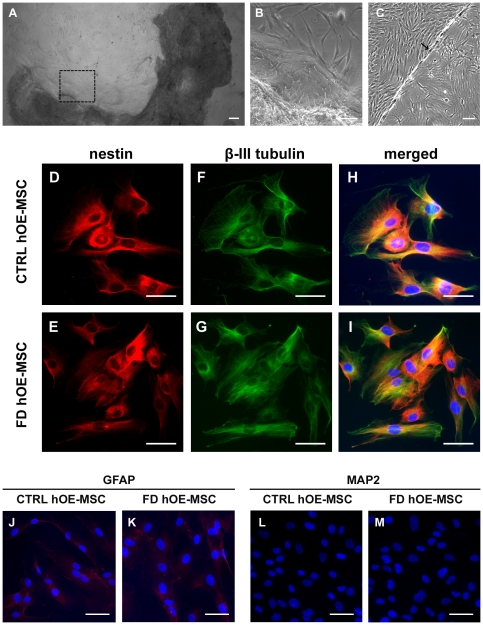
Familial dysautonomia (FD) is a hereditary neuropathy caused by mutations in the IKBKAP gene, the most common of which results in variable tissue-specific mRNA splicing with skipping of exon 20. Defective splicing is especially severe in nervous tissue, leading to incomplete development and progressive degeneration of sensory and autonomic neurons. The specificity of neuron loss in FD is poorly understood due to the lack of an appropriate model system. To better understand and modelize the molecular mechanisms of IKBKAP mRNA splicing, we collected human olfactory ecto-mesenchymal stem cells (hOE-MSC) from FD patients. hOE-MSCs have a pluripotent ability to differentiate into various cell lineages, including neurons and glial cells.
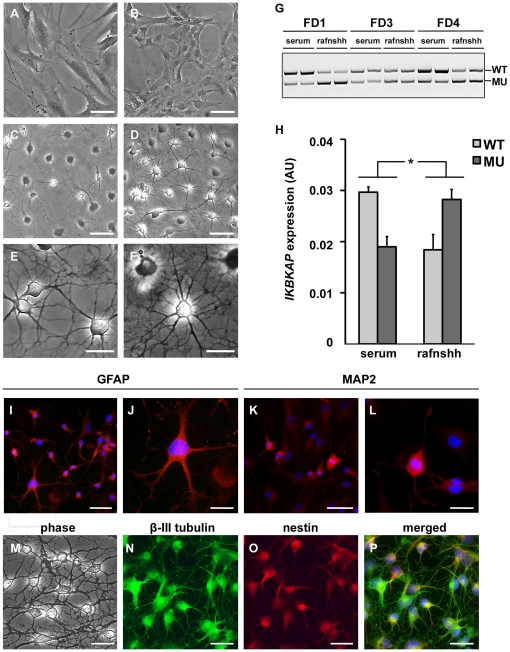
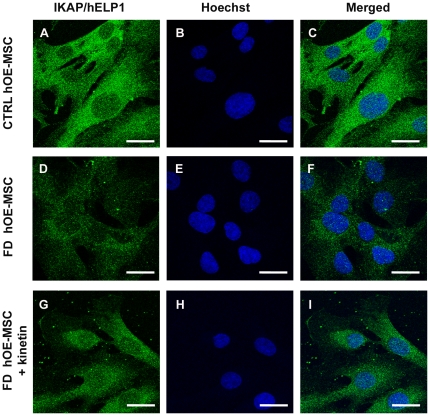
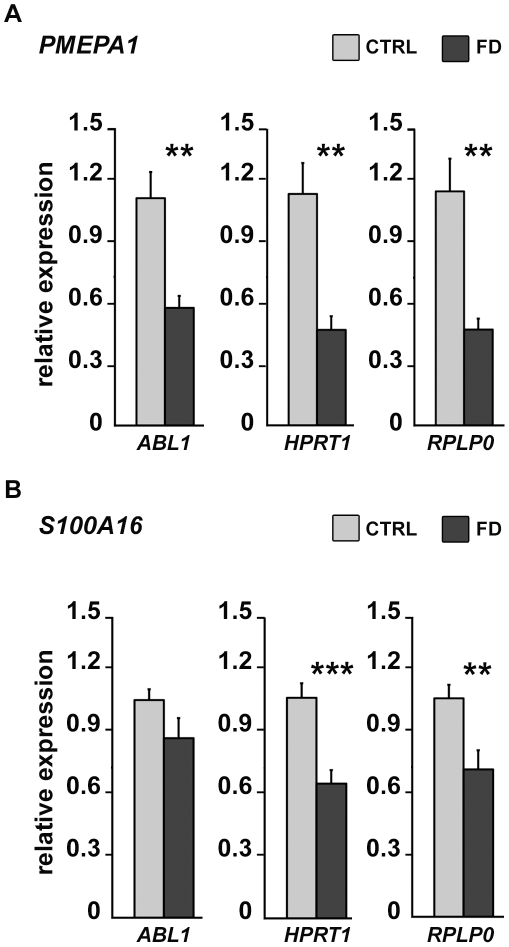
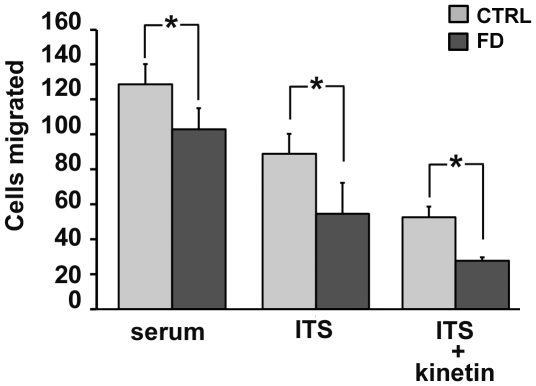
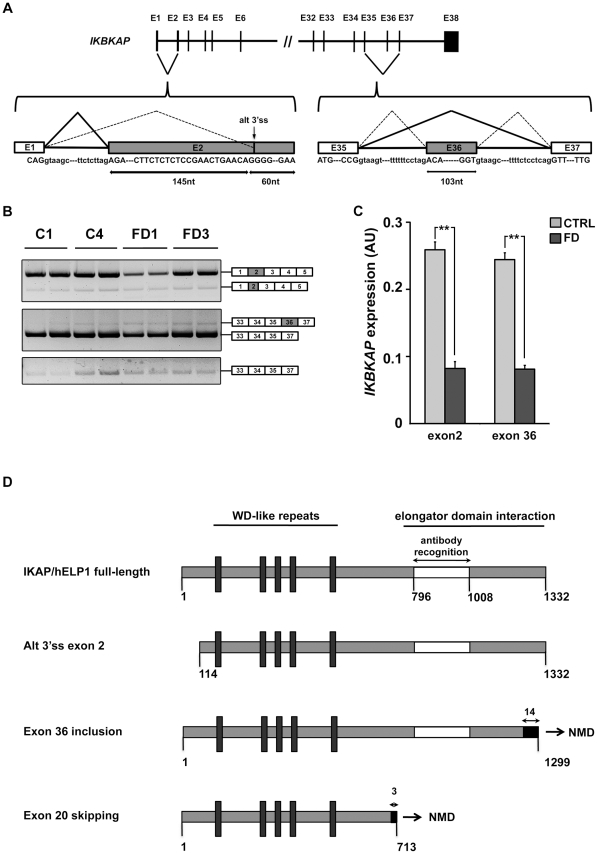
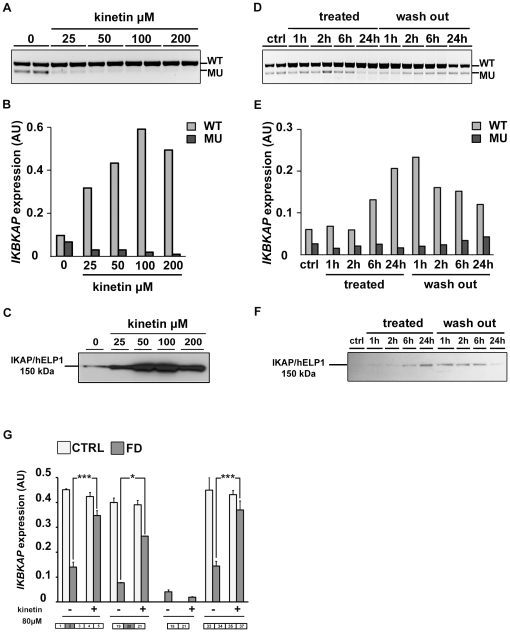
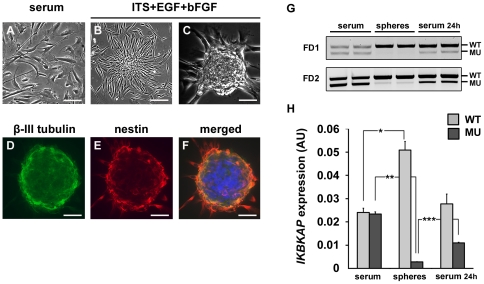
METHODOLOGY/PRINCIPAL FINDINGS: We confirmed IKBKAP mRNA alternative splicing in FD hOE-MSCs and identified 2 novel spliced isoforms also present in control cells. We observed a significant lower expression of both IKBKAP transcript and IKAP/hELP1 protein in FD cells resulting from the degradation of the transcript isoform skipping exon 20. We localized IKAP/hELP1 in different cell compartments, including the nucleus, which supports multiple roles for that protein. We also investigated cellular pathways altered in FD, at the genome-wide level, and confirmed that cell migration and cytoskeleton reorganization were among the processes altered in FD. Indeed, FD hOE-MSCs exhibit impaired migration compared to control cells. Moreover, we showed that kinetin improved exon 20 inclusion and restores a normal level of IKAP/hELP1 in FD hOE-MSCs. Furthermore, we were able to modify the IKBKAP splicing ratio in FD hOE-MSCs, increasing or reducing the WT (exon 20 inclusion):MU (exon 20 skipping) ratio respectively, either by producing free-floating spheres, or by inducing cells into neural differentiation.
CONCLUSIONS/SIGNIFICANCE: hOE-MSCs isolated from FD patients represent a new approach for modeling FD to better understand genetic expression and possible therapeutic approaches. This model could also be applied to other neurological genetic diseases.
家族性自主神经机能异常(FD)是一种遗传性神经病,由 IKBKAP 基因突变引起,最常见的突变导致外显子 20 可变组织特异性 mRNA 剪接,外显子 20 缺失。神经组织中的剪接缺陷尤其严重,导致感觉和自主神经元发育不完全和进行性退化。由于缺乏合适的模型系统,FD 中神经元丢失的特异性尚不清楚。为了更好地理解和模拟 IKBKAP mRNA 剪接的分子机制,我们从 FD 患者中收集了人嗅外胚层间充质干细胞(hOE-MSC)。hOE-MSCs 具有多能性,可分化为多种细胞谱系,包括神经元和神经胶质细胞。
方法/主要发现:我们在 FD hOE-MSCs 中证实了 IKBKAP mRNA 可变剪接,并鉴定了 2 种在对照细胞中也存在的新剪接异构体。我们观察到 FD 细胞中 IKBKAP 转录本和 IKAP/hELP1 蛋白的表达显著降低,这是由于转录本缺失外显子 20 的降解所致。我们将 IKAP/hELP1 定位在不同的细胞区室中,包括细胞核,这支持了该蛋白的多种作用。我们还在全基因组水平上研究了 FD 中改变的细胞途径,并证实细胞迁移和细胞骨架重排是 FD 中改变的过程之一。事实上,FD hOE-MSCs 的迁移能力比对照细胞差。此外,我们表明,激动素可改善外显子 20 的包含,并恢复 FD hOE-MSCs 中正常水平的 IKAP/hELP1。此外,我们能够在 FD hOE-MSCs 中改变 IKBKAP 剪接比,分别通过产生游离球体或诱导细胞向神经分化,增加或减少 WT(外显子 20 包含):MU(外显子 20 缺失)的比值。
结论/意义:从 FD 患者中分离出的 hOE-MSCs 为更好地理解遗传表达和可能的治疗方法提供了一种建模 FD 的新方法。该模型也可应用于其他神经遗传疾病。