Cho Min Hyun
Department of Pediatrics, Kyungpook National University School of Medicine, Daegu, Korea.
Korean J Pediatr. 2010 Jul;53(7):735-40. doi: 10.3345/kjp.2010.53.7.735. Epub 2010 Jul 31.
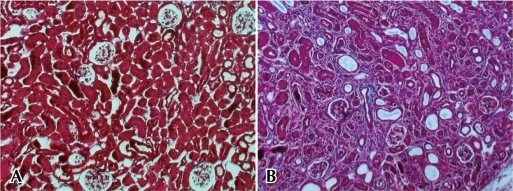
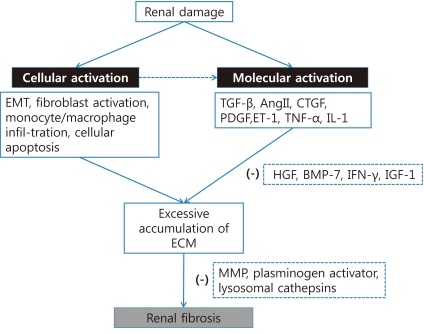
Renal fibrosis, characterized by tubulointerstitial fibrosis and glomerulosclerosis, is the final manifestation of chronic kidney disease. Renal fibrosis is characterized by an excessive accumulation and deposition of extracellular matrix components. This pathologic result usually originates from both underlying complicated cellular activities such as epithelial-to-mesenchymal transition, fibroblast activation, monocyte/macrophage infiltration, and cellular apoptosis and the activation of signaling molecules such as transforming growth factor beta and angiotensin II. However, because the pathogenesis of renal fibrosis is extremely complicated and our knowledge regarding this condition is still limited, further studies are needed.
肾纤维化以肾小管间质纤维化和肾小球硬化为特征,是慢性肾脏病的最终表现形式。肾纤维化的特点是细胞外基质成分过度积聚和沉积。这种病理结果通常源于潜在的复杂细胞活动,如上皮-间充质转化、成纤维细胞活化、单核细胞/巨噬细胞浸润和细胞凋亡,以及信号分子如转化生长因子β和血管紧张素II的激活。然而,由于肾纤维化的发病机制极其复杂,我们对这种疾病的了解仍然有限,因此需要进一步研究。