Institute of Crop Sciences, Chinese Academy of Agriculture Sciences, Beijing, 100081, China.
BMC Genomics. 2010 Dec 30;11:730. doi: 10.1186/1471-2164-11-730.
Grain endosperm chalkiness of rice is a varietal characteristic that negatively affects not only the appearance and milling properties but also the cooking texture and palatability of cooked rice. However, grain chalkiness is a complex quantitative genetic trait and the molecular mechanisms underlying its formation are poorly understood.
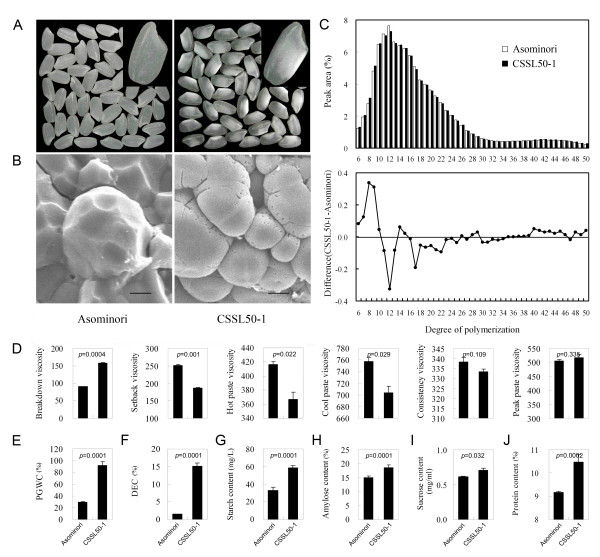
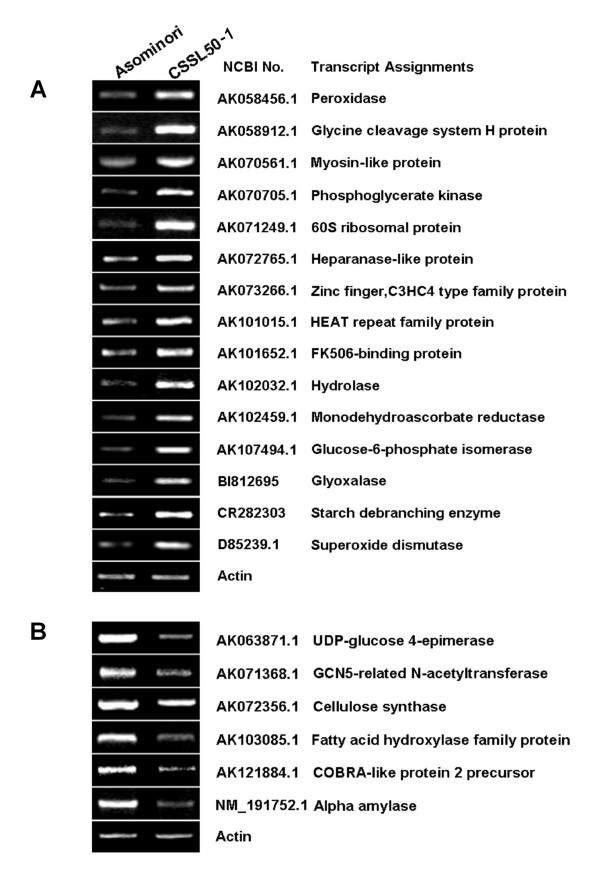
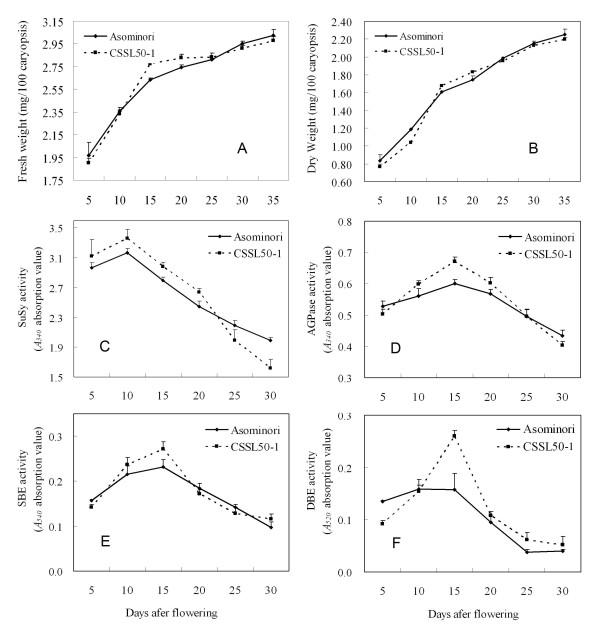
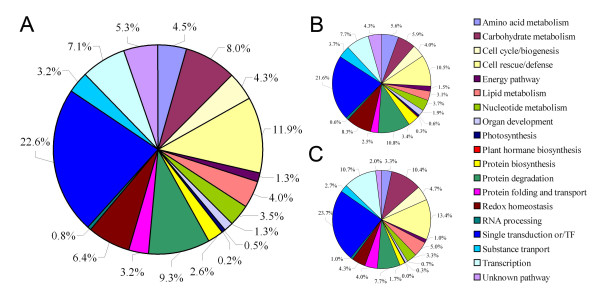
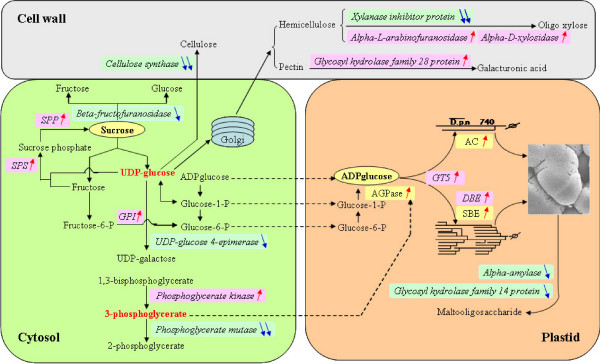
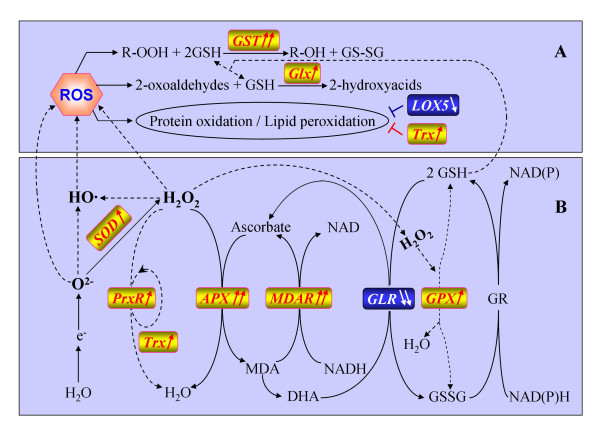
A near-isogenic line CSSL50-1 with high chalkiness was compared with its normal parental line Asominori for grain endosperm chalkiness. Physico-biochemical analyses of ripened grains showed that, compared with Asominori, CSSL50-1 contains higher levels of amylose and 8 DP (degree of polymerization) short-chain amylopectin, but lower medium length 12 DP amylopectin. Transcriptome analysis of 15 DAF (day after flowering) caryopses of the isogenic lines identified 623 differential expressed genes (P < 0.01), among which 324 genes are up-regulated and 299 down-regulated. These genes were classified into 18 major categories, with 65.3% of them belong to six major functional groups: signal transduction, cell rescue/defense, transcription, protein degradation, carbohydrate metabolism and redox homeostasis. Detailed pathway dissection demonstrated that genes involved in sucrose and starch synthesis are up-regulated, whereas those involved in non-starch polysaccharides are down regulated. Several genes involved in oxidoreductive homeostasis were found to have higher expression levels in CSSL50-1 as well, suggesting potential roles of ROS in grain chalkiness formation.
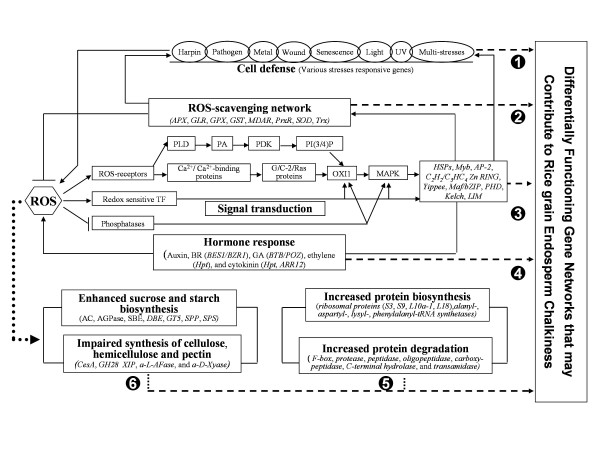
Extensive gene expression changes were detected during rice grain chalkiness formation. Over half of these differentially expressed genes are implicated in several important categories of genes, including signal transduction, transcription, carbohydrate metabolism and redox homeostasis, suggesting that chalkiness formation involves multiple metabolic and regulatory pathways.
水稻的米粒垩白度是一个品种特性,不仅会影响外观和碾米特性,还会影响米饭的烹饪质地和口感。然而,米粒垩白度是一个复杂的数量遗传性状,其形成的分子机制还知之甚少。
高垩白度的近等基因系 CSSL50-1 与正常亲本品种 Asominori 进行了米粒垩白度比较。对成熟籽粒的理化生物分析表明,与 Asominori 相比,CSSL50-1 含有更高水平的直链淀粉和 8 DP(聚合度)短链支链淀粉,但中链 12 DP 支链淀粉较低。对近等基因系 15 DAF(开花后天数)颖果的转录组分析鉴定出 623 个差异表达基因(P < 0.01),其中 324 个基因上调,299 个基因下调。这些基因被分为 18 个主要类别,其中 65.3%属于六个主要功能组:信号转导、细胞拯救/防御、转录、蛋白质降解、碳水化合物代谢和氧化还原稳态。详细的途径分析表明,参与蔗糖和淀粉合成的基因上调,而参与非淀粉多糖的基因下调。还发现几个与氧化还原稳态相关的基因在 CSSL50-1 中的表达水平更高,表明 ROS 在籽粒垩白形成中可能发挥作用。
在水稻米粒垩白形成过程中检测到广泛的基因表达变化。这些差异表达基因中有一半以上涉及几个重要的基因类别,包括信号转导、转录、碳水化合物代谢和氧化还原稳态,表明垩白形成涉及多个代谢和调控途径。