Department of Community Health, School of Medical Sciences, Kwame Nkrumah University of Science and Technology, Kumasi, Ghana.
PLoS One. 2010 Dec 28;5(12):e14425. doi: 10.1371/journal.pone.0014425.
The effectiveness of intermittent preventive treatment of malaria in pregnancy (IPTp) may be compromised by the spread of resistance to sulphadoxine/pyrimethamine (SP) across Africa. But little information exists on alternative drugs for IPTp or alternative strategies for the prevention of malaria in pregnancy. Therefore, we have investigated whether screening with a rapid diagnostic test and treatment of those who are positive (IST) at routine antenatal clinic attendances is as effective and as safe as SP-IPTp in pregnant women.
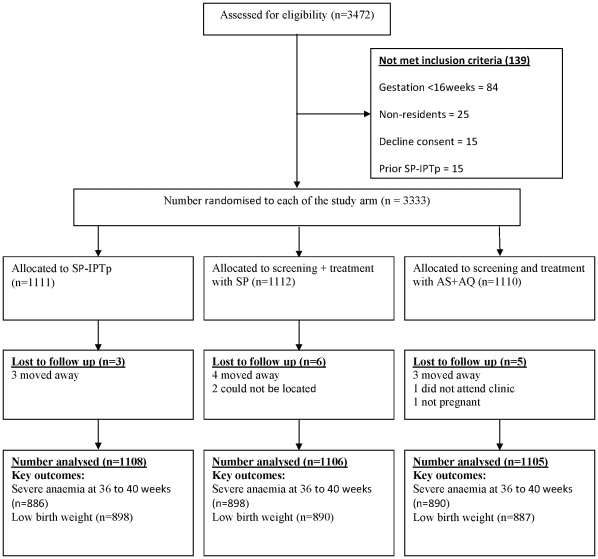
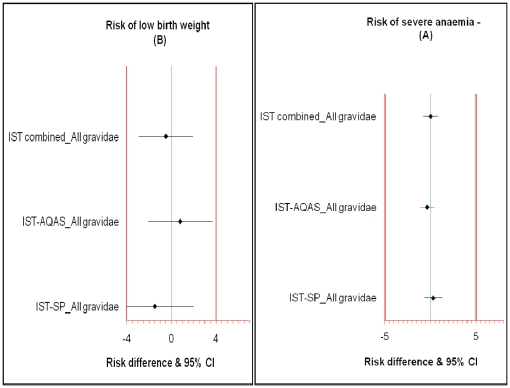
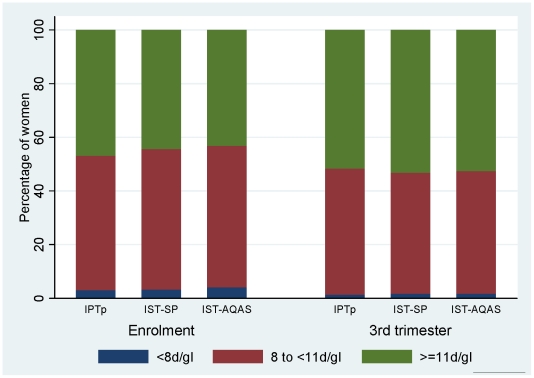
During antenatal clinic sessions in six health facilities in Ghana held between March 2007 and September 2007, 3333 pregnant women who satisfied inclusion criteria were randomised into three intervention arms (1) standard SP-IPTp, (2) IST and treatment with SP or (3) IST and treatment with amodiaquine+artesunate (AQ+AS). All women received a long-lasting insecticide treated net. Study women had a maximum of three scheduled follow-up visits following enrollment. Haemoglobin concentration and peripheral parasitaemia were assessed between 36 and 40 weeks of gestation. Birth weight was measured at delivery or within 72 hours for babies delivered at home. Parasite prevalence at enrollment in primigravidae and in multigravidae was 29.6% and 10.2% respectively. At 36-40 weeks of gestation the prevalence of asymptomatic parasitaemia was 12.1% in study women overall and was very similar in all treatment groups. The risk of third trimester severe anaemia or low birth weight did not differ significantly between the three treatment groups regardless of gravidity. IST with AQ+AS or SP was not inferior to SP-IPTp in reducing the risk of low birth weight (RD = -1.17[95%CI; -4.39-1.02] for IST-SP vs. SP-IPTp and RD = 0.78[95%CI; -2.11-3.68] for IST-AQAS vs. SP-IPTp); third trimester severe anaemia (RD = 0.29[95%CI; -0.69-1.30] for IST-SP vs. SP-IPTp and RD = -0.36[95%CI;-1.12-0.44] for IST-AQAS vs. SP-IPTp).
The results of this study suggest that in an area of moderately high malaria transmission, IST with SP or AS+AQ may be a safe and effective strategy for the control of malaria in pregnancy. However, it is important that these encouraging findings are confirmed in other geographical areas and that the impact of IST on placental malaria is investigated.
ClinicalTrials.gov NCT00432367 [NCT00432367].
在非洲,由于磺胺多辛-乙胺嘧啶(SP)耐药性的传播,间歇性预防治疗疟疾(IPTp)的有效性可能受到影响。但是,关于 IPTp 的替代药物或预防妊娠疟疾的替代策略的信息很少。因此,我们研究了在常规产前检查中使用快速诊断检测(RDT)筛查并对阳性者(IST)进行治疗,是否与 SP-IPTp 一样有效和安全。
在 2007 年 3 月至 2007 年 9 月期间,在加纳的六个卫生机构举行的产前检查期间,共有 3333 名符合纳入标准的孕妇被随机分配到三个干预组:(1)标准 SP-IPTp;(2)IST 和 SP 治疗;(3)IST 和阿莫地喹+青蒿琥酯(AQ+AS)治疗。所有妇女均使用长效驱虫蚊帐。研究妇女在入组后最多可进行三次预约随访。妊娠 36-40 周时评估血红蛋白浓度和外周寄生虫血症。对于在家中分娩的婴儿,在分娩时或 72 小时内测量出生体重。初产妇和多产妇的寄生虫患病率分别为 29.6%和 10.2%。在妊娠 36-40 周时,研究妇女的无症状寄生虫血症患病率总体上为 12.1%,且在所有治疗组中非常相似。无论孕妇的妊娠次数如何,三组治疗之间第三孕期严重贫血或低出生体重的风险均无显著差异。IST 联合 AQ+AS 或 SP 并不比 SP-IPTp 更能降低低出生体重的风险(IST-SP 与 SP-IPTp 相比,RD= -1.17[95%CI;-4.39-1.02];IST-AQAS 与 SP-IPTp 相比,RD=0.78[95%CI;-2.11-3.68]);第三孕期严重贫血(IST-SP 与 SP-IPTp 相比,RD=0.29[95%CI;-0.69-1.30];IST-AQAS 与 SP-IPTp 相比,RD=-0.36[95%CI;-1.12-0.44])。
这项研究的结果表明,在疟疾中度高传播地区,SP 或 AS+AQ 的 IST 可能是一种安全有效的控制妊娠疟疾的策略。然而,重要的是,这些令人鼓舞的发现需要在其他地理区域得到证实,并需要研究 IST 对胎盘疟疾的影响。
ClinicalTrials.gov NCT00432367 [NCT00432367]。