Center for Vaccine Research, University of Pittsburgh, Pittsburgh, Pennsylvania, United States of America.
PLoS Pathog. 2010 Dec 23;6(12):e1001235. doi: 10.1371/journal.ppat.1001235.
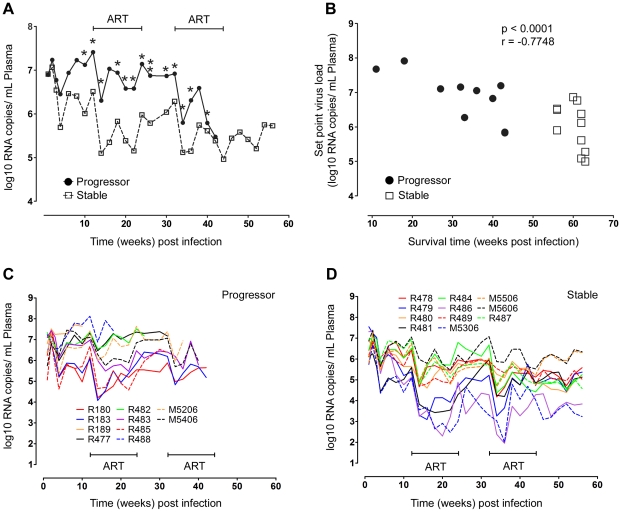
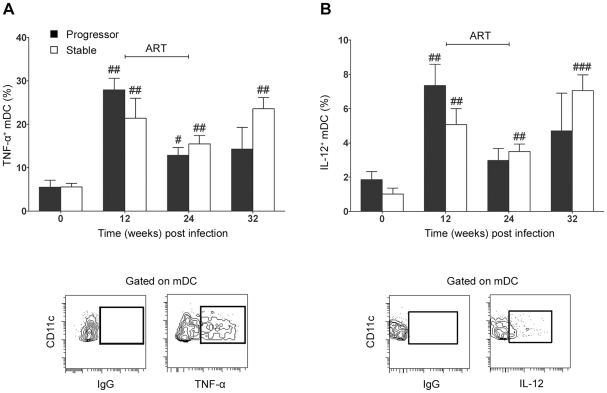
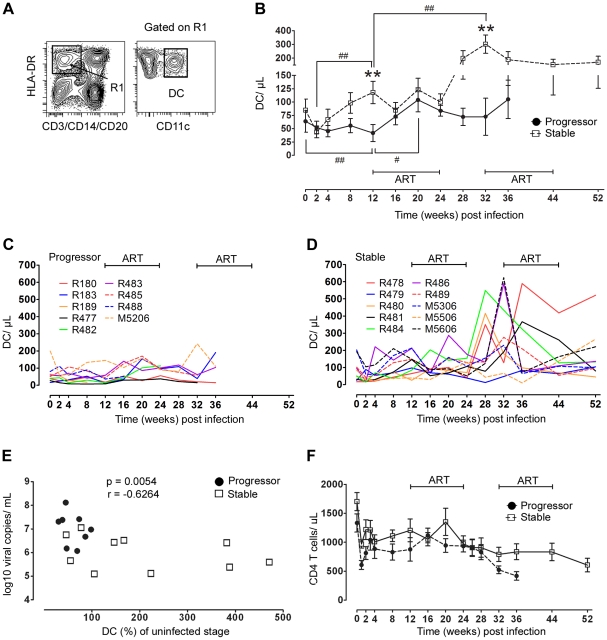
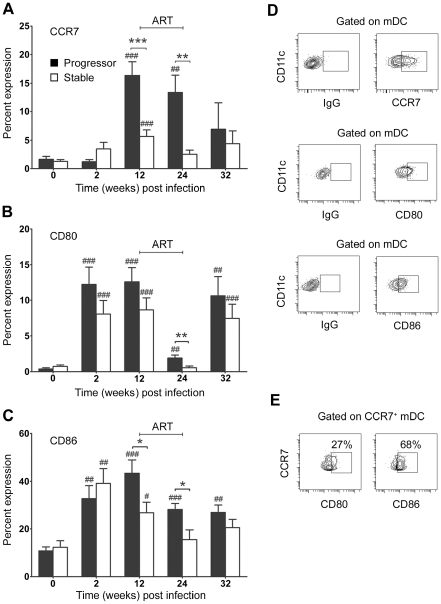
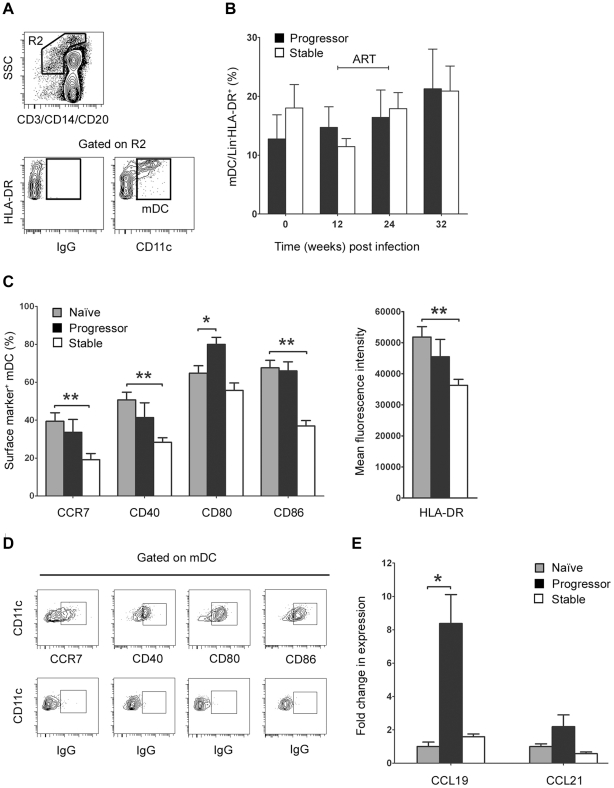
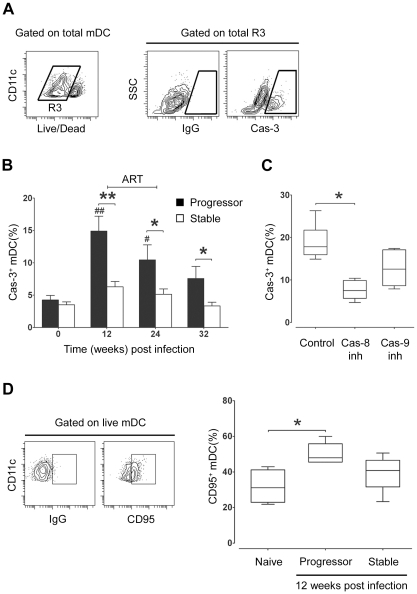
Myeloid dendritic cells (mDC) are lost from blood in individuals with human immunodeficiency virus (HIV) infection but the mechanism for this loss and its relationship to disease progression are not known. We studied the mDC response in blood and lymph nodes of simian immunodeficiency virus (SIV)-infected rhesus macaques with different disease outcomes. Early changes in blood mDC number were inversely correlated with virus load and reflective of eventual disease outcome, as animals with stable infection that remained disease-free for more than one year had average increases in blood mDC of 200% over preinfection levels at virus set-point, whereas animals that progressed rapidly to AIDS had significant loss of mDC at this time. Short term antiretroviral therapy (ART) transiently reversed mDC loss in progressor animals, whereas discontinuation of ART resulted in a 3.5-fold increase in mDC over preinfection levels only in stable animals, approaching 10-fold in some cases. Progressive SIV infection was associated with increased CCR7 expression on blood mDC and an 8-fold increase in expression of CCL19 mRNA in lymph nodes, consistent with increased mDC recruitment. Paradoxically, lymph node mDC did not accumulate in progressive infection but rather died from caspase-8-dependent apoptosis that was reduced by ART, indicating that increased recruitment is offset by increased death. Lymph node mDC from both stable and progressor animals remained responsive to exogenous stimulation with a TLR7/8 agonist. These data suggest that mDC are mobilized in SIV infection but that an increase in the CCR7-CCL19 chemokine axis associated with high virus burden in progressive infection promotes exodus of activated mDC from blood into lymph nodes where they die from apoptosis. We suggest that inflamed lymph nodes serve as a sink for mDC through recruitment, activation and death that contributes to AIDS pathogenesis.
髓样树突状细胞(mDC)在人类免疫缺陷病毒(HIV)感染者的血液中丢失,但这种丢失的机制及其与疾病进展的关系尚不清楚。我们研究了具有不同疾病结果的感染猴免疫缺陷病毒(SIV)的恒河猴血液和淋巴结中的 mDC 反应。血液 mDC 数量的早期变化与病毒载量呈负相关,反映了最终的疾病结果,因为感染后保持无病状态超过一年的稳定感染动物在病毒设定点时平均增加了 200%的血液 mDC,而迅速进展为艾滋病的动物在此时间点显著丧失 mDC。短期抗逆转录病毒治疗(ART)暂时逆转了进展动物的 mDC 丢失,而 ART 的停药仅导致稳定动物的 mDC 增加了 3.5 倍,在某些情况下接近 10 倍。进行性 SIV 感染与血液 mDC 上 CCR7 表达增加和淋巴结中 CCL19 mRNA 表达增加 8 倍有关,这与 mDC 募集增加一致。矛盾的是,进行性感染中淋巴结 mDC 没有积聚,而是由于 caspase-8 依赖性凋亡而死亡,ART 可减少这种凋亡,表明增加的募集被增加的死亡所抵消。来自稳定和进展动物的淋巴结 mDC 仍然对 TLR7/8 激动剂的外源性刺激有反应。这些数据表明,mDC 在 SIV 感染中被动员,但与进行性感染中高病毒载量相关的 CCR7-CCL19 趋化因子轴的增加促进了活化的 mDC 从血液中迁移到淋巴结中,并从凋亡中死亡。我们认为,炎症性淋巴结通过募集、激活和死亡成为 mDC 的汇点,这有助于艾滋病的发病机制。