Next Generation Sequencing Group, Max Planck Institute for Molecular Genetics, Berlin, Germany.
PLoS One. 2010 Dec 22;5(12):e15661. doi: 10.1371/journal.pone.0015661.
Colorectal cancer (CRC) is with approximately 1 million cases the third most common cancer worldwide. Extensive research is ongoing to decipher the underlying genetic patterns with the hope to improve early cancer diagnosis and treatment. In this direction, the recent progress in next generation sequencing technologies has revolutionized the field of cancer genomics. However, one caveat of these studies remains the large amount of genetic variations identified and their interpretation.
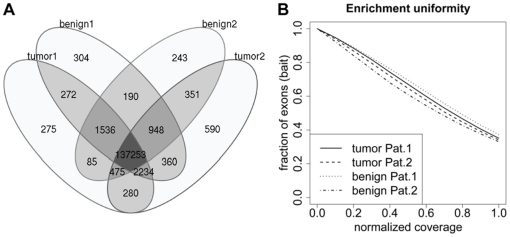
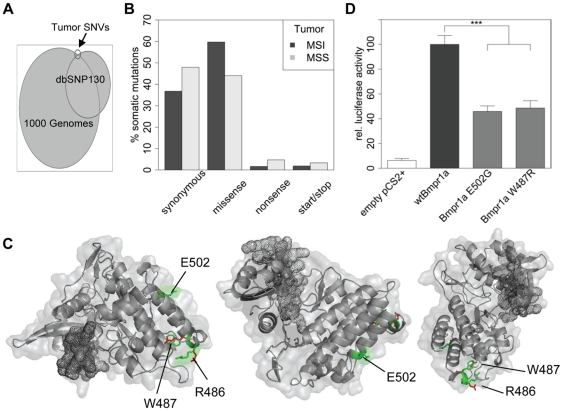
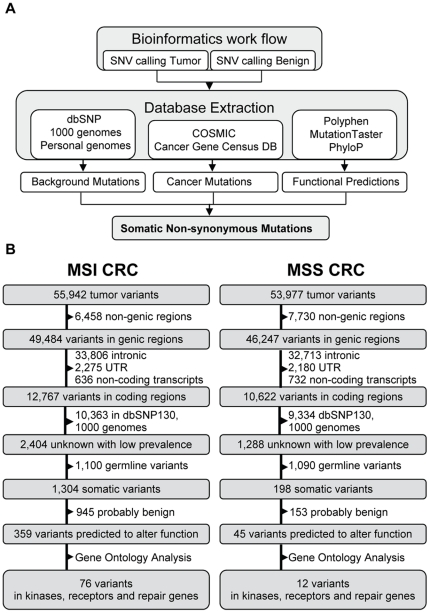
METHODOLOGY/PRINCIPAL FINDINGS: Here we present the first work on whole exome NGS of primary colon cancers. We performed 454 whole exome pyrosequencing of tumor as well as adjacent not affected normal colonic tissue from microsatellite stable (MSS) and microsatellite instable (MSI) colon cancer patients and identified more than 50,000 small nucleotide variations for each tissue. According to predictions based on MSS and MSI pathomechanisms we identified eight times more somatic non-synonymous variations in MSI cancers than in MSS and we were able to reproduce the result in four additional CRCs. Our bioinformatics filtering approach narrowed down the rate of most significant mutations to 359 for MSI and 45 for MSS CRCs with predicted altered protein functions. In both CRCs, MSI and MSS, we found somatic mutations in the intracellular kinase domain of bone morphogenetic protein receptor 1A, BMPR1A, a gene where so far germline mutations are associated with juvenile polyposis syndrome, and show that the mutations functionally impair the protein function.
CONCLUSIONS/SIGNIFICANCE: We conclude that with deep sequencing of tumor exomes one may be able to predict the microsatellite status of CRC and in addition identify potentially clinically relevant mutations.
结直肠癌(CRC)是全球第三大常见癌症,约有 100 万例。为了破译潜在的遗传模式,人们正在进行广泛的研究,希望能改善早期癌症的诊断和治疗。在这一方向上,下一代测序技术的最新进展彻底改变了癌症基因组学领域。然而,这些研究仍存在一个问题,即大量鉴定出的遗传变异及其解释。
方法/主要发现:在这里,我们展示了首次对原发性结肠癌进行全外显子组 NGS 的工作。我们对微卫星稳定(MSS)和微卫星不稳定(MSI)结肠癌患者的肿瘤以及相邻未受影响的正常结肠组织进行了 454 次全外显子焦磷酸测序,为每个组织鉴定了超过 50000 个小核苷酸变异。根据基于 MSS 和 MSI 发病机制的预测,我们在 MSI 癌症中鉴定出的体细胞非同义变异是 MSS 的 8 倍,并且在另外 4 例 CRC 中我们能够重现该结果。我们的生物信息学过滤方法将 MSI CRC 中最显著突变的比率降低到 359 个,将 MSS CRC 中的比率降低到 45 个,这些突变预测具有改变的蛋白质功能。在这两种 CRC 中,MSI 和 MSS,我们在骨形态发生蛋白受体 1A(BMPR1A)的细胞内激酶结构域中发现了体细胞突变,该基因迄今为止与青少年息肉病综合征相关的种系突变,并且表明突变可破坏蛋白功能。
结论/意义:我们的结论是,通过对肿瘤外显子组进行深度测序,人们也许能够预测 CRC 的微卫星状态,并能识别出潜在的临床相关突变。