Zentrum für Molekulare Biologie der Universität Heidelberg (ZMBH), DKFZ-ZMBH Alliance, Heidelberg, Germany.
Mol Biol Cell. 2011 Mar 1;22(5):652-60. doi: 10.1091/mbc.E10-05-0461. Epub 2011 Jan 5.
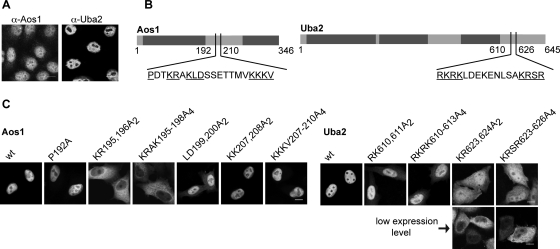
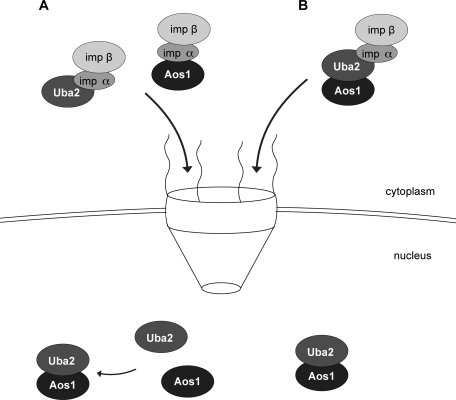
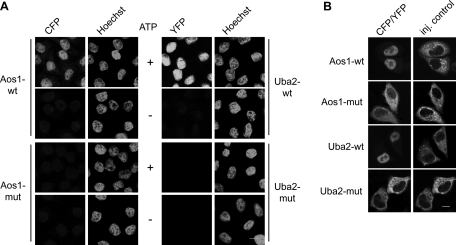
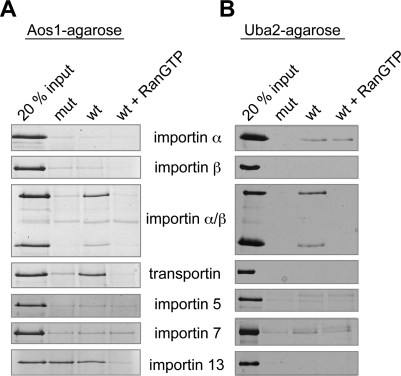
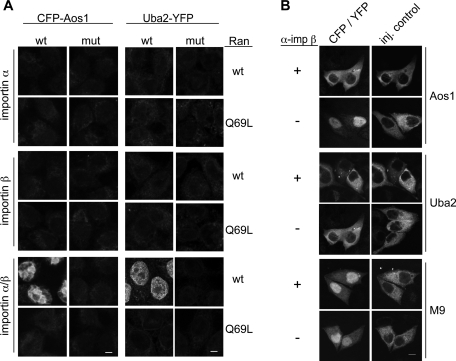
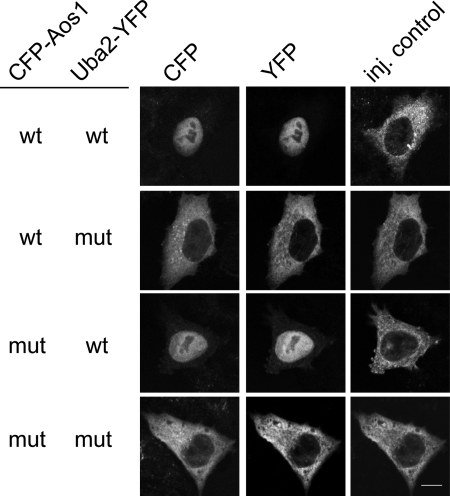
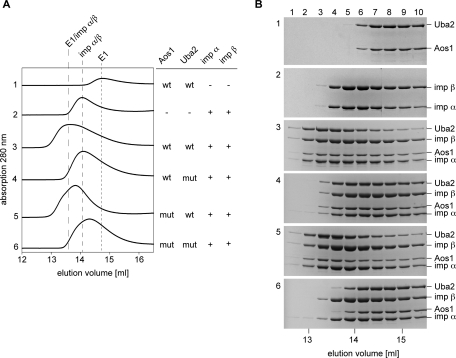
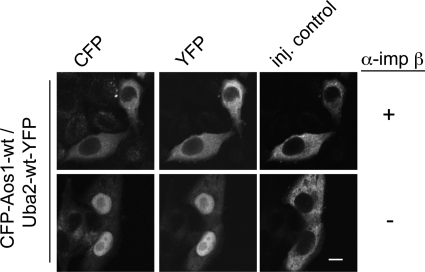
SUMOylation, reversible attachment of small ubiquitin-related modifier (SUMO), serves to regulate hundreds of proteins. Consistent with predominantly nuclear targets, enzymes required for attachment and removal of SUMO are highly enriched in this compartment. This is true also for the first enzyme of the SUMOylation cascade, the SUMO E1 enzyme heterodimer, Aos1/Uba2 (SAE1/SAE2). This essential enzyme serves to activate SUMO and to transfer it to the E2-conjugating enzyme Ubc9. Although the last 40 amino acids in yeast Uba2 have been implicated in its nuclear localization, little was known about the import pathways of Aos1, Uba2, and/or of the assembled E1 heterodimer. Here we show that the mammalian E1 subunits can be imported separately, identify nuclear localization signals (NLSs) in Aos1 and in Uba2, and demonstrate that their import is mediated by importin α/β in vitro and in intact cells. Once assembled into a stable heterodimer, the E1 enzyme can still be efficiently imported by importin α/β, due to the Uba2 NLS that is still accessible. These pathways may serve distinct purposes: import of nascent subunits prior to assembly and reimport of stable E1 enzyme complex after mitosis.
SUMOylation,即小泛素相关修饰物(SUMO)的可逆附着,可调节数百种蛋白质。与主要的核靶标一致,附着和去除 SUMO 所需的酶在这个隔室中高度富集。这对于 SUMOylation 级联的第一个酶,SUMO E1 酶异二聚体 Aos1/Uba2(SAE1/SAE2)也是如此。这种必需的酶用于激活 SUMO 并将其转移到 E2 连接酶 Ubc9。尽管酵母 Uba2 中的最后 40 个氨基酸被认为与其核定位有关,但对于 Aos1、Uba2 和/或组装的 E1 异二聚体的输入途径知之甚少。在这里,我们表明哺乳动物的 E1 亚基可以分别输入,鉴定 Aos1 和 Uba2 中的核定位信号(NLS),并证明其输入是通过体外和完整细胞中的 importin α/β 介导的。一旦组装成稳定的异二聚体,E1 酶仍然可以通过 importin α/β 有效地输入,因为仍然可以访问 Uba2 NLS。这些途径可能具有不同的用途:在组装之前输入新生亚基,以及在有丝分裂后再输入稳定的 E1 酶复合物。