Research Team of Infochemicals, Institute of Organic Chemistry and Biochemistry, Czech Academy of Sciences, Prague, Czech Republic.
PLoS One. 2010 Dec 30;5(12):e15761. doi: 10.1371/journal.pone.0015761.
The frontal gland is a unique adaptation of advanced termite families. It has been intensively studied in soldiers with respect to its anatomy and chemistry, with numerous novel compounds being discovered within the tremendous richness of identified products. At the same time, the presence of the frontal gland in non-soldier castes received only negligible attention in the past.
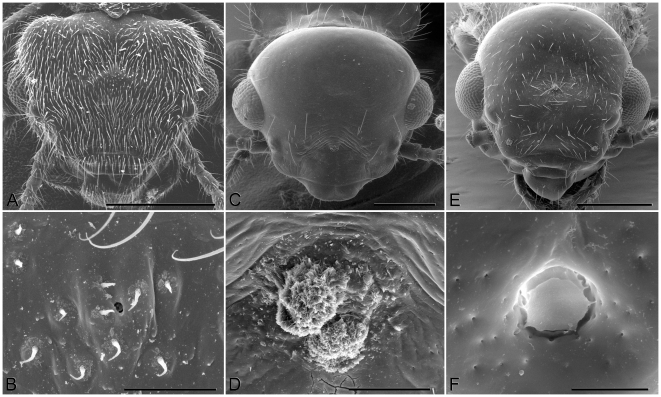
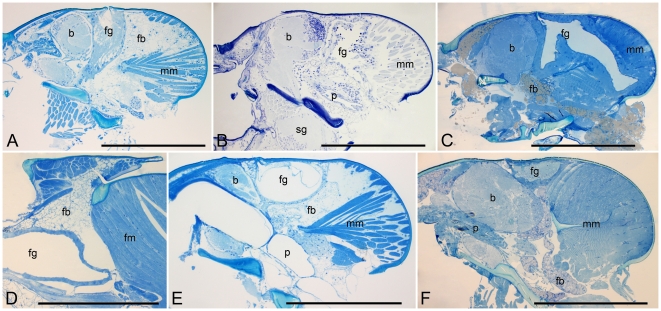
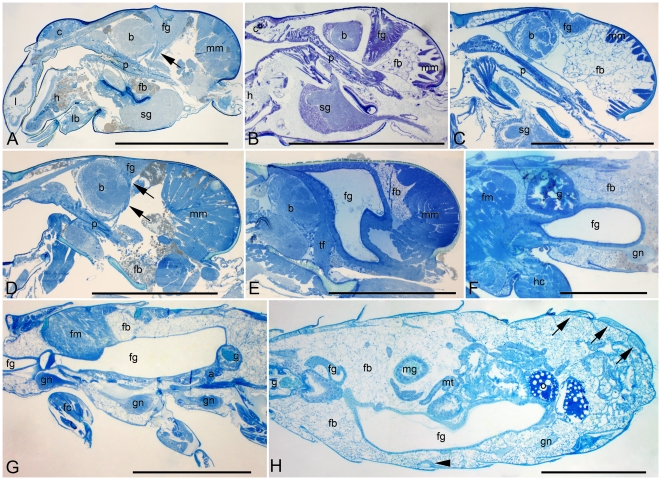
Here, we report on the development of the frontal gland in alate imagoes of 10 genera and 13 species of Rhinotermitidae and Serritermitidae, in order to shed light on the evolution and function of this gland in imagoes. All investigated species possess a frontal gland. In most cases, it is well-developed and equipped with a sac-like reservoir, located in the postero-dorsal part of cranium, but reaching as far as the seventh abdominal segment in some Rhinotermitinae. The only exception is the genus Psammotermes, in which the gland is very small and devoid of the reservoir.
Our direct observations and comparisons with soldiers suggest a defensive role of the gland in imagoes of all studied species. This functional analogy, along with the anatomic homology between the frontal gland in soldiers and imagoes, make it likely that the gland appeared once during the early evolution of rhinotermitid ancestors, and remained as a defensive organ of prime importance in both, soldiers and imagoes.
额腺是高级白蚁科的一种独特适应。人们对兵蚁的额腺解剖结构和化学特性进行了深入研究,在大量已鉴定产物中发现了许多新化合物。与此同时,过去人们对非兵蚁品级的额腺几乎没有关注。
在这里,我们报告了 10 个属和 13 种 Rhinotermitidae 和 Serritermitidae 的若虫前蛹额腺的发育情况,以阐明该腺体在成虫中的进化和功能。所有研究的物种都具有额腺。在大多数情况下,它发育良好,配备有一个囊状储液器,位于颅后背部,但在某些 Rhinotermitinae 中可达第七腹节。唯一的例外是 Psammotermes 属,其腺体非常小且没有储液器。
我们的直接观察和与兵蚁的比较表明,该腺体在所有研究物种的成虫中具有防御作用。这种功能上的相似性,加上兵蚁和成虫额腺之间的解剖同源性,使得该腺体很可能在 Rhinotermitidae 祖先的早期进化中出现,并在兵蚁和成虫中都保持着重要的防御器官的地位。