Department of Pharmacology, Nippon Medical School, 1-1-5 Sendagi, Bunkyo-ku, Tokyo, Japan.
Mol Pain. 2011 Jan 7;7:2. doi: 10.1186/1744-8069-7-2.
Local anesthetics alleviate neuropathic pain in some cases in clinical practice, and exhibit longer durations of action than those predicted on the basis of the pharmacokinetics of their blocking effects on voltage-dependent sodium channels. Therefore, local anesthetics may contribute to additional mechanisms for reversal of the sensitization of nociceptive pathways that occurs in the neuropathic pain state. In recent years, spinal glial cells, microglia and astrocytes, have been shown to play critical roles in neuropathic pain, but their participation in the analgesic effects of local anesthetics remains largely unknown.
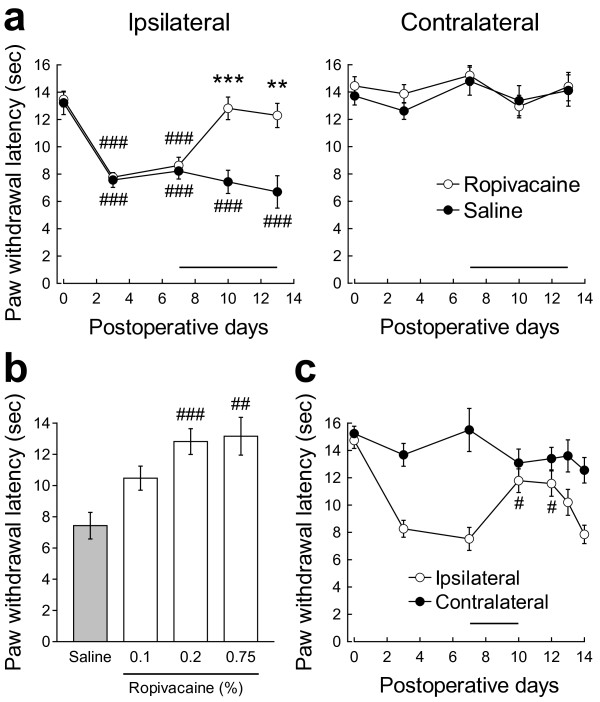
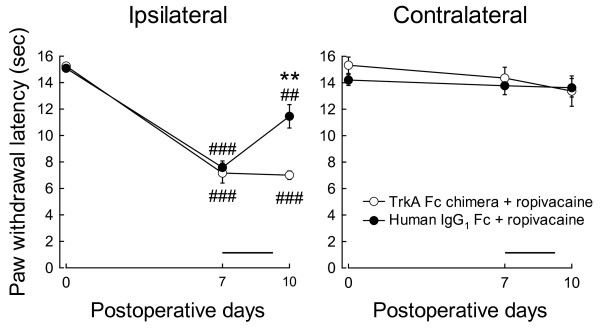
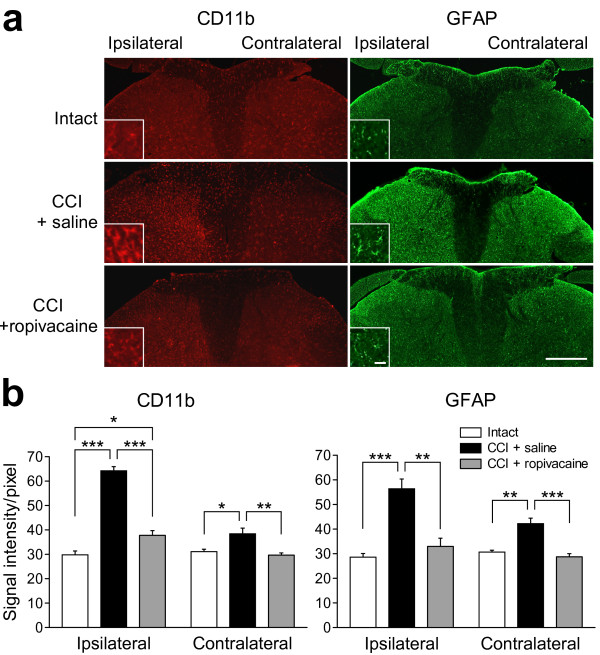
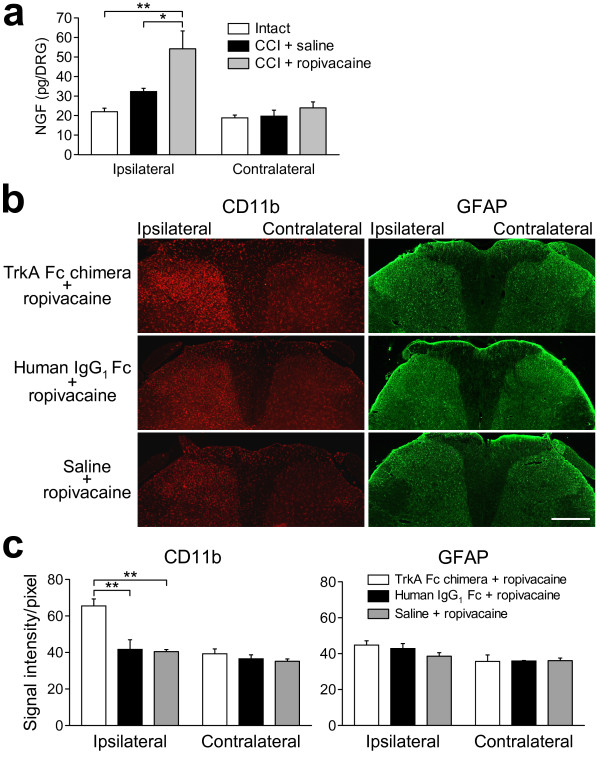
Repetitive epidural administration of ropivacaine reduced the hyperalgesia induced by chronic constrictive injury of the sciatic nerve. Concomitantly with this analgesia, ropivacaine suppressed the increases in the immunoreactivities of CD11b and glial fibrillary acidic protein in the dorsal spinal cord, as markers of activated microglia and astrocytes, respectively. In addition, epidural administration of a TrkA-IgG fusion protein that blocks the action of nerve growth factor (NGF), which was upregulated by ropivacaine in the dorsal root ganglion, prevented the inhibitory effect of ropivacaine on microglia, but not astrocytes. The blockade of NGF action also abolished the analgesic effect of ropivacaine on neuropathic pain.
Ropivacaine provides prolonged analgesia possibly by suppressing microglial activation in an NGF-dependent manner and astrocyte activation in an NGF-independent manner in the dorsal spinal cord. Local anesthetics, including ropivacaine, may represent a new approach for glial cell inhibition and, therefore, therapeutic strategies for neuropathic pain.
在临床实践中,局部麻醉剂在某些情况下缓解神经性疼痛,其作用持续时间长于根据其对电压门控钠通道阻断作用的药代动力学预测的时间。因此,局部麻醉剂可能有助于逆转神经性疼痛状态下发生的伤害性通路敏化的其他机制。近年来,脊髓神经胶质细胞、小胶质细胞和星形胶质细胞已被证明在神经性疼痛中发挥关键作用,但它们在局部麻醉剂的镇痛作用中的参与程度在很大程度上仍不清楚。
重复硬膜外给予罗哌卡因可减轻坐骨神经慢性缩窄性损伤引起的痛觉过敏。这种镇痛作用伴随着罗哌卡因抑制背根神经节中 CD11b 和神经胶质酸性蛋白免疫反应性的增加,分别作为激活小胶质细胞和星形胶质细胞的标志物。此外,硬膜外给予一种 TrkA-IgG 融合蛋白,该蛋白阻断了罗哌卡因在背根神经节中上调的神经生长因子 (NGF) 的作用,可防止罗哌卡因对小胶质细胞的抑制作用,但不能防止对星形胶质细胞的抑制作用。NGF 作用的阻断也消除了罗哌卡因对神经性疼痛的镇痛作用。
罗哌卡因通过以 NGF 依赖性方式抑制背根神经节中小胶质细胞的激活和以 NGF 非依赖性方式抑制星形胶质细胞的激活,提供了长时间的镇痛作用。包括罗哌卡因在内的局部麻醉剂可能代表了一种新的神经胶质细胞抑制方法,因此也代表了治疗神经性疼痛的策略。