Breitsprecher Dennis, Kiesewetter Antje K, Linkner Joern, Vinzenz Marlene, Stradal Theresia E B, Small John Victor, Curth Ute, Dickinson Richard B, Faix Jan
Institute for Biophysical Chemistry, Hannover Medical School, Hannover, Germany.
EMBO J. 2011 Feb 2;30(3):456-67. doi: 10.1038/emboj.2010.348. Epub 2011 Jan 7.
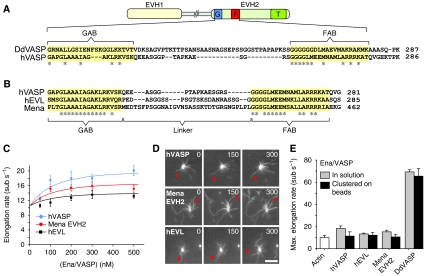
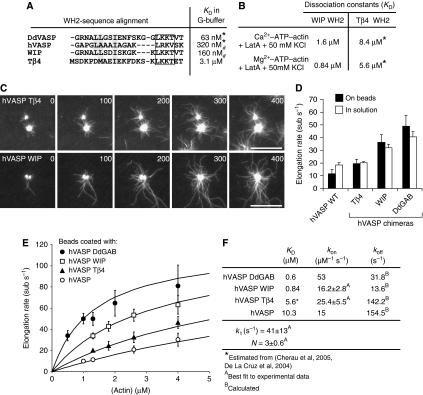
Ena/VASP proteins are implicated in a variety of fundamental cellular processes including axon guidance and cell migration. In vitro, they enhance elongation of actin filaments, but at rates differing in nearly an order of magnitude according to species, raising questions about the molecular determinants of rate control. Chimeras from fast and slow elongating VASP proteins were generated and their ability to promote actin polymerization and to bind G-actin was assessed. By in vitro TIRF microscopy as well as thermodynamic and kinetic analyses, we show that the velocity of VASP-mediated filament elongation depends on G-actin recruitment by the WASP homology 2 motif. Comparison of the experimentally observed elongation rates with a quantitative mathematical model moreover revealed that Ena/VASP-mediated filament elongation displays a saturation dependence on the actin monomer concentration, implying that Ena/VASP proteins, independent of species, are fully saturated with actin in vivo and generally act as potent filament elongators. Moreover, our data showed that spontaneous addition of monomers does not occur during processive VASP-mediated filament elongation on surfaces, suggesting that most filament formation in cells is actively controlled.
Ena/VASP蛋白参与多种基本细胞过程,包括轴突导向和细胞迁移。在体外,它们能增强肌动蛋白丝的伸长,但根据物种不同,伸长速率相差近一个数量级,这引发了关于速率控制分子决定因素的问题。我们构建了快速和慢速伸长的VASP蛋白嵌合体,并评估了它们促进肌动蛋白聚合和结合G-肌动蛋白的能力。通过体外全内反射荧光显微镜以及热力学和动力学分析,我们发现VASP介导的丝伸长速度取决于WASP同源2基序对G-肌动蛋白的招募。此外,将实验观察到的伸长速率与定量数学模型进行比较后发现,Ena/VASP介导的丝伸长对肌动蛋白单体浓度呈现饱和依赖性,这意味着Ena/VASP蛋白在体内无论物种如何都能与肌动蛋白完全饱和,通常作为有效的丝伸长因子发挥作用。此外,我们的数据表明,在表面上由VASP介导的持续性丝伸长过程中不会发生单体的自发添加,这表明细胞中大多数丝的形成是受到主动控制的。