Deshpande Sudheer, Nagendra H R, Nagarathna Raghuram
Department of Yoga Research, Swami Vivekananda Yoga Anusandhana Samsthana, Bangalore, India.
Int J Yoga. 2009 Jan;2(1):13-21. doi: 10.4103/0973-6131.43287.
BACKGROUND/AIMS: To study the efficacy of yoga on Gunas (personality) and self esteem in normal adults through a randomized comparative study.
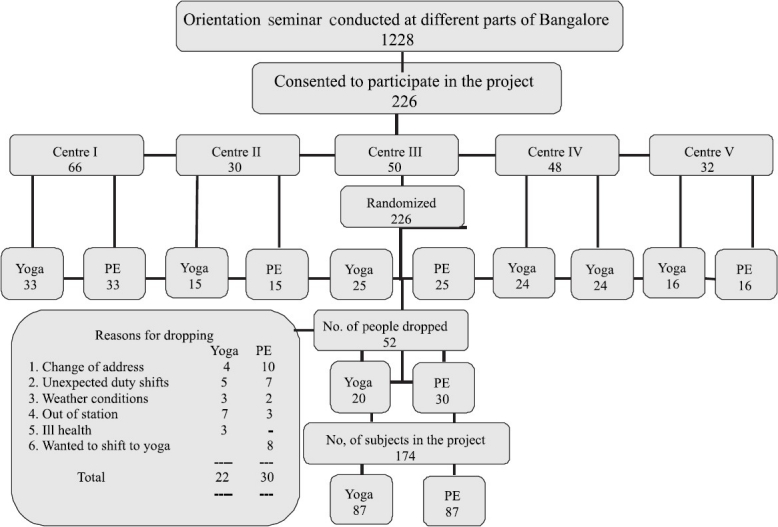
Of the 1228 persons who attended motivational lectures, 226 subjects aged 18-71 years, of both sexes, who satisfied the inclusion and exclusion criteria, and who consented to participate in the study were randomly allocated into two groups. The Yoga (Y) group practised an integrated yoga module that included asanas, pranayama, meditation, notional correction, and devotional sessions. The comparison group practised mild to moderate physical exercises (PE). Both groups had supervised practices for one hour daily, six days a week, for eight weeks. Guna (personality) was assessed before and after eight weeks using the self-administered "The 'Gita" Inventory of Personality" (GIN) to assess Sattva, Rajas, and Tamas. Self esteem in terms of competency (COM), global self esteem (GSE), moral and self esteem (MSE), social esteem (SET), family self esteem (FSE), body and physical appearance (BPA), and the lie scale (LIS) were assessed using the self esteem questionnaire (SEQ).
The baseline scores for all domains for both the groups did not differ significantly (P > 0.05 independent samples t-test). There were significant pre-post improvements in all domains in both groups (P < 0.001 paired t-test). The number of persons who showed improvement in Sattva and decrease in Tamas was significant in the Y but not in the PE group (McNemar test). The effect size for self esteem in the Y group is greater than for the PE group in three out of seven domains.
This randomized controlled study has shown the influence of Yoga on Gunas and self esteem in comparison to physical exercise.
背景/目的:通过随机对照研究,探讨瑜伽对正常成年人性格及自尊的影响。
在1228名参加励志讲座的人中,选取226名年龄在18 - 71岁之间、符合纳入和排除标准且同意参与研究的男女受试者,随机分为两组。瑜伽组进行综合瑜伽练习,包括体式、呼吸控制法、冥想、观念矫正和虔诚祈祷。对照组进行轻度至中度体育锻炼。两组均在每周六天、每天一小时的监督下练习八周。八周前后使用自评的“《薄伽梵歌》人格量表”(GIN)评估性格,以评估萨埵、罗阇和答摩。使用自尊问卷(SEQ)评估能力自尊(COM)、总体自尊(GSE)、道德与自尊(MSE)、社会自尊(SET)、家庭自尊(FSE)、身体与外貌自尊(BPA)以及说谎量表(LIS)。
两组所有领域的基线得分无显著差异(独立样本t检验,P > 0.05)。两组所有领域在前后测中均有显著改善(配对t检验,P < 0.001)。瑜伽组中萨埵得分提高且答摩得分降低的人数显著,而体育锻炼组则不然(麦克尼马尔检验)。在七个领域中的三个领域,瑜伽组自尊的效应量大于体育锻炼组。
这项随机对照研究表明,与体育锻炼相比,瑜伽对性格和自尊有影响。