Laboratory of Endocrinology and Genomics, CHUL Research Center and Department of Molecular Medicine, Faculty of Medicine, Laval University, 2705 Laurier boul,, Québec, G1V 4G2, Canada.
Mol Neurodegener. 2011 Jan 14;6(1):5. doi: 10.1186/1750-1326-6-5.
Alzheimer's disease (AD) is an age-related neurodegenerative disorder associated with brain innate immune activation mainly mediated by microglia. These cells are known to be activated in the brain of AD patients and to produce inflammatory cytokines and neurotoxic molecules in response to Amyloid beta (Aβ). Activation of microglia can also promote Aβ clearance via Toll-like receptors (TLRs). Myeloid differentiation factor 88 (MyD88) is the adaptor molecule for most of these innate immune receptors, transducing the intracellular signal from TLRs to nucleus.
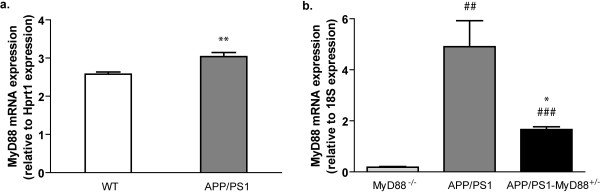
Here, we report that more than 50% reduction in MyD88 expression in a mouse model of AD accelerated spatial learning and memory deficits. Brain of APPswe/PS1-MyD88+/- mice was characterized by a delay in accumulation of Aβ plaques and increased soluble levels of Aβ oligomers. Furthermore, inflammatory monocyte subset and brain IL-1β gene expression were significantly reduced in APPswe/PS1 mice with impaired MyD88 signaling.
These data indicate that activation of MyD88 intracellular signaling pathway, likely by TLRs, acts as a natural innate immune mechanism to restrict disease progression of APPswe/PS1 mice.
阿尔茨海默病(AD)是一种与年龄相关的神经退行性疾病,与大脑固有免疫激活有关,主要由小胶质细胞介导。这些细胞已知在 AD 患者的大脑中被激活,并在响应淀粉样蛋白β(Aβ)时产生炎症细胞因子和神经毒性分子。小胶质细胞的激活还可以通过 Toll 样受体(TLR)促进 Aβ清除。髓样分化因子 88(MyD88)是这些固有免疫受体的大多数衔接分子,将 TLR 从细胞内信号转导到细胞核。
在这里,我们报告说,AD 小鼠模型中 MyD88 表达减少超过 50%,加速了空间学习和记忆缺陷。APPswe/PS1-MyD88+/- 小鼠的大脑表现为 Aβ 斑块积累延迟和可溶性 Aβ 寡聚物水平增加。此外,APPswe/PS1 小鼠中 MyD88 信号受损时,炎症单核细胞亚群和脑 IL-1β 基因表达显著降低。
这些数据表明,MyD88 细胞内信号通路的激活,可能通过 TLRs,作为一种天然的固有免疫机制,限制 APPswe/PS1 小鼠的疾病进展。