University and Regional Laboratories Region Skåne, Department of Pathology, Lund University Hospital, Sölvegatan 25, SE 22185, Lund, Sweden.
Infect Agent Cancer. 2011 Jan 17;6(1):1. doi: 10.1186/1750-9378-6-1.
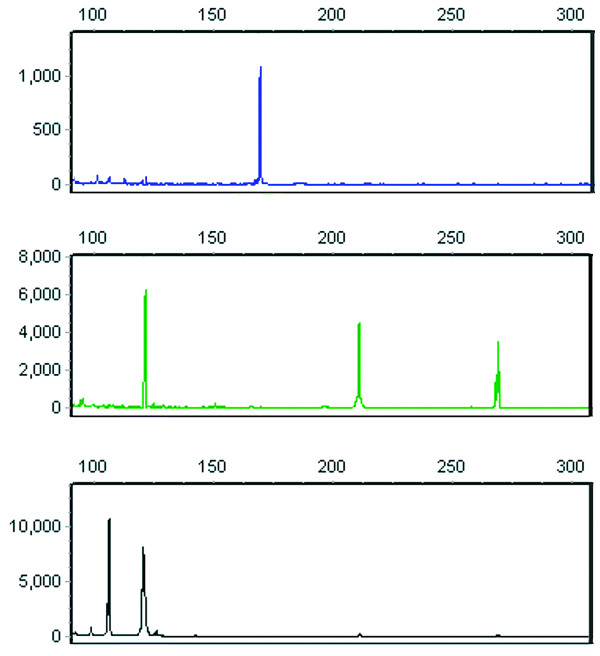
Human papillomavirus (HPV) E6/E7 type-specific oncogenes are required for cervical carcinogenesis. Current PCR protocols for genotyping high-risk HPV in cervical screening are not standardized and usually use consensus primers targeting HPV capsid genes, which are often deleted in neoplasia. PCR fragments are detected using specialized equipment and extra steps, including probe hybridization or primer extension. In published papers, analytical sensitivity is typically compared with a different protocol on the same sample set.A single-tube multiplex PCR containing type-specific primers was developed to target the E6/E7 genes of two low-risk and 19 high-risk genotypes (HPV6, 11 and 16, 18, 26, 31, 33, 35, 39, 45, 51, 52, 53, 56, 58, 59, 66, 68, 70, 73 and 82) and the resulting short fragments were directly genotyped by high-resolution fluorescence capillary electrophoresis.
The method was validated using long oligonucleotide templates, plasmid clones and 207 clinical samples of DNA from liquid-based cytology, fresh and formalin-fixed specimens and FTA Microcards® imprinted with cut tumor surfaces, swabbed cervical cancers or ejected aspirates from nodal metastases of head and neck carcinomas. Between one and five long oligonucleotide targets per sample were detected without false calls. Each of the 21 genotypes was detected in the clinical sample set with up to five types simultaneously detected in individual specimens. All 101 significant cervical neoplasias (CIN 2 and above), except one adenocarcinoma, contained E6/E7 genes. The resulting genotype distribution accorded with the national pattern with HPV16 and 18 accounting for 69% of tumors. Rare HPV types 70 and 73 were present as the sole genotype in one carcinoma each. One cervical SCC contained DNA from HPV6 and 11 only. Six of twelve oropharyngeal cancer metastases and three neck metastases of unknown origin bore E6/E7 DNA; all but one were HPV16. One neck aspirate contained atypical squames with HPV26.Analytical sensitivity in dilute plasmid mixes was variable.
A primer-rich PCR readily detects the E6/E7 oncogenes of 21 HPV types in cellular and fixed tissue specimens. The method is straightforward, robust and reproducible and avoids post-PCR enzymatic and hybridization steps while detecting HPV with high clinical sensitivity in significant HPV-related neoplasia regardless of specimen type.
人乳头瘤病毒(HPV)E6/E7 型特异性致癌基因是宫颈癌发生所必需的。目前用于宫颈癌筛查的高危 HPV 基因分型的 PCR 方案尚未标准化,通常使用针对 HPV 衣壳基因的共识引物,而这些基因在肿瘤中经常缺失。PCR 片段使用专用设备和额外步骤进行检测,包括探针杂交或引物延伸。在已发表的论文中,分析灵敏度通常是在同一组样本上与不同方案进行比较。
开发了一种包含型特异性引物的单管多重 PCR,用于针对两种低危型和 19 种高危型(HPV6、11 和 16、18、26、31、33、35、39、45、51、52、53、56、58、59、66、68、70、73 和 82)的 E6/E7 基因。所得短片段通过高分辨率荧光毛细管电泳直接进行基因分型。
使用长寡核苷酸模板、质粒克隆和 207 例来自液体基细胞学的 DNA 临床样本、新鲜和福尔马林固定标本以及印迹有切除肿瘤表面的 FTA Microcards® 印迹、拭取的宫颈癌或头颈部癌淋巴结转移的吸出物对该方法进行了验证。每个样本可检测到 1 至 5 个长寡核苷酸靶标,没有假阳性。在临床样本组中检测到 21 种基因型中的每一种,在个别标本中同时检测到多达 5 种类型。除了一个腺癌外,所有 101 例显著的宫颈癌前病变(CIN2 及以上)均含有 E6/E7 基因。所得的基因型分布与全国模式一致,HPV16 和 18 占肿瘤的 69%。罕见的 HPV 类型 70 和 73 分别在一个癌中作为唯一的基因型存在。一个宫颈 SCC 仅含有 HPV6 和 11 的 DNA。12 个口咽癌转移灶中的 6 个和来源不明的 3 个颈部转移灶含有 E6/E7 DNA;除一个外均为 HPV16。一个颈部吸出物含有 HPV26 的非典型鳞状细胞。在稀释的质粒混合物中的分析灵敏度是可变的。
富含引物的 PCR 可轻松检测细胞和固定组织标本中 21 种 HPV 类型的 E6/E7 致癌基因。该方法简单、稳健且可重复,避免了 PCR 后酶切和杂交步骤,同时在无论标本类型如何,对显著的 HPV 相关肿瘤均具有高临床灵敏度检测 HPV。