Torii Kengo, Chiwata Ichiro
Torii Dental Clinic, 1-23-2 Ando, Aoi-ku, Shizuoka-shi, 420-0882 Japan.
Open Dent J. 2010 Oct 21;4:218-22. doi: 10.2174/1874210601004010218.
Splint therapy is a widely used modality for temporomandibular disorders (TMDs). However, questions remain regarding the mechanism of symptom relief. Recently, a relation between TMD and a discrepancy between the habitual occlusal position (HOP) and the anterior flat plane bite plate-induced occlusal position (BPOP) has been reported. Therefore, to understand the mechanism of the symptom relief associated with the use of a bite plate, the changes in both the HOP and BPOP values were observed during anterior bite plate treatment in a patient with TMD.
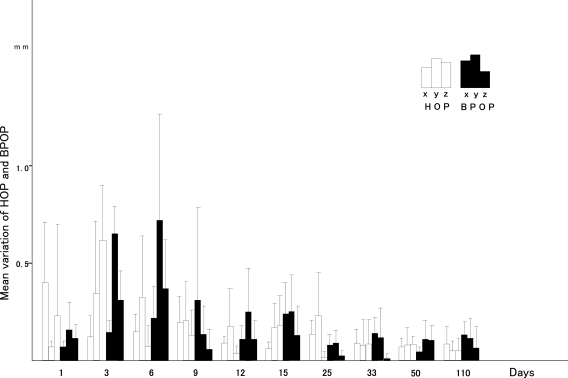
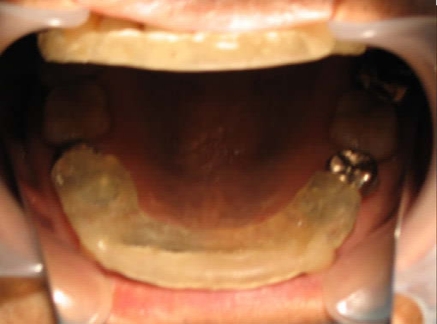
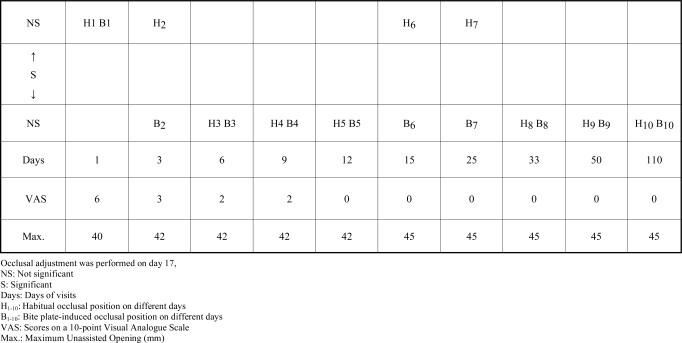
Anterior bite plate treatment was started in a patient complaining of arthralgia. A discrepancy between the HOP and BPOP values was recorded three days after the first visit; this discrepancy disappeared on day 6, and the disappearance was maintained between days 6 and 12. The disappearance was associated with a decrease in the severity of the patient's symptoms; however, the discrepancy reappeared after 15 days, coinciding with the complete disappearance of the patient's symptoms. Therefore, the effect of the bite plate on the resolution of the discrepancy between the HOP and BPOP values was interpreted as being unsustainable and occlusal equilibration for the BPOP was performed at 17 days. Thereafter, neither a discrepancy in the HOP and BPOP values nor any symptoms of TMD (right temporomandibular joint pain or limited jaw opening) reoccurred during a two-year follow-up period.
Within the limitations of the present study, the symptom-relieving action of an anterior flat plane bite plate on the resolution of occlusal discrepancy appeared to be temporary. This outcome supports previously reported conclusions that the effectiveness of stabilization splint therapy for reducing symptoms in patients with pain dysfunction syndrome does not differ significantly from that of other conservative therapies or of no treatment at all.
夹板疗法是颞下颌关节紊乱病(TMDs)广泛使用的一种治疗方式。然而,关于症状缓解的机制仍存在疑问。最近,有报道称TMD与习惯性咬合位(HOP)和前牙平面咬合板诱导的咬合位(BPOP)之间的差异有关。因此,为了解与咬合板使用相关的症状缓解机制,观察了一名TMD患者在前牙咬合板治疗期间HOP和BPOP值的变化。
一名主诉关节痛的患者开始接受前牙咬合板治疗。首次就诊三天后记录到HOP和BPOP值之间存在差异;该差异在第6天消失,并在第6天至第12天之间保持消失状态。这种消失与患者症状严重程度的降低相关;然而,15天后差异再次出现,同时患者症状完全消失。因此,咬合板对HOP和BPOP值差异解决的影响被认为是不可持续的,在第17天对BPOP进行了咬合平衡。此后,在两年的随访期内,HOP和BPOP值均未出现差异,也未再出现TMD的任何症状(右侧颞下颌关节疼痛或张口受限)。
在本研究的局限性范围内,前牙平面咬合板对咬合差异解决的症状缓解作用似乎是暂时的。这一结果支持了先前报道的结论,即稳定夹板疗法对疼痛功能障碍综合征患者减轻症状的有效性与其他保守疗法或根本不治疗相比没有显著差异。