Infectious Disease Epidemiology, Bernhard Nocht Institute for Tropical Medicine, Hamburg, Germany.
J Infect Dis. 2011 Feb 15;203(4):556-60. doi: 10.1093/infdis/jiq079. Epub 2010 Dec 20.
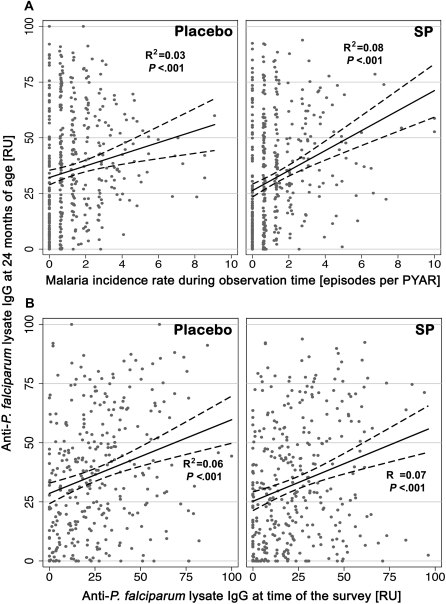
Recently, the World Health Organization emphasized the potential benefit of intermittent preventive treatment in infants (IPTi) to control malaria and officially recommended implementation of IPTi with sulfadoxine-pyrimethamine (SP) in areas with moderate and high transmission, where SP resistance is not high. As reported rebound effects make further observation mandatory, we performed a survey of participants of a former IPTi trial. Malariometric parameters were similar in the SP and the placebo group. In contrast, anti-Plasmodium falciparum lysate immunoglobulin G antibody levels, a proxy measure for preceding malaria episodes, remained lower in the SP arm. The most likely explanation is a lower overall exposure to parasitic antigens after IPTi.
最近,世界卫生组织强调了间歇性预防治疗在婴儿中的潜在益处(IPTi)以控制疟疾,并正式建议在中度和高度传播地区、抗药性不高的地区实施以磺胺多辛-乙胺嘧啶(SP)为基础的 IPTi。据报道,反弹效应使得进一步观察成为必要,我们对以前的 IPTi 试验的参与者进行了调查。SP 组和安慰剂组的疟疾参数相似。相比之下,抗疟原虫裂解物免疫球蛋白 G 抗体水平(先前疟疾发作的替代指标)在 SP 组中仍然较低。最有可能的解释是 IPTi 后寄生虫抗原的总体暴露水平较低。