Department of Family Medicine and Public Health, College of Medicine and Health Sciences, Sultan Qaboos University, Oman.
BMC Pregnancy Childbirth. 2011 Jan 20;11:7. doi: 10.1186/1471-2393-11-7.
Studies that explore the controversial association between parity and anaemia-in-pregnancy (AIP) were often hampered by not distinguishing incident cases caused by pregnancy from prevalent cases complicated by pregnancy. The authors' aim in conducting this study was to overcome this methodological concern.
A retrospective cohort study was conducted in Oman on 1939 pregnancies among 479 parous female participants with available pregnancy records in a community trial. We collected information from participants, the community trial, and health records of each pregnancy. Throughout the follow-up period, we enumerated 684 AIP cases of which 289 (42.2%) were incident cases. High parity (HP, ≥ 5 pregnancies) accounted for 48.7% of total pregnancies. Two sets of regression analyses were conducted: the first restricted to incident cases only, and the second inclusive of all cases. The relation with parity as a dichotomy and as multiple categories was examined for each set; multi-level logistic regression (MLLR) was employed to produce adjusted models.
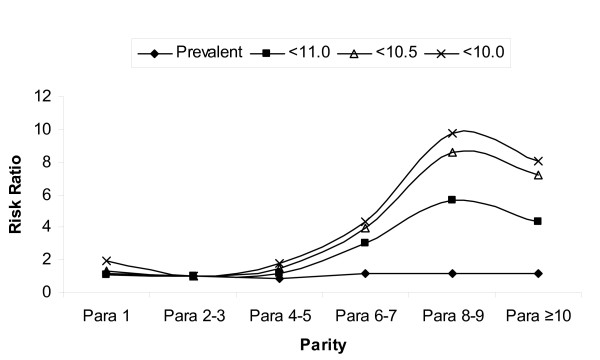
In the fully adjusted MLLR models that were restricted to incident cases, women with HP pregnancies had a higher risk of AIP compared to those who had had fewer pregnancies (Risk Ratio, RR = 2.92; 95% CI 2.02, 4.59); the AIP risk increased in a dose-response fashion over multiple categories of parity. In the fully adjusted MLLR models that included all cases, the association disappeared (RR = 1.11; 95% CI 0.91, 1.18) and the dose-response pattern flattened.
This study shows the importance of specifying which cases of AIP are incident and provides supportive evidence for a causal relation between parity and occurrence of incidental AIP.
研究探索生育次数与妊娠贫血(AIP)之间的争议性关联时,通常受到困扰,因为这些研究无法区分由妊娠引起的新发病例与因妊娠而复杂化的现患病例。作者进行这项研究的目的是克服这一方法上的关注。
在阿曼进行了一项回顾性队列研究,纳入了 479 名生育过的女性参与者的 1939 例妊娠,这些参与者在社区试验中有可获得的妊娠记录。我们从参与者、社区试验和每例妊娠的健康记录中收集信息。在整个随访期间,我们共确定了 684 例 AIP 病例,其中 289 例(42.2%)为新发病例。高生育次数(HP,≥5 次妊娠)占总妊娠的 48.7%。进行了两组回归分析:第一组仅限于新发病例,第二组包括所有病例。对每一组都检查了生育次数作为二分类变量和多分类变量的关系;采用多水平逻辑回归(MLLR)生成调整模型。
在仅限于新发病例的完全调整后的 MLLR 模型中,与生育次数较少的妇女相比,生育 HP 妊娠的妇女 AIP 风险更高(风险比,RR=2.92;95%置信区间,2.02,4.59);随着生育次数的增加,AIP 风险呈剂量反应模式。在包括所有病例的完全调整后的 MLLR 模型中,这种关联消失(RR=1.11;95%置信区间,0.91,1.18),且剂量反应模式趋于平坦。
这项研究表明指定哪些 AIP 病例为新发病例的重要性,并为生育次数与偶发性 AIP 发生之间的因果关系提供了支持性证据。