Klu Desmond, Kyei-Arthur Frank, Appiah Margaret, Odame Michael Larbi
Centre for Malaria Research, Institute of Health Research, University of Health and Allied Sciences, Ho, Volta Region, Ghana.
Department of Environment and Public Health, University of Environment and Sustainable Development, Somanya, Eastern Region, Ghana.
PLOS Glob Public Health. 2024 Sep 5;4(9):e0003673. doi: 10.1371/journal.pgph.0003673. eCollection 2024.
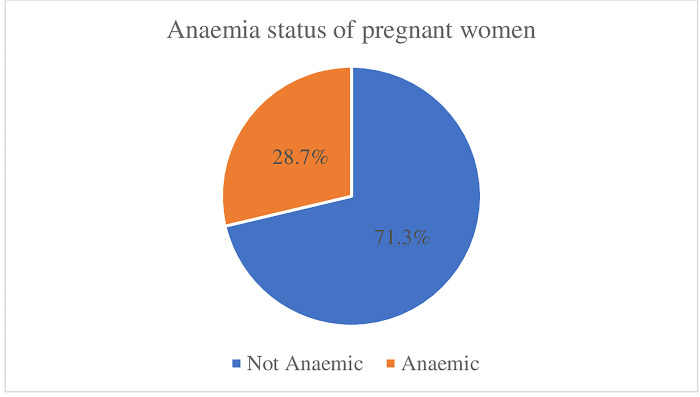
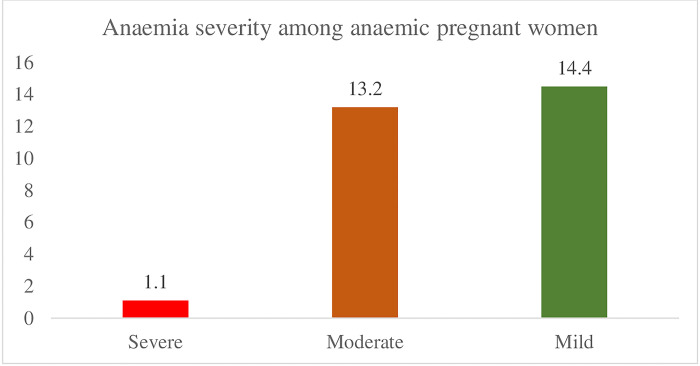
Anaemia in pregnant women is a major public health concern. A number of multilevel factors have been attributed as contributors to anaemia in pregnancy. The purpose of this study was to examine the multilevel factors predicting anaemia among pregnant women in Ghana. Data for this study were obtained from the 2019 Ghana Malaria Indicator Survey (GMIS) conducted between September 25 and November 24, 2019 in all regions in Ghana. The weighted sample comprised 353 pregnant women aged 15-49 years. Data were analysed with SPSS version 25 using descriptive statistics, Pearson's chi-square test and binary logistic regression modelling. In this study, the outcome variable was anaemia status among pregnant women, while the predictor variables included individual, household, community, and health system level factors. The overall prevalence of anaemia among pregnant women was 28.7%. Of these, 14.5% had mild anaemia, and 13.2% and 1.1% had moderate and severe anaemia, respectively. The results indicate that a higher probability of anaemia in pregnancy is likely to be found among pregnant women less than 35 years (15-24 years, aOR = 3.31; C.I: 1.13-9.73) (25-34 years, aOR = 2.49; C.I:1.06-5.84). A higher likelihood of anaemia was found among pregnant women who did not take SP drug (aOR = 3.70; C.I:1.20-11.43) and also among household heads aged 30-39 years (aOR = 4.51; C.I:1.09-18.71). However, a lower odd of being anaemic was found among pregnant women who had attained secondary or higher education (aOR = 0.19; C.I:0.05-0.76), women in the richest households (aOR = 0.02; C.I:0.00-0.42) and those accessing unimproved drinking water (aOR = 0.37; C.I:0.14-0.95). Furthermore, pregnant women with health insurance coverage had lower probability (aOR = 0.24; C.I: 0.06-0.94) of being anaemic. The results highlight the importance of varying factors at different levels in understanding the prevalence of anaemia among pregnant women. Understanding these factors will play a major contributor to developing strategies and programmes aimed at addressing anaemia among pregnant women.
孕妇贫血是一个重大的公共卫生问题。许多多层次因素被认为是导致孕期贫血的原因。本研究的目的是调查加纳孕妇中预测贫血的多层次因素。本研究的数据来自2019年9月25日至11月24日在加纳所有地区进行的2019年加纳疟疾指标调查(GMIS)。加权样本包括353名年龄在15 - 49岁之间的孕妇。使用SPSS 25版软件进行数据分析,采用描述性统计、Pearson卡方检验和二元逻辑回归模型。在本研究中,结果变量是孕妇的贫血状况,而预测变量包括个人、家庭、社区和卫生系统层面的因素。孕妇贫血的总体患病率为28.7%。其中,14.5%为轻度贫血,13.2%和1.1%分别为中度和重度贫血。结果表明,年龄小于35岁的孕妇(15 - 24岁,调整后比值比 = 3.31;置信区间:1.13 - 9.73)(25 - 34岁,调整后比值比 = 2.49;置信区间:1.06 - 5.84)孕期贫血的可能性更高。未服用磺胺多辛 - 乙胺嘧啶(SP)药物的孕妇(调整后比值比 = 3.70;置信区间:1.20 - 11.43)以及年龄在30 - 39岁的户主孕妇(调整后比值比 = 4.51;置信区间:1.09 - 18.71)贫血的可能性也更高。然而,接受过中等或高等教育的孕妇(调整后比值比 = 0.19;置信区间:0.05 - 0.76)、最富裕家庭的女性(调整后比值比 = 0.02;置信区间:0.00 - 0.42)以及饮用未改善饮用水的孕妇(调整后比值比 = 0.37;置信区间:0.14 - 0.95)贫血的几率较低。此外,有医疗保险的孕妇贫血的可能性较低(调整后比值比 = 0.24;置信区间:0.06 - 0.94)。结果强调了不同层面的各种因素在理解孕妇贫血患病率方面的重要性。了解这些因素将对制定旨在解决孕妇贫血问题的策略和计划起到重要作用。