Department of Biology, University of Copenhagen, Copenhagen, Denmark.
PLoS Genet. 2011 Jan 6;7(1):e1001268. doi: 10.1371/journal.pgen.1001268.
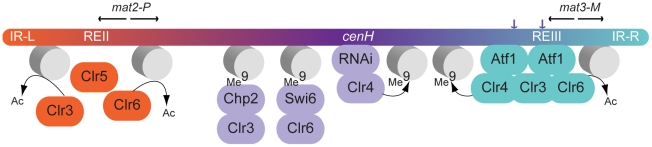
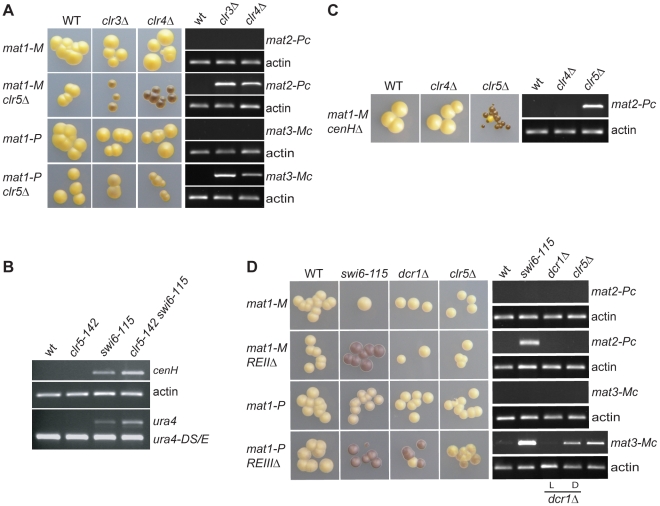
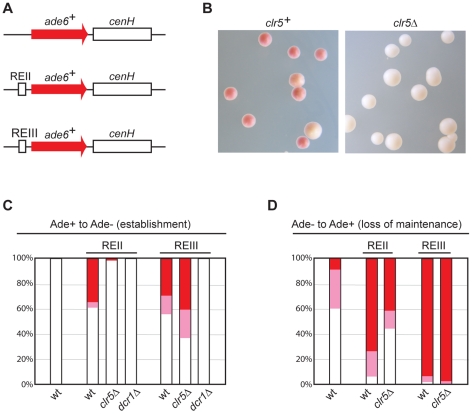
Nucleosomes in heterochromatic regions bear histone modifications that distinguish them from euchromatic nucleosomes. Among those, histone H3 lysine 9 methylation (H3K9me) and hypoacetylation have been evolutionarily conserved and are found in both multicellular eukaryotes and single-cell model organisms such as fission yeast. In spite of numerous studies, the relative contributions of the various heterochromatic histone marks to the properties of heterochromatin remain largely undefined. Here, we report that silencing of the fission yeast mating-type cassettes, which are located in a well-characterized heterochromatic region, is hardly affected in cells lacking the H3K9 methyltransferase Clr4. We document the existence of a pathway parallel to H3K9me ensuring gene repression in the absence of Clr4 and identify a silencing factor central to this pathway, Clr5. We find that Clr5 controls gene expression at multiple chromosomal locations in addition to affecting the mating-type region. The histone deacetylase Clr6 acts in the same pathway as Clr5, at least for its effects in the mating-type region, and on a subset of other targets, notably a region recently found to be prone to neo-centromere formation. The genomic targets of Clr5 also include Ste11, a master regulator of sexual differentiation. Hence Clr5, like the multi-functional Atf1 transcription factor which also modulates chromatin structure in the mating-type region, controls sexual differentiation and genome integrity at several levels. Globally, our results point to histone deacetylases as prominent repressors of gene expression in fission yeast heterochromatin. These deacetylases can act in concert with, or independently of, the widely studied H3K9me mark to influence gene silencing at heterochromatic loci.
异染色质区域的核小体带有区分于常染色质核小体的组蛋白修饰。其中,组蛋白 H3 赖氨酸 9 甲基化(H3K9me)和低乙酰化在多细胞真核生物和单细胞模式生物如裂殖酵母中都具有进化保守性。尽管进行了大量研究,但各种异染色质组蛋白标记对异染色质性质的相对贡献在很大程度上仍未得到明确界定。在这里,我们报告说,位于一个特征明确的异染色质区域的裂殖酵母交配型盒的沉默,在缺乏 H3K9 甲基转移酶 Clr4 的细胞中几乎不受影响。我们记录了一条与 H3K9me 平行的途径的存在,该途径确保了在 Clr4 缺失的情况下基因的沉默,并确定了该途径的一个核心沉默因子 Clr5。我们发现 Clr5 除了影响交配型区域外,还在多个染色体位置控制基因表达。组蛋白去乙酰化酶 Clr6 与 Clr5 作用于相同的途径,至少在其对交配型区域的影响以及其他一些靶标(尤其是最近发现易形成新着丝粒的区域)上是如此。Clr5 的基因组靶标还包括性分化的主调控因子 Ste11。因此,Clr5 与多效性 Atf1 转录因子一样,也调节交配型区域的染色质结构,在多个层面上控制着性分化和基因组完整性。总的来说,我们的结果表明,组蛋白去乙酰化酶是裂殖酵母异染色质中基因表达的主要抑制剂。这些去乙酰化酶可以与广泛研究的 H3K9me 标记协同作用,或独立作用,影响异染色质基因座的基因沉默。