• 文献检索
  • 文档翻译
  • 深度研究
  • 学术资讯
  • Suppr Zotero 插件Zotero 插件
  • 邀请有礼
  • 套餐&价格
  • 历史记录
应用&插件
Suppr Zotero 插件Zotero 插件浏览器插件Mac 客户端Windows 客户端微信小程序
定价
高级版会员购买积分包购买API积分包
服务
文献检索文档翻译深度研究API 文档MCP 服务
关于我们
关于 Suppr公司介绍联系我们用户协议隐私条款
关注我们

Suppr 超能文献

核心技术专利:CN118964589B侵权必究
粤ICP备2023148730 号-1Suppr @ 2026

文献检索

告别复杂PubMed语法,用中文像聊天一样搜索,搜遍4000万医学文献。AI智能推荐,让科研检索更轻松。

立即免费搜索

文件翻译

保留排版,准确专业,支持PDF/Word/PPT等文件格式,支持 12+语言互译。

免费翻译文档

深度研究

AI帮你快速写综述,25分钟生成高质量综述,智能提取关键信息,辅助科研写作。

立即免费体验

Armeo Spring 作为一种训练工具,可改善多发性硬化症患者的上肢功能:一项初步研究。

The Armeo Spring as training tool to improve upper limb functionality in multiple sclerosis: a pilot study.

机构信息

REVAL Rehabilitation Research Center, Hasselt University, Agoralaan Building A, BE-3590 Diepenbeek, Belgium.

出版信息

J Neuroeng Rehabil. 2011 Jan 24;8:5. doi: 10.1186/1743-0003-8-5.

DOI:10.1186/1743-0003-8-5
PMID:21261965
原文链接:https://pmc.ncbi.nlm.nih.gov/articles/PMC3037310/
Abstract

BACKGROUND

Few research in multiple sclerosis (MS) has focused on physical rehabilitation of upper limb dysfunction, though the latter strongly influences independent performance of activities of daily living. Upper limb rehabilitation technology could hold promise for complementing traditional MS therapy. Consequently, this pilot study aimed to examine the feasibility of an 8-week mechanical-assisted training program for improving upper limb muscle strength and functional capacity in MS patients with evident paresis.

METHODS

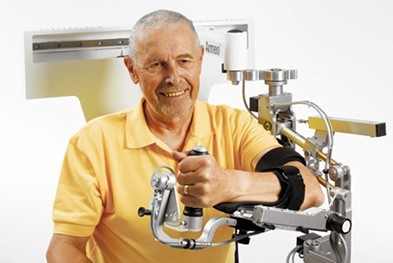
A case series was applied, with provision of a training program (3×/week, 30 minutes/session), supplementary on the customary maintaining care, by employing a gravity-supporting exoskeleton apparatus (Armeo Spring). Ten high-level disability MS patients (Expanded Disability Status Scale 7.0-8.5) actively performed task-oriented movements in a virtual real-life-like learning environment with the affected upper limb. Tests were administered before and after training, and at 2-month follow-up. Muscle strength was determined through the Motricity Index and Jamar hand-held dynamometer. Functional capacity was assessed using the TEMPA, Action Research Arm Test (ARAT) and 9-Hole Peg Test (9HPT).

RESULTS

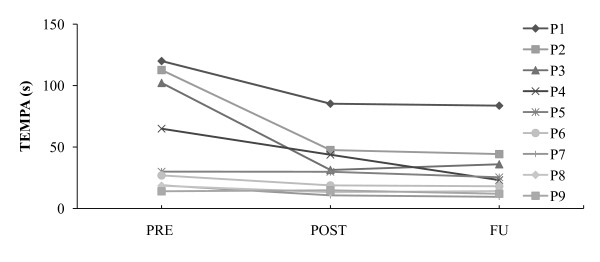
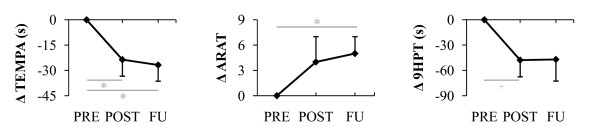
Muscle strength did not change significantly. Significant gains were particularly found in functional capacity tests. After training completion, TEMPA scores improved (p = 0.02), while a trend towards significance was found for the 9HPT (p = 0.05). At follow-up, the TEMPA as well as ARAT showed greater improvement relative to baseline than after the 8-week intervention period (p = 0.01, p = 0.02 respectively).

CONCLUSIONS

The results of present pilot study suggest that upper limb functionality of high-level disability MS patients can be positively influenced by means of a technology-enhanced physical rehabilitation program.

摘要

背景

多发性硬化症(MS)的研究很少关注上肢功能障碍的物理康复,尽管后者强烈影响日常生活活动的独立表现。上肢康复技术可能有望补充传统的 MS 治疗。因此,本初步研究旨在检查 8 周机械辅助训练方案对改善明显瘫痪的 MS 患者上肢肌肉力量和功能能力的可行性。

方法

采用病例系列研究,在常规维持治疗的基础上提供训练方案(每周 3 次,每次 30 分钟),使用重力支撑式外骨骼设备(Armeo Spring)。10 名高残疾水平的 MS 患者(扩展残疾状况量表 7.0-8.5)在受影响的上肢进行虚拟真实学习环境中的任务导向运动。在训练前后以及 2 个月随访时进行测试。肌肉力量通过运动力量指数和 Jamar 手持测力计测定。功能能力通过 TEMPA、行动研究上肢测试(ARAT)和 9 孔钉测试(9HPT)评估。

结果

肌肉力量没有显著变化。功能能力测试中发现了显著的增益。训练完成后,TEMPA 评分提高(p=0.02),9HPT 也出现了显著趋势(p=0.05)。随访时,TEMPA 和 ARAT 的改善均明显优于基线,优于 8 周干预期(p=0.01,p=0.02)。

结论

本初步研究结果表明,通过技术增强的物理康复方案,可对高水平残疾 MS 患者的上肢功能产生积极影响。
https://cdn.ncbi.nlm.nih.gov/pmc/blobs/4ced/3037310/d0659cf120b2/1743-0003-8-5-3.jpg
https://cdn.ncbi.nlm.nih.gov/pmc/blobs/4ced/3037310/8e7001ce7b4f/1743-0003-8-5-1.jpg
https://cdn.ncbi.nlm.nih.gov/pmc/blobs/4ced/3037310/eb20d76be07b/1743-0003-8-5-2.jpg
https://cdn.ncbi.nlm.nih.gov/pmc/blobs/4ced/3037310/d0659cf120b2/1743-0003-8-5-3.jpg
https://cdn.ncbi.nlm.nih.gov/pmc/blobs/4ced/3037310/8e7001ce7b4f/1743-0003-8-5-1.jpg
https://cdn.ncbi.nlm.nih.gov/pmc/blobs/4ced/3037310/eb20d76be07b/1743-0003-8-5-2.jpg
https://cdn.ncbi.nlm.nih.gov/pmc/blobs/4ced/3037310/d0659cf120b2/1743-0003-8-5-3.jpg

相似文献

1
The Armeo Spring as training tool to improve upper limb functionality in multiple sclerosis: a pilot study.Armeo Spring 作为一种训练工具,可改善多发性硬化症患者的上肢功能:一项初步研究。
J Neuroeng Rehabil. 2011 Jan 24;8:5. doi: 10.1186/1743-0003-8-5.
2
Robot-supported upper limb training in a virtual learning environment : a pilot randomized controlled trial in persons with MS.虚拟学习环境中机器人辅助上肢训练:一项针对多发性硬化症患者的试点随机对照试验
J Neuroeng Rehabil. 2015 Jul 23;12:60. doi: 10.1186/s12984-015-0043-3.
3
Progressive muscle-strength protocol for the functionality of upper limbs and quality of life in individuals with Parkinson's disease: Pilot study.渐进式肌肉力量训练方案对帕金森病患者上肢功能和生活质量的影响:一项初步研究。
Complement Ther Med. 2020 Aug;52:102432. doi: 10.1016/j.ctim.2020.102432. Epub 2020 May 23.
4
Using an upper extremity exoskeleton for semi-autonomous exercise during inpatient neurological rehabilitation- a pilot study.在上肢外骨骼的辅助下进行住院神经康复中的半自主运动——一项初步研究。
J Neuroeng Rehabil. 2018 Aug 2;15(1):72. doi: 10.1186/s12984-018-0415-6.
5
Upper limb motor training based on task-oriented exercises induces functional brain reorganization in patients with multiple sclerosis.基于任务导向的上肢运动训练可诱导多发性硬化症患者的功能性大脑重组。
Neuroscience. 2019 Jul 1;410:150-159. doi: 10.1016/j.neuroscience.2019.05.004. Epub 2019 May 11.
6
Validity of the TEMPA for the measurement of upper limb function in multiple sclerosis.用于测量多发性硬化症上肢功能的TEMPA的效度
Clin Rehabil. 2002 Mar;16(2):166-73. doi: 10.1191/0269215502cr471oa.
7
Influence of New Technologies on Post-Stroke Rehabilitation: A Comparison of Armeo Spring to the Kinect System.新技术对脑卒中康复的影响:Armeo Spring 与 Kinect 系统的比较。
Medicina (Kaunas). 2019 Apr 9;55(4):98. doi: 10.3390/medicina55040098.
8
Effects of a Home-Based Upper Limb Training Program in Patients With Multiple Sclerosis: A Randomized Controlled Trial.一项针对多发性硬化症患者的居家上肢训练计划的效果:一项随机对照试验。
Arch Phys Med Rehabil. 2016 Dec;97(12):2027-2033. doi: 10.1016/j.apmr.2016.05.018. Epub 2016 Jun 22.
9
Combined upper limb and breathing exercise programme for pain management in ambulatory and non-ambulatory multiple sclerosis individuals: part II analyses from feasibility study.上肢和呼吸联合锻炼方案在门诊和非门诊多发性硬化症个体中的疼痛管理:可行性研究的第二部分分析。
Neurol Sci. 2020 Jan;41(1):65-74. doi: 10.1007/s10072-019-04046-4. Epub 2019 Aug 17.
10
Intensity-dependent clinical effects of an individualized technology-supported task-oriented upper limb training program in Multiple Sclerosis: A pilot randomized controlled trial.个体化、基于技术的任务导向性上肢训练方案对多发性硬化的强度依赖性临床效果:一项先导随机对照试验。
Mult Scler Relat Disord. 2019 Sep;34:119-127. doi: 10.1016/j.msard.2019.06.014. Epub 2019 Jun 17.

引用本文的文献

1
Evaluation of a passive wearable arm ExoNET.一款被动式可穿戴手臂外骨骼ExoNET的评估
Front Robot AI. 2024 Jul 10;11:1387177. doi: 10.3389/frobt.2024.1387177. eCollection 2024.
2
Robotic systems for upper-limb rehabilitation in multiple sclerosis: a SWOT analysis and the synergies with virtual and augmented environments.用于多发性硬化症上肢康复的机器人系统:SWOT分析以及与虚拟和增强环境的协同作用
Front Robot AI. 2024 Feb 27;11:1335147. doi: 10.3389/frobt.2024.1335147. eCollection 2024.
3
User Experience Evaluation of Upper Limb Rehabilitation Robots: Implications for Design Optimization: A Pilot Study.

本文引用的文献

1
Adaptive robot training for the treatment of incoordination in Multiple Sclerosis.适应型机器人训练治疗多发性硬化症的协调障碍。
J Neuroeng Rehabil. 2010 Jul 29;7:37. doi: 10.1186/1743-0003-7-37.
2
Robot-based rehabilitation of the upper limbs in multiple sclerosis: feasibility and preliminary results.基于机器人的多发性硬化症上肢康复:可行性及初步结果
J Rehabil Med. 2009 Nov;41(12):966-70. doi: 10.2340/16501977-0401.
3
Constraint-induced movement therapy for upper extremities in stroke patients.中风患者上肢的强制性运动疗法
上肢康复机器人的用户体验评估:对设计优化的启示:一项初步研究。
Sensors (Basel). 2023 Nov 6;23(21):9003. doi: 10.3390/s23219003.
4
Metabolic costs of walking and arm reaching in persons with mild multiple sclerosis.轻度多发性硬化症患者行走和手臂伸展的代谢成本。
J Neurophysiol. 2023 Apr 1;129(4):819-832. doi: 10.1152/jn.00373.2022. Epub 2023 Mar 8.
5
A 3-DoF robotic platform for the rehabilitation and assessment of reaction time and balance skills of MS patients.一种用于康复和评估 MS 患者反应时间和平衡技能的 3 自由度机器人平台。
PLoS One. 2023 Feb 24;18(2):e0280505. doi: 10.1371/journal.pone.0280505. eCollection 2023.
6
The Efficacity of the NeuroAssist Robotic System for Motor Rehabilitation of the Upper Limb-Promising Results from a Pilot Study.神经辅助机器人系统在上肢运动康复中的疗效——一项初步研究的有前景结果
J Clin Med. 2023 Jan 4;12(2):425. doi: 10.3390/jcm12020425.
7
THE EFFECTS OF EXERCISE TRAINING ON UPPER EXTREMITY FUNCTION FOR PERSONS WITH MULTIPLE SCLEROSIS: A SYSTEMATIC REVIEW.运动训练对多发性硬化症患者上肢功能的影响:一项系统综述。
J Rehabil Med Clin Commun. 2022 Sep 29;5:2306. doi: 10.2340/jrmcc.v5.2306. eCollection 2022.
8
The Use of ArmeoSpring Device to Assess the Effect of Trunk Stabilization Exercises on the Functional Capabilities of the Upper Limb-An Observational Study of Patients after Stroke.使用 ArmeoSpring 设备评估躯干稳定性练习对上肢功能能力的影响:一项对脑卒中后患者的观察性研究。
Sensors (Basel). 2022 Jun 8;22(12):4336. doi: 10.3390/s22124336.
9
Improving Upper Extremity Bradykinesia in Parkinson's Disease: A Randomized Clinical Trial on the Use of Gravity-Supporting Exoskeletons.改善帕金森病上肢运动迟缓:一项关于使用重力支持外骨骼的随机临床试验
J Clin Med. 2022 May 1;11(9):2543. doi: 10.3390/jcm11092543.
10
A Case Study of Upper Limb Robotic-Assisted Therapy Using the Track-Hold Device.使用跟踪保持装置的上肢机器人辅助治疗案例研究。
Sensors (Basel). 2022 Jan 28;22(3):1009. doi: 10.3390/s22031009.
Cochrane Database Syst Rev. 2009 Oct 7(4):CD004433. doi: 10.1002/14651858.CD004433.pub2.
4
Sensorimotor training in virtual reality: a review.虚拟现实中的感觉运动训练:综述
NeuroRehabilitation. 2009;25(1):29-44. doi: 10.3233/NRE-2009-0497.
5
Arm and hand skills: training preferences after stroke.手臂和手部技能:中风后的训练偏好
Disabil Rehabil. 2009;31(16):1344-52. doi: 10.1080/09638280902823664.
6
A randomized controlled trial of gravity-supported, computer-enhanced arm exercise for individuals with severe hemiparesis.一项针对严重偏瘫患者的重力支持、计算机辅助手臂运动的随机对照试验。
Neurorehabil Neural Repair. 2009 Jun;23(5):505-14. doi: 10.1177/1545968308331148. Epub 2009 Feb 23.
7
Technology-assisted training of arm-hand skills in stroke: concepts on reacquisition of motor control and therapist guidelines for rehabilitation technology design.中风后手臂-手部技能的技术辅助训练:运动控制重新习得的概念及康复技术设计的治疗师指南
J Neuroeng Rehabil. 2009 Jan 20;6:1. doi: 10.1186/1743-0003-6-1.
8
Effect of exercise training on walking mobility in multiple sclerosis: a meta-analysis.运动训练对多发性硬化症患者步行能力的影响:一项荟萃分析。
Neurorehabil Neural Repair. 2009 Feb;23(2):108-16. doi: 10.1177/1545968308320641. Epub 2008 Oct 23.
9
Electromechanical and robot-assisted arm training for improving arm function and activities of daily living after stroke.用于改善中风后手臂功能和日常生活活动的机电和机器人辅助手臂训练。
Cochrane Database Syst Rev. 2008 Oct 8(4):CD006876. doi: 10.1002/14651858.CD006876.pub2.
10
Constraint-Induced Movement therapy can improve hemiparetic progressive multiple sclerosis. Preliminary findings.强制性运动疗法可改善偏瘫型进展性多发性硬化症。初步研究结果。
Mult Scler. 2008 Aug;14(7):992-4. doi: 10.1177/1352458508090223. Epub 2008 Jun 23.