Centro de Bioproductos Marinos, Agencia de Medio Ambiente, Ministerio de Ciencia, Tecnología y Medio Ambiente, Loma y 37, Alturas del Vedado, CP 10600 La Habana, Cuba.
Mol Pain. 2011 Jan 24;7:10. doi: 10.1186/1744-8069-7-10.
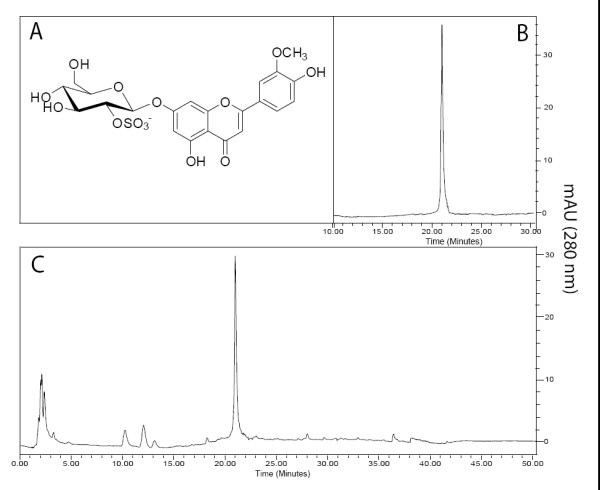
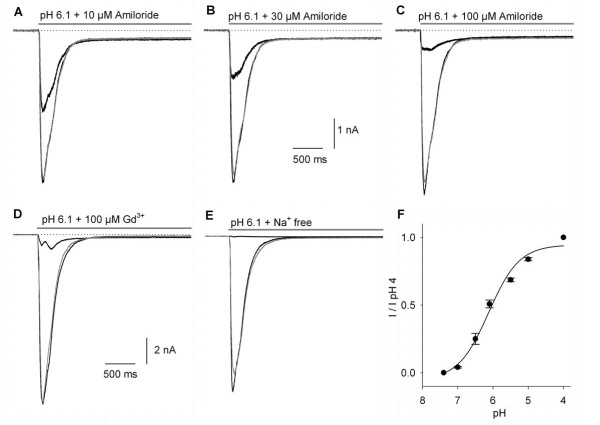
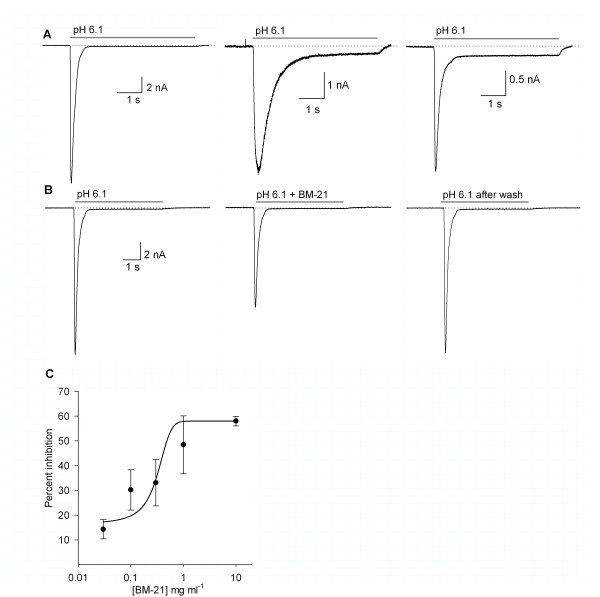
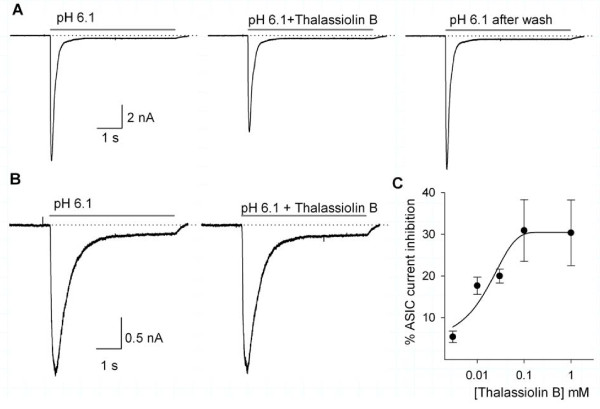
Acid-sensing ion channels (ASICs) have a significant role in the sensation of pain and constitute an important target for the search of new antinociceptive drugs. In this work we studied the antinociceptive properties of the BM-21 extract, obtained from the sea grass Thalassia testudinum, in chemical and thermal models of nociception in mice. The action of the BM-21 extract and the major phenolic component isolated from this extract, a sulphated flavone glycoside named thalassiolin B, was studied in the chemical nociception test and in the ASIC currents of the dorsal root ganglion (DRG) neurons obtained from Wistar rats.
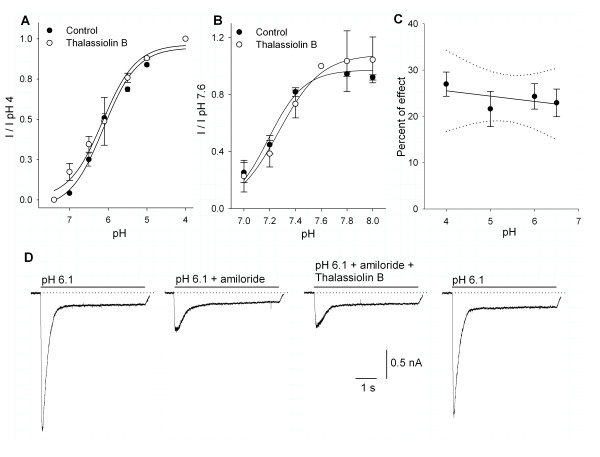
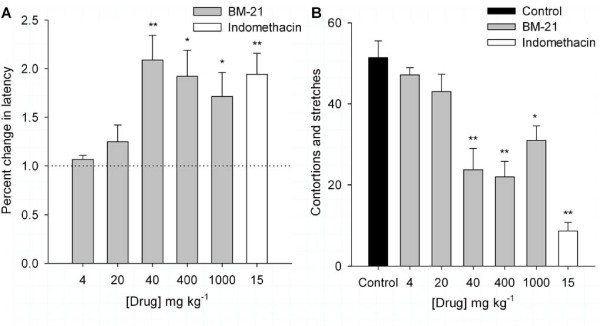
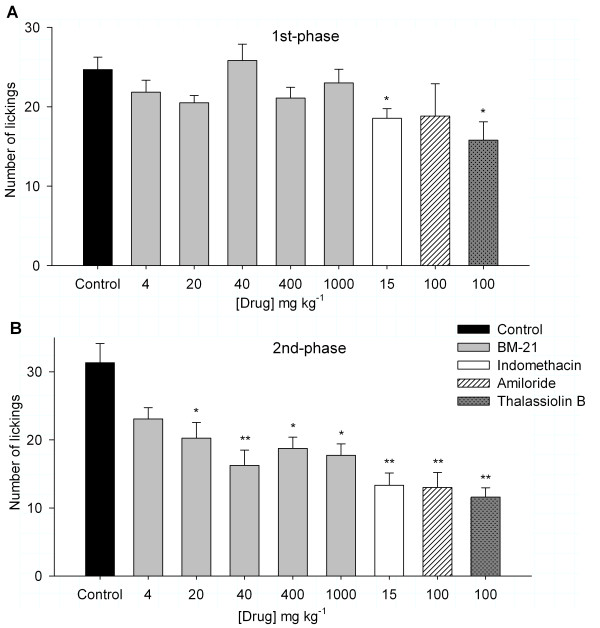
Behavioral antinociceptive experiments were made on male OF-1 mice. Single oral administration of BM-21 produced a significant inhibition of chemical nociception caused by acetic acid and formalin (specifically during its second phase), and increased the reaction time in the hot plate test. Thalassiolin B reduced the licking behavior during both the phasic and tonic phases in the formalin test. It was also found that BM-21 and thalassiolin B selectively inhibited the fast desensitizing (τ < 400 ms) ASIC currents in DRG neurons obtained from Wistar rats, with a nonsignificant action on ASIC currents with a slow desensitizing time-course. The action of thalassiolin B shows no pH or voltage dependence nor is it modified by steady-state ASIC desensitization or voltage. The high concentration of thalassiolin B in the extract may account for the antinociceptive action of BM-21.
To our knowledge, this is the first report of an ASIC-current inhibitor derived of a marine-plant extract, and in a phenolic compound. The antinociceptive effects of BM-21 and thalassiolin B may be partially because of this action on the ASICs. That the active components of the extract are able to cross the blood-brain barrier gives them an additional advantage for future uses as tools to study pain mechanisms with a potential therapeutic application.
酸敏离子通道(ASICs)在疼痛感觉中起重要作用,是寻找新型抗伤害药物的重要靶点。本工作研究了从海草马尾藻(Thalassia testudinum)中提取的 BM-21 提取物在化学和热伤害感受模型中的抗伤害作用。在化学伤害感受试验和从 Wistar 大鼠背根神经节(DRG)神经元分离得到的 ASIC 电流中,研究了 BM-21 提取物及其主要酚类成分,一种硫酸化黄酮糖苷命名为马尾藻苷 B 的作用。
在雄性 OF-1 小鼠上进行行为学抗伤害实验。单次口服 BM-21 可显著抑制醋酸和福尔马林引起的化学伤害感受(特别是在第二阶段),并延长热板试验中的反应时间。马尾藻苷 B 可减少福尔马林试验中时相和持续相的舔舐行为。还发现,BM-21 和马尾藻苷 B 选择性抑制 Wistar 大鼠 DRG 神经元中快速脱敏(τ<400 ms)的 ASIC 电流,对具有缓慢脱敏时间过程的 ASIC 电流无明显作用。马尾藻苷 B 的作用无 pH 或电压依赖性,也不受 ASIC 稳态脱敏或电压影响。提取物中马尾藻苷 B 的高浓度可能解释了 BM-21 的抗伤害作用。
据我们所知,这是首次报道海洋植物提取物中的 ASIC 电流抑制剂,也是首次报道酚类化合物具有这种作用。BM-21 和马尾藻苷 B 的抗伤害作用可能部分是由于这种对 ASIC 的作用。提取物的有效成分能够穿过血脑屏障,为将来作为研究疼痛机制的工具提供了额外的优势,具有潜在的治疗应用。