Department of Chemistry and Chemical Biology, Harvard University, Cambridge, Massachusetts, United States of America.
PLoS One. 2011 Jan 10;6(1):e15945. doi: 10.1371/journal.pone.0015945.
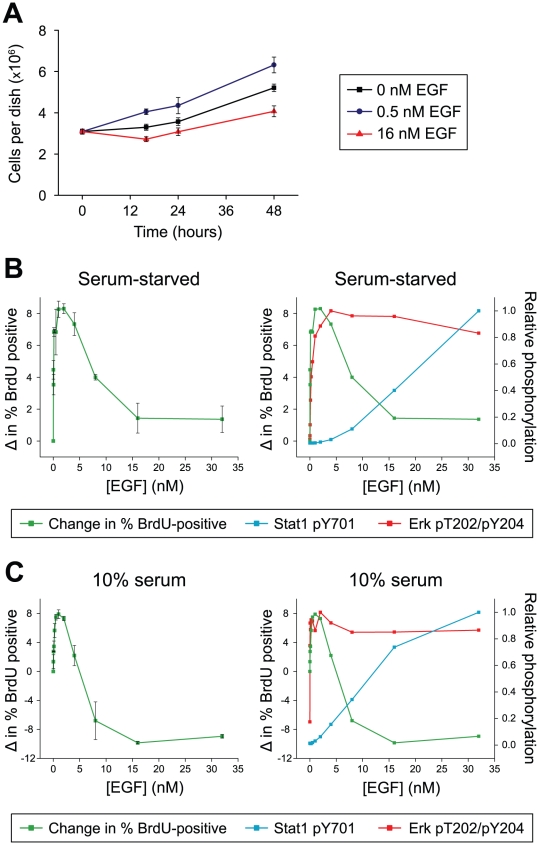
Signaling mediated by the Epidermal Growth Factor Receptor (EGFR) is crucial in normal development, and aberrant EGFR signaling has been implicated in a wide variety of cancers. Here we find that the high- and low-affinity interactions between EGFR and its ligands activate different signaling pathways. While high-affinity ligand binding is sufficient for activation of most canonical signaling pathways, low-affinity binding is required for the activation of the Signal transducers and activators of transcription (Stats) and Phospholipase C-gamma 1 (PLCγ1). As the Stat proteins are involved in many cellular responses including proliferation, migration and apoptosis, these results assign a function to low-affinity interactions that has been omitted from computational models of EGFR signaling. The existence of receptors with distinct signaling properties provides a way for EGFR to respond to different concentrations of the same ligand in qualitatively different ways.
表皮生长因子受体(EGFR)介导的信号转导对于正常发育至关重要,异常的 EGFR 信号转导与多种癌症有关。在这里,我们发现 EGFR 与其配体之间的高亲和性和低亲和性相互作用激活了不同的信号通路。虽然高亲和性配体结合足以激活大多数经典的信号通路,但低亲和性结合对于信号转导和转录激活物(Stats)和磷酸脂酶 C-γ1(PLCγ1)的激活是必需的。由于 Stat 蛋白参与许多细胞反应,包括增殖、迁移和凋亡,这些结果为低亲和性相互作用赋予了一个功能,而这个功能在 EGFR 信号转导的计算模型中被忽略了。具有不同信号特性的受体的存在为 EGFR 提供了一种方法,可以以不同的方式对同一配体的不同浓度做出反应。