Department of Medicine, Division Nephrology, University of California San Francisco, 521 Parnassus Avenue, San Francisco, CA 94143-0532, USA.
BMC Nephrol. 2011 Jan 26;12:3. doi: 10.1186/1471-2369-12-3.
Defined as estimated glomerular filtration rate (eGFR) < 60 ml/min/1.73 m2, chronic kidney disease (CKD) is strongly and independently associated with cardiovascular and overall mortality. We hypothesized that reduced kidney function would be characterized by abnormalities of hemostasis.
We tested cross-sectional associations between (eGFR) and multiple hemostatic markers among 6751 participants representing a broad spectrum of kidney function in the Multi-Ethnic Study of Atherosclerosis (MESA). Kidney function was measured using cystatin C (eGFRcys) or creatinine, using CKD Epidemiology Collaboration (eGFRcr). Hemostatic markers included soluble thrombomodulin (sTM), soluble tissue factor (sTF), D-Dimer, von Willebrand factor (vWF), factor VIII, plasmin-antiplasmin complex (PAP), tissue factor pathway inhibitor (TFPI), plasminogen activator inhibitor-1 (PAI-1), and fibrinogen. Associations were tested using multivariable linear regression with adjustment for demographics and comorbidities.
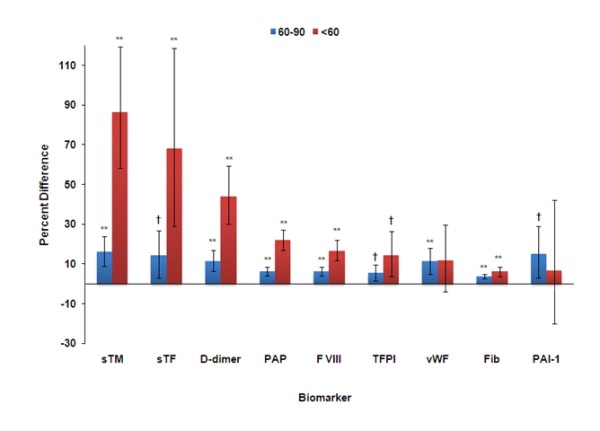
In comparison to persons with eGFRcys >90 ml/min/1.73 m2, subjects with eGFRcys < 60 ml/min/1.73 m2 had adjusted levels of sTM, sTF, D-Dimer, PAP, Factor VIII, TFPI, vWF and fibrinogen that were respectively 86%, 68%, 44%, 22%, 17%, 15%, 12% and 6% higher. Subjects with eGFRcys 60-90 ml/min/1.73 m2 had adjusted levels that were respectively 16%, 14%, 12%, 6%, 6%, 6%, 11% and 4% higher (p < 0.05 for all). Percent differences were not significantly different when groups were categorized by eGFRcr.
Throughout a broad spectrum of kidney function, lower eGFR was associated with higher levels of hemostatic markers. Dysregulation of hemostasis may be a mechanism by which reduced kidney function promotes higher cardiovascular risk.
定义为估计肾小球滤过率(eGFR)<60 ml/min/1.73 m2,慢性肾脏病(CKD)与心血管和总体死亡率呈强独立相关。我们假设肾功能降低的特征将是止血异常。
我们在多民族动脉粥样硬化研究(MESA)中代表广泛肾功能范围的 6751 名参与者中测试了(eGFR)与多种止血标志物之间的横断面关联。使用胱抑素 C(eGFRcys)或肌酐测量肾功能,使用 CKD 流行病学合作组(eGFRcr)。止血标志物包括可溶性血栓调节蛋白(sTM)、可溶性组织因子(sTF)、D-二聚体、血管性血友病因子(vWF)、VIII 因子、纤溶酶-抗纤溶酶复合物(PAP)、组织因子途径抑制剂(TFPI)、纤溶酶原激活物抑制剂-1(PAI-1)和纤维蛋白原。使用多变量线性回归进行关联测试,并进行了调整以适应人口统计学和合并症。
与 eGFRcys>90 ml/min/1.73 m2 的人相比,eGFRcys<60 ml/min/1.73 m2 的受试者的 sTM、sTF、D-二聚体、PAP、VIII 因子、TFPI、vWF 和纤维蛋白原水平分别高 86%、68%、44%、22%、17%、15%、12%和 6%。eGFRcys 60-90 ml/min/1.73 m2 的受试者的调整水平分别高 16%、14%、12%、6%、6%、6%、11%和 4%(所有 p<0.05)。当按 eGFRcr 对组进行分类时,百分比差异无显著差异。
在广泛的肾功能范围内,较低的 eGFR 与较高的止血标志物水平相关。止血的失调可能是肾功能降低促进更高心血管风险的机制之一。