University of California, San Diego, San Diego, California, USA.
Diabetes Care. 2011 Feb;34(2):262-7. doi: 10.2337/dc10-1732.
To assess the effectiveness of structured blood glucose testing in poorly controlled, noninsulin-treated type 2 diabetes.
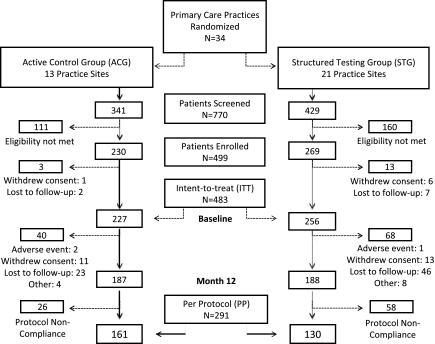
This 12-month, prospective, cluster-randomized, multicenter study recruited 483 poorly controlled (A1C ≥ 7.5%), insulin-naïve type 2 diabetic subjects from 34 primary care practices in the U.S. Practices were randomized to an active control group (ACG) with enhanced usual care or a structured testing group (STG) with enhanced usual care and at least quarterly use of structured self-monitoring of blood glucose (SMBG). STG patients and physicians were trained to use a paper tool to collect/interpret 7-point glucose profiles over 3 consecutive days. The primary end point was A1C level measured at 12 months.
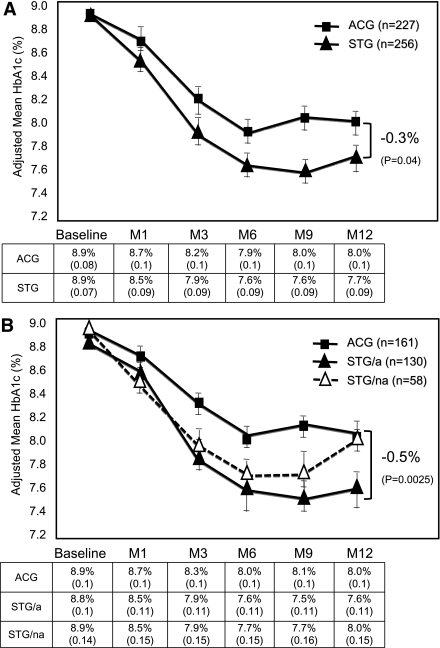
The 12-month intent-to-treat analysis (ACG, n = 227; STG, n = 256) showed significantly greater reductions in mean (SE) A1C in the STG compared with the ACG: -1.2% (0.09) vs. -0.9% (0.10); Δ = -0.3%; P = 0.04. Per protocol analysis (ACG, n = 161; STG, n = 130) showed even greater mean (SE) A1C reductions in the STG compared with the ACG: -1.3% (0.11) vs. -0.8% (0.11); Δ = -0.5%; P < 0.003. Significantly more STG patients received a treatment change recommendation at the month 1 visit compared with ACG patients, regardless of the patient's initial baseline A1C level: 179 (75.5%) vs. 61 (28.0%); <0.0001. Both STG and ACG patients displayed significant (P < 0.0001) improvements in general well-being (GWB).
Appropriate use of structured SMBG significantly improves glycemic control and facilitates more timely/aggressive treatment changes in noninsulin-treated type 2 diabetes without decreasing GWB.
评估强化血糖监测对未经胰岛素治疗的 2 型糖尿病血糖控制不佳患者的疗效。
这是一项为期 12 个月的前瞻性、聚类随机、多中心研究,在美国 34 家初级保健机构共招募了 483 例血糖控制不佳(A1C≥7.5%)、未使用胰岛素的 2 型糖尿病患者。这些患者按 1:1 随机分为强化常规治疗的主动对照组(ACG)或强化常规治疗联合至少每季度使用 7 点血糖自我监测的结构化血糖监测组(STG)。STG 患者及其医生接受了使用纸质工具收集/解读连续 3 天 7 点血糖谱的培训。主要终点是治疗 12 个月后的 A1C 水平。
12 个月意向治疗分析(ACG,n=227;STG,n=256)显示,STG 组的平均(SE)A1C 较 ACG 组显著降低:-1.2%(0.09)vs.-0.9%(0.10);Δ=-0.3%;P=0.04。基于方案的分析(ACG,n=161;STG,n=130)显示,STG 组的平均(SE)A1C 较 ACG 组降幅更大:-1.3%(0.11)vs.-0.8%(0.11);Δ=-0.5%;P<0.003。无论患者的初始 A1C 基线水平如何,STG 组在第 1 个月就诊时获得治疗改变建议的患者比例均显著高于 ACG 组:179(75.5%)vs.61(28.0%);<0.0001。STG 和 ACG 组患者的总体健康状况(GWB)均显著改善(P<0.0001)。
适当使用结构化自我血糖监测可显著改善未经胰岛素治疗的 2 型糖尿病患者的血糖控制,并促进更及时/更积极的治疗改变,而不会降低 GWB。