Key Laboratory of Nutrition and Metabolism, Institute for Nutritional Sciences, Shanghai Institute for Biological Sciences, Chinese Academy of Sciences, the Graduate School of the Chinese Academy of Sciences, Shanghai, China.
Diabetes. 2011 Mar;60(3):746-56. doi: 10.2337/db10-1246. Epub 2011 Jan 31.
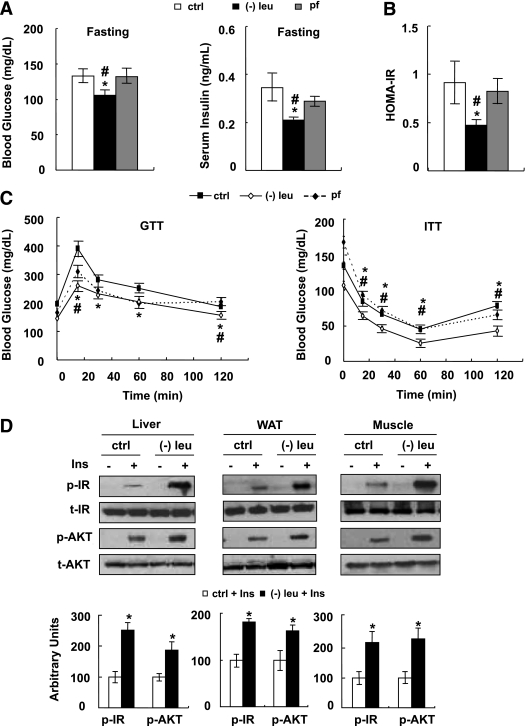
We have previously shown that serum insulin levels decrease threefold and blood glucose levels remain normal in mice fed a leucine-deficient diet, suggesting increased insulin sensitivity. The goal of the current study is to investigate this possibility and elucidate the underlying cellular mechanisms.
Changes in metabolic parameters and expression of genes and proteins involved in regulation of insulin sensitivity were analyzed in mice, human HepG2 cells, and mouse primary hepatocytes under leucine deprivation.
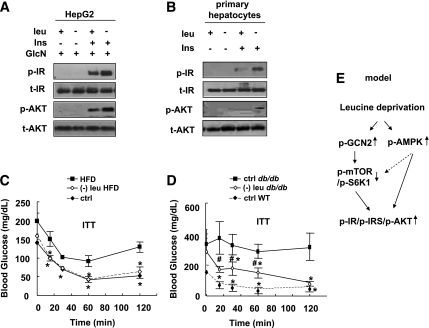
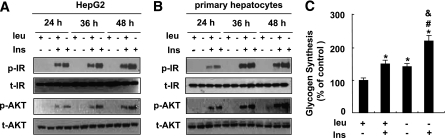
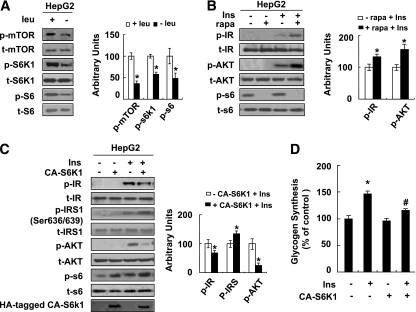
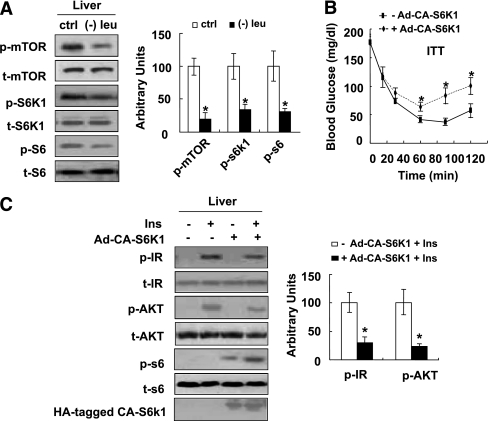
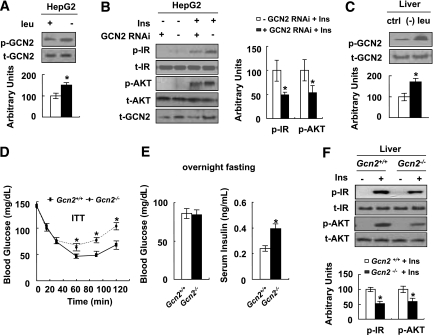
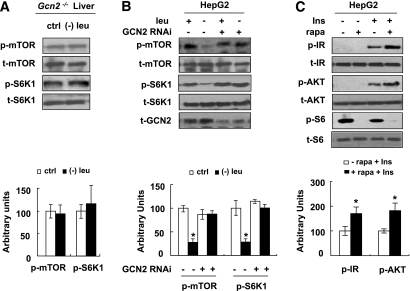
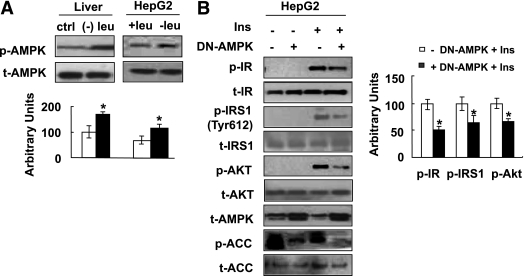
We show that leucine deprivation improves hepatic insulin sensitivity by sequentially activating general control nonderepressible (GCN)2 and decreasing mammalian target of rapamycin/S6K1 signaling. In addition, we show that activation of AMP-activated protein kinase also contributes to leucine deprivation-increased hepatic insulin sensitivity. Finally, we show that leucine deprivation improves insulin sensitivity under insulin-resistant conditions.
This study describes mechanisms underlying increased hepatic insulin sensitivity under leucine deprivation. Furthermore, we demonstrate a novel function for GCN2 in the regulation of insulin sensitivity. These observations provide a rationale for short-term dietary restriction of leucine for the treatment of insulin resistance and associated metabolic diseases.
我们之前的研究表明,喂食缺乏亮氨酸的饮食会使小鼠的血清胰岛素水平降低三倍,而血糖水平保持正常,这表明胰岛素敏感性增加。本研究的目的是探讨这种可能性,并阐明潜在的细胞机制。
在缺乏亮氨酸的情况下,分析了小鼠、人 HepG2 细胞和小鼠原代肝细胞中代谢参数以及参与胰岛素敏感性调节的基因和蛋白的表达变化。
我们表明,亮氨酸缺乏通过依次激活一般控制非抑制性(GCN)2 和降低哺乳动物雷帕霉素靶蛋白/S6K1 信号来改善肝脏胰岛素敏感性。此外,我们表明,AMP 激活蛋白激酶的激活也有助于亮氨酸缺乏引起的肝胰岛素敏感性增加。最后,我们表明亮氨酸缺乏在胰岛素抵抗条件下改善胰岛素敏感性。
本研究描述了亮氨酸缺乏时肝脏胰岛素敏感性增加的机制。此外,我们证明了 GCN2 在调节胰岛素敏感性方面具有新的功能。这些观察结果为短期限制亮氨酸饮食治疗胰岛素抵抗和相关代谢疾病提供了依据。