Institut Pasteur, Hépacivirus et Immunité Innée, CNRS URA 3015, Paris, France.
PLoS One. 2011 Jan 6;6(1):e15871. doi: 10.1371/journal.pone.0015871.
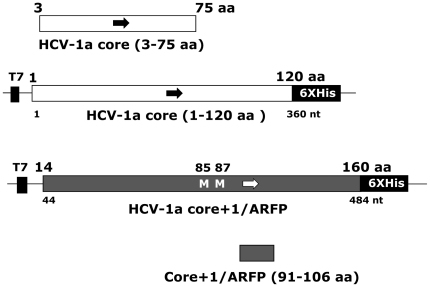
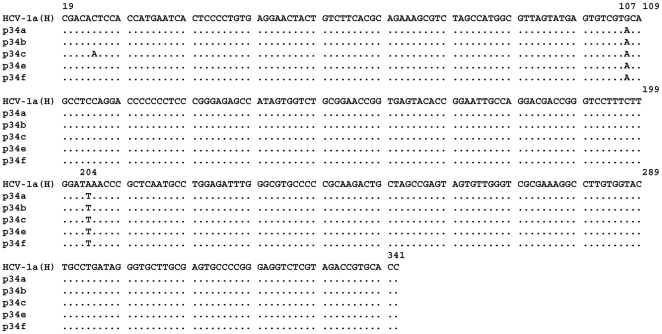
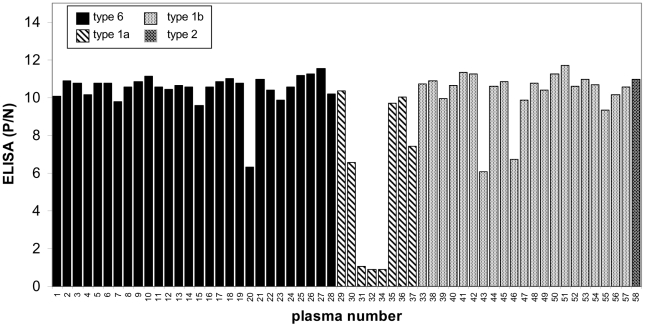
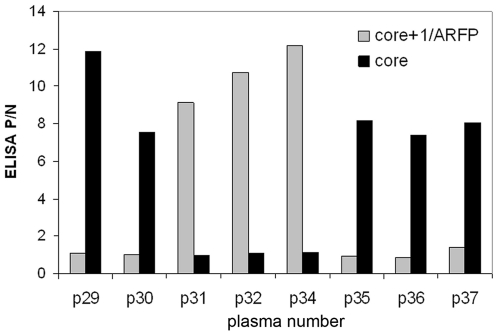
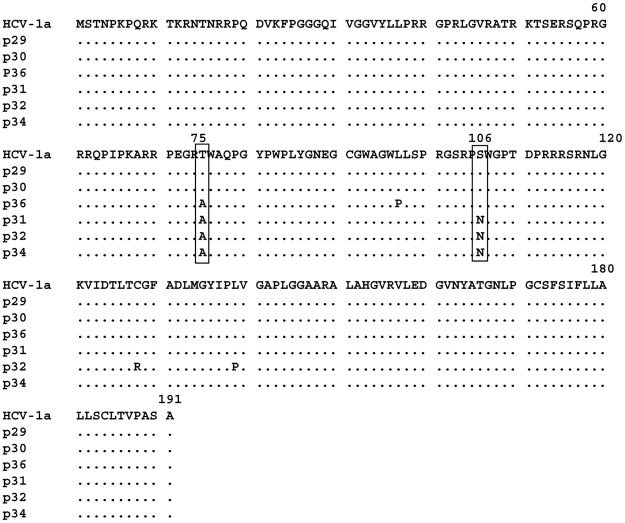
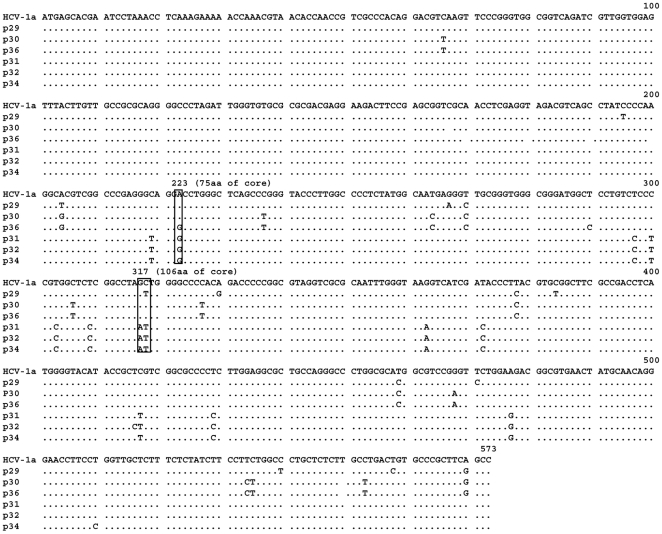
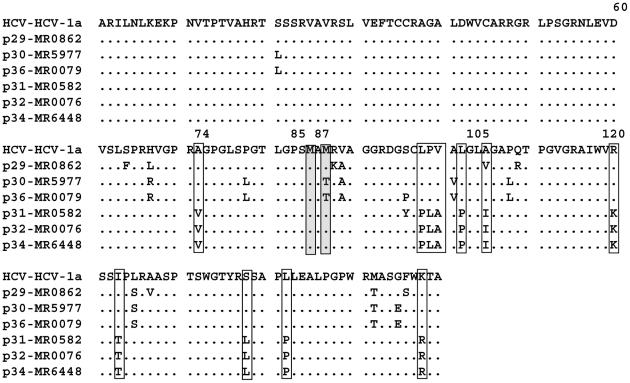
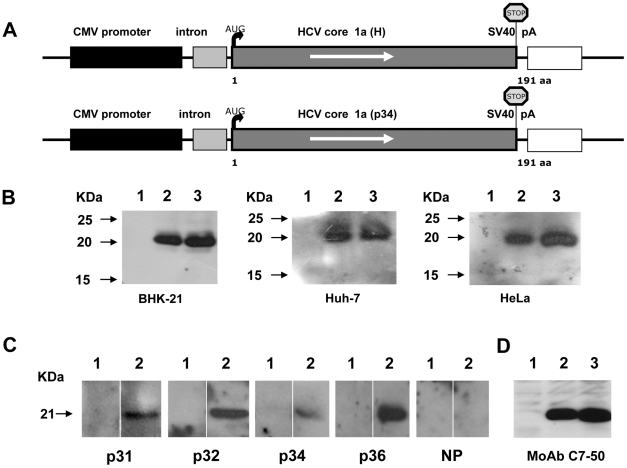
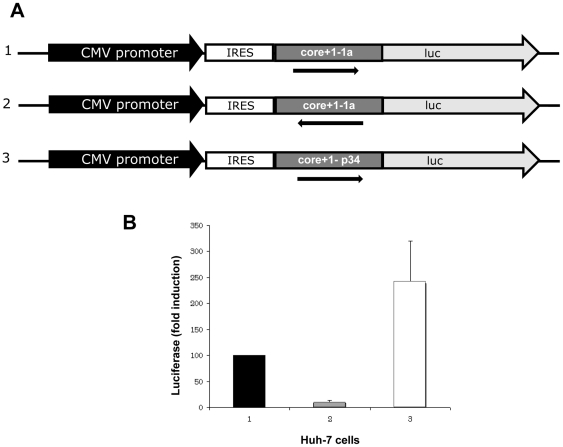
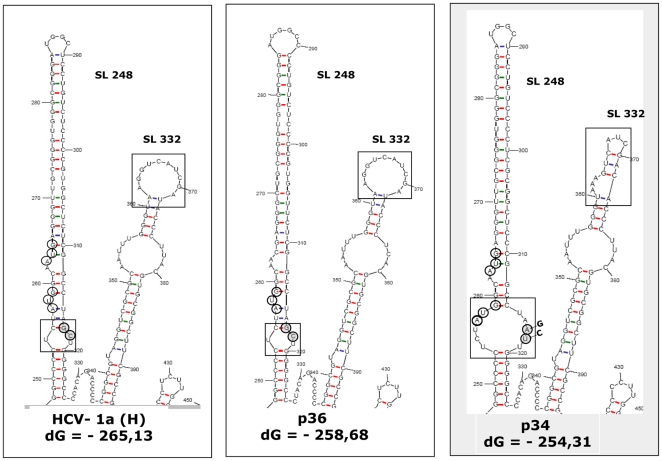
The biological role of the protein encoded by the alternative open reading frame (core+1/ARF) of the Hepatitis C virus (HCV) genome remains elusive, as does the significance of the production of corresponding antibodies in HCV infection. We investigated the prevalence of anti-core and anti-core+1/ARFP antibodies in HCV-positive blood donors from Cambodia, using peptide and recombinant protein-based ELISAs. We detected unusual serological profiles in 3 out of 58 HCV positive plasma of genotype 1a. These patients were negative for anti-core antibodies by commercial and peptide-based assays using C-terminal fragments of core but reacted by Western Blot with full-length core protein. All three patients had high levels of anti-core+1/ARFP antibodies. Cloning of the cDNA that corresponds to the core-coding region from these sera resulted in the expression of both core and core+1/ARFP in mammalian cells. The core protein exhibited high amino-acid homology with a consensus HCV1a sequence. However, 10 identical synonymous mutations were found, and 7 were located in the aa(99-124) region of core. All mutations concerned the third base of a codon, and 5/10 represented a T>C mutation. Prediction analyses of the RNA secondary structure revealed conformational changes within the stem-loop region that contains the core+1/ARFP internal AUG initiator at position 85/87. Using the luciferase tagging approach, we showed that core+1/ARFP expression is more efficient from such a sequence than from the prototype HCV1a RNA. We provide additional evidence of the existence of core+1/ARFP in vivo and new data concerning expression of HCV core protein. We show that HCV patients who do not produce normal anti-core antibodies have unusually high levels of anti-core+1/ARFP and harbour several identical synonymous mutations in the core and core+1/ARFP coding region that result in major changes in predicted RNA structure. Such HCV variants may favour core+1/ARFP production during HCV infection.
丙型肝炎病毒(HCV)基因组中替代开放阅读框(核心+1/ARF)编码的蛋白质的生物学作用仍然难以捉摸,HCV 感染中相应抗体产生的意义也是如此。我们使用基于肽和重组蛋白的 ELISA 法,研究了柬埔寨 HCV 阳性献血者中抗核心和抗核心+1/ARF 抗体的流行情况。我们在 58 例 HCV 阳性血浆中发现了 3 例 1a 基因型的异常血清学特征。这些患者使用基于 C 端核心片段的商业和肽基检测试剂盒检测抗核心抗体呈阴性,但通过 Western Blot 与全长核心蛋白反应。所有三名患者的抗核心+1/ARF 抗体水平均较高。从这些血清中克隆与核心编码区相对应的 cDNA,导致哺乳动物细胞中表达核心和核心+1/ARF。核心蛋白与 HCV1a 共识序列具有高度的氨基酸同源性。然而,发现了 10 个相同的同义突变,其中 7 个位于核心的 aa(99-124)区域。所有突变都涉及一个密码子的第三个碱基,其中 5/10 为 T>C 突变。RNA 二级结构的预测分析显示,包含核心+1/ARF 内部 AUG 起始子的茎环区域内发生了构象变化。我们使用荧光素酶标记方法表明,从这种序列表达核心+1/ARF 比从原型 HCV1a RNA 表达更有效。我们提供了核心+1/ARF 在体内存在的额外证据,并提供了有关 HCV 核心蛋白表达的新数据。我们表明,不产生正常抗核心抗体的 HCV 患者具有异常高的抗核心+1/ARF 水平,并在核心和核心+1/ARF 编码区存在几个相同的同义突变,导致预测 RNA 结构发生重大变化。这种 HCV 变体可能在 HCV 感染期间有利于核心+1/ARF 的产生。