Jiang Yong-Xiang, Lu Yi, Liu Tian-Jing, Yang Jin, Chen Yan, Fang Yan-Wen
Department of Ophthalmology, Eye and ENT Hospital, Fudan University, 83 Fenyang Road, Shanghai, China.
Mol Vis. 2011 Jan 27;17:291-9.
To establish a novel, targeted lentivirus-based HSV-tk (herpes simplex virus thymidine kinase)/GCV (ganciclovir) gene therapy system to inhibit lens epithelial cell proliferation for treatment of posterior capsular opacification (PCO) after cataract surgery.
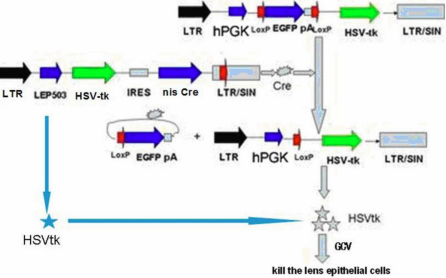
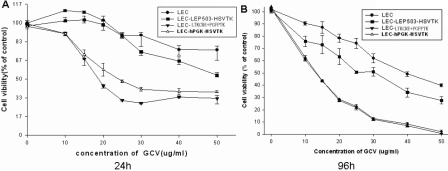
An enhanced Cre recombinase (Cre/loxP) system with a lentiviral vector expressing Cre under the control of the lens-specific promoter LEP503 (Lenti-LEP503-HSVtk-Cre [LTKCRE]) was constructed, as well as another lentiviral vector containing a switching unit. The latter vector contains a stuffer sequence encoding EGFP (Lenti-hPGK-Loxp-EGFP-pA-Loxp-HSVtk [PGFPTK]) with a functional polyadenylation signal between two loxP sites, followed by the herpes simplex virus thymidine kinase (HSV-tk) gene, both under the control of the human phosphoglycerate kinase (hPGK) promoter. Expression of the downstream gene (HSV-tk) is activated by co-expression of Cre. Human lens epithelial cells (HLECs) or retinal pigmental epithelial cells (RPECs) were co-infected with LTKCRE and PGFPTK. The inhibitory effects on HLECs and RPECs infected by the enhanced specific lentiviral vector combination at the concentration of 20 µg/ml GCV were assayed and compared.
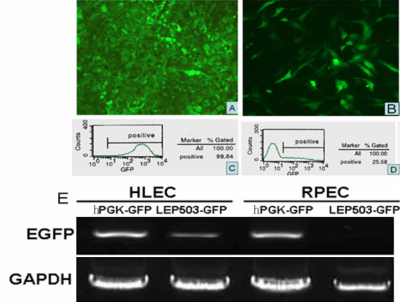
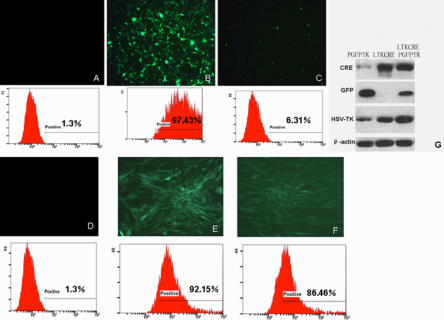
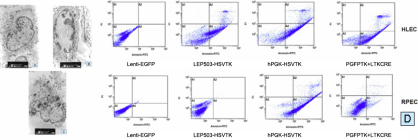
The specific gene expression of Cre and HSV-tk in HLECs is activated by the LEP503 promoter. LTKCRE and PGFPTK co-infected HLECs, but not RPECs, expressed high levels of the HSV-tk protein. After 96 h of GCV treatment, the percentage of apoptotic HLECs infected by the enhanced specific lentiviral vector combination was 87.23%, whereas that of apoptotic RPECs was only 10.12%. Electron microscopy showed that GCV induced apoptosis and necrosis of the infected HLECs.
The enhanced specific lentiviral vector combination selectively and effectively expressed HSV-tk in HLECs. A concentration of 20 µg/ml, GCV is effective against the proliferation of HLECs in vitro. This cell-type-specific gene therapy using a Cre/loxP lentivirus system may be a feasible treatment strategy to prevent PCO.
建立一种新型的、基于靶向慢病毒的单纯疱疹病毒胸苷激酶(HSV-tk)/更昔洛韦(GCV)基因治疗系统,以抑制晶状体上皮细胞增殖,用于治疗白内障手术后的后囊膜混浊(PCO)。
构建一种增强型Cre重组酶(Cre/loxP)系统,其慢病毒载体在晶状体特异性启动子LEP503的控制下表达Cre(Lenti-LEP503-HSVtk-Cre [LTKCRE]),以及另一种含有切换单元的慢病毒载体。后一种载体包含一个编码EGFP的填充序列(Lenti-hPGK-Loxp-EGFP-pA-Loxp-HSVtk [PGFPTK]),在两个loxP位点之间有一个功能性聚腺苷酸化信号,随后是单纯疱疹病毒胸苷激酶(HSV-tk)基因,两者均在人磷酸甘油酸激酶(hPGK)启动子的控制下。下游基因(HSV-tk)的表达通过Cre的共表达来激活。将人晶状体上皮细胞(HLECs)或视网膜色素上皮细胞(RPECs)与LTKCRE和PGFPTK共感染。测定并比较在20 μg/ml GCV浓度下,增强型特异性慢病毒载体组合对感染的HLECs和RPECs的抑制作用。
LEP503启动子激活了HLECs中Cre和HSV-tk的特异性基因表达。LTKCRE和PGFPTK共感染的HLECs,而非RPECs,表达高水平的HSV-tk蛋白。在GCV处理96小时后,增强型特异性慢病毒载体组合感染的凋亡HLECs百分比为87.23%,而凋亡RPECs的百分比仅为10.12%。电子显微镜显示GCV诱导了感染的HLECs凋亡和坏死。
增强型特异性慢病毒载体组合在HLECs中选择性且有效地表达HSV-tk。20 μg/ml的GCV浓度在体外对HLECs的增殖有效。这种使用Cre/loxP慢病毒系统的细胞类型特异性基因治疗可能是预防PCO的一种可行治疗策略。