Kaji Yuichi, Kiuchi Takahiro, Oshika Tetsuro
Department of Ophthalmology, University of Tsukuba Institute of Clinical Medicine, Tennoudai 1-1-1, Tsukuba, Ibaraki 305-8575, Japan.
Open Ophthalmol J. 2010 Oct 12;4:60-5. doi: 10.2174/1874364101004010060.
Anti-oxidant activities of adrenergic β-blockers are proposed in various organs. The aim of the present study was to investigate the effect of carteolol hydrochloride, an adrenergic β-blocker, on the production of reactive oxygen species (ROS) and the viable cell number after ultraviolet irradiation of cultured lens epithelial cells (LECs).
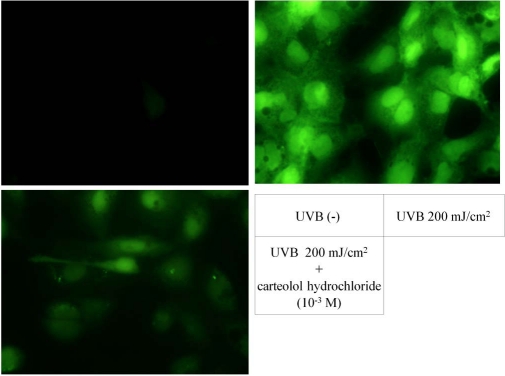
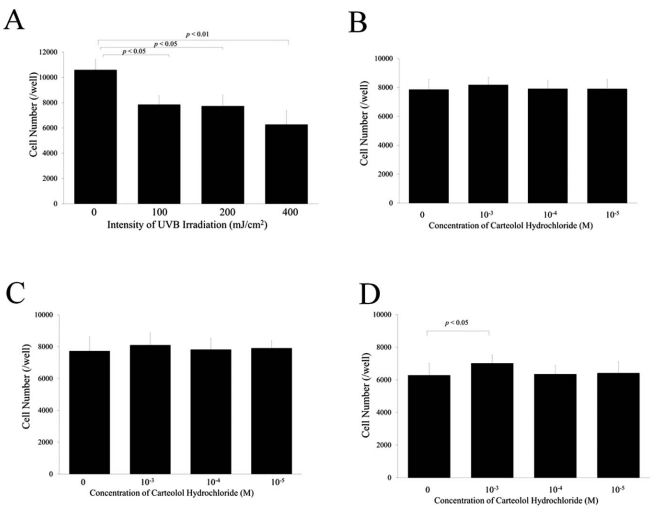
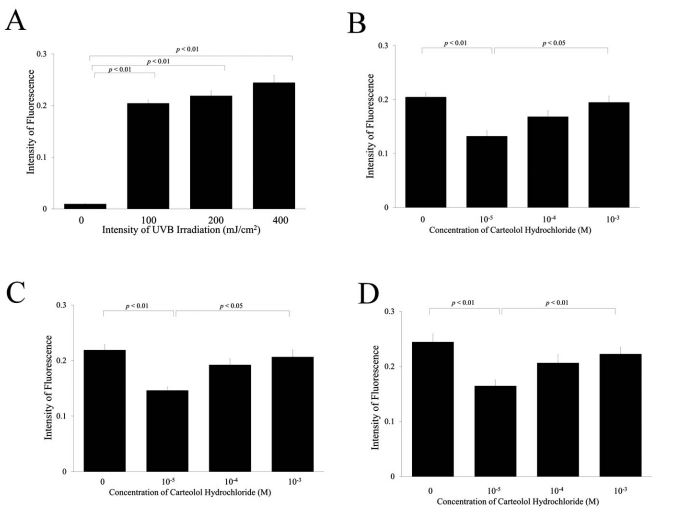
Cultured LECs were exposed to 0, 10(-5), 10(-4), and 10(-3) M carteolol hydrochloride for 30 min followed by ultraviolet B (UVB) irradiation at intensity of 100, 200, or 400 mJ/cm(2). The amount of ROS in the LECs was measured using dichlorodihydrofluorescein at 30 min after exposure to UVB. In addition, the number of living LECs was counted at 15 h after exposure to UVB.
Exposure to 10(-3) M carteolol hydrochloride significantly decreased the amount of ROS after exposure to UVB at intensities of 100, 200, and 400 mJ/cm(2). In addition, 10(-3) M carteolol hydrochloride significantly increased the viable cell number after exposure to UVB at 400 mJ/cm(2). However, 10(-4) and 10(-5)M carteolol hydrochloride had no significant effect on ROS or the viable cell number in LECs.
Carteolol hydrochloride protects LECs against UVB irradiation by inhibiting the intracellular production of ROS.
肾上腺素能β受体阻滞剂在多个器官中具有抗氧化活性。本研究旨在探讨肾上腺素能β受体阻滞剂盐酸卡替洛尔对培养的晶状体上皮细胞(LECs)紫外线照射后活性氧(ROS)生成及活细胞数量的影响。
将培养的LECs分别用0、10⁻⁵、10⁻⁴和10⁻³ M盐酸卡替洛尔处理30分钟,随后分别以100、200或400 mJ/cm²的强度进行紫外线B(UVB)照射。在UVB照射后30分钟,使用二氯二氢荧光素测定LECs中的ROS含量。此外,在UVB照射后15小时,对活的LECs进行计数。
暴露于10⁻³ M盐酸卡替洛尔后,在100、200和400 mJ/cm²强度的UVB照射下,ROS含量显著降低。此外,在400 mJ/cm²的UVB照射后,10⁻³ M盐酸卡替洛尔显著增加了活细胞数量。然而,10⁻⁴和10⁻⁵ M盐酸卡替洛尔对LECs中的ROS或活细胞数量没有显著影响。
盐酸卡替洛尔通过抑制细胞内ROS的产生来保护LECs免受UVB照射。