Division of Biology, University of Missouri, Columbia, Missouri, United States of America.
PLoS One. 2011 Jan 25;6(1):e16370. doi: 10.1371/journal.pone.0016370.
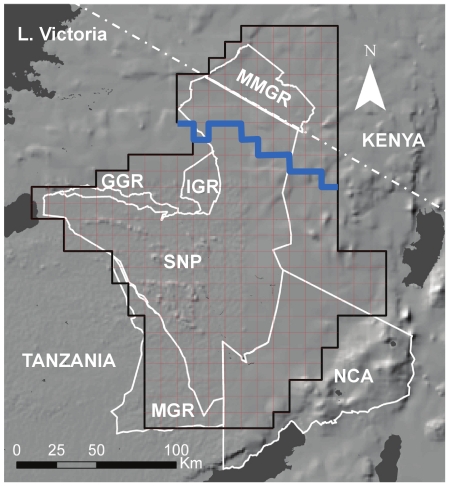
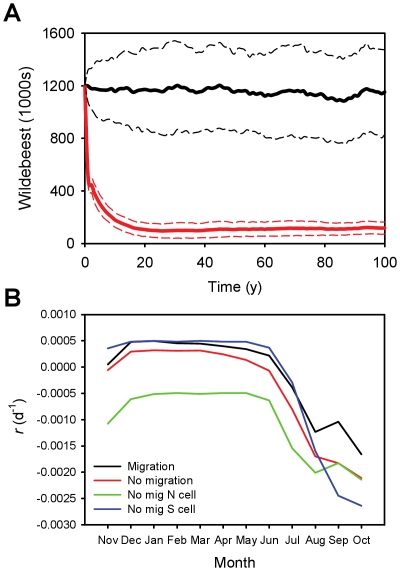
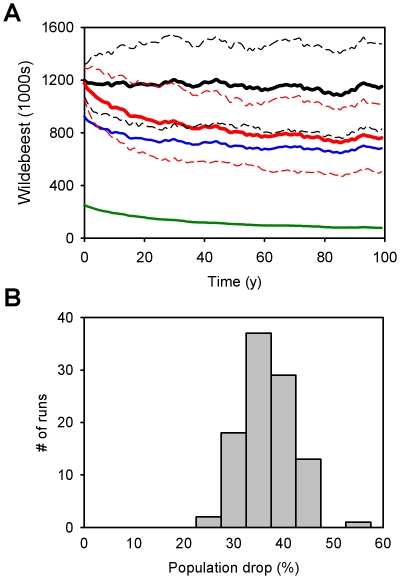
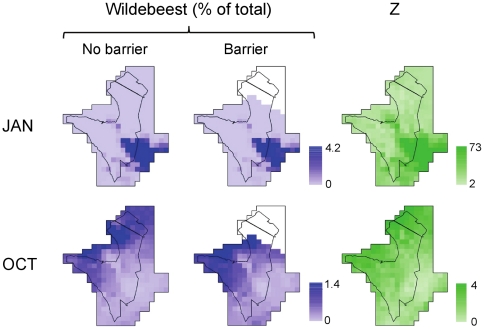
The Serengeti wildebeest migration is a rare and spectacular example of a once-common biological phenomenon. A proposed road project threatens to bisect the Serengeti ecosystem and its integrity. The precautionary principle dictates that we consider the possible consequences of a road completely disrupting the migration. We used an existing spatially-explicit simulation model of wildebeest movement and population dynamics to explore how placing a barrier to migration across the proposed route (thus creating two disjoint but mobile subpopulations) might affect the long-term size of the wildebeest population. Our simulation results suggest that a barrier to migration--even without causing habitat loss--could cause the wildebeest population to decline by about a third. The driver of this decline is the effect of habitat fragmentation (even without habitat loss) on the ability of wildebeest to effectively track temporal shifts in high-quality forage resources across the landscape. Given the important role of the wildebeest migration for a number of key ecological processes, these findings have potentially important ramifications for ecosystem biodiversity, structure, and function in the Serengeti.
塞伦盖蒂角马大迁徙是曾经很常见的生物现象中一个罕见而壮观的例子。一个拟议中的道路项目有可能将塞伦盖蒂生态系统一分为二,破坏其完整性。预防原则要求我们考虑道路完全阻断迁徙可能带来的后果。我们利用现有的角马运动和种群动态的空间明确模拟模型来探索在拟议路线上设置迁徙障碍(从而形成两个不连续但可移动的亚种群)可能对角马种群长期规模的影响。我们的模拟结果表明,迁徙障碍——即使没有导致栖息地丧失——也可能导致角马数量减少约三分之一。造成这种下降的原因是栖息地破碎化(即使没有栖息地丧失)对角马有效跟踪景观中高质量饲料资源的时间变化的能力的影响。鉴于角马大迁徙对许多关键生态过程的重要作用,这些发现可能对角马迁徙对塞伦盖蒂生态系统生物多样性、结构和功能具有重要影响。