Center for Infection and Immunity, Institute of Biophysics, Chinese Academy of Sciences, Beijing, People's Republic of China.
PLoS One. 2011 Jan 25;6(1):e16428. doi: 10.1371/journal.pone.0016428.
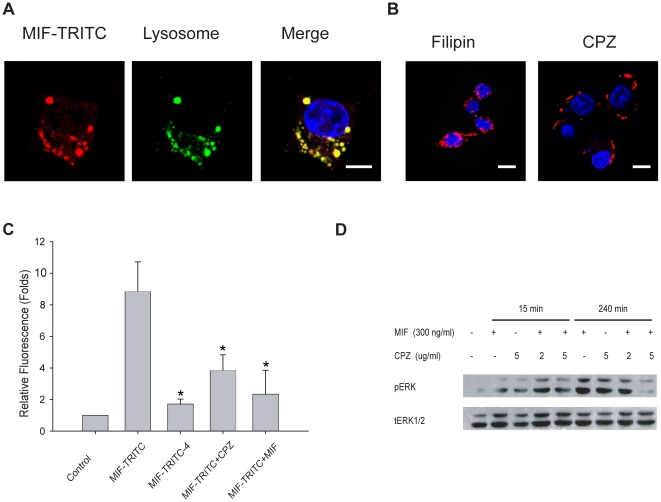
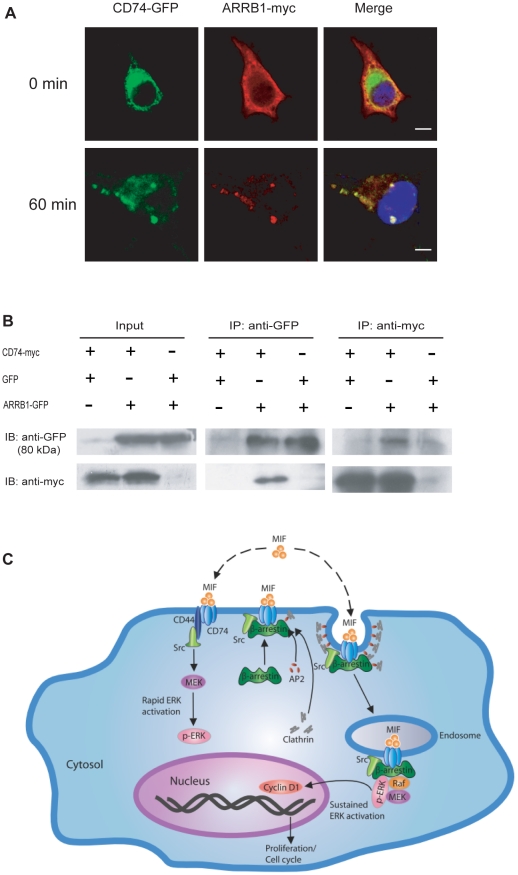
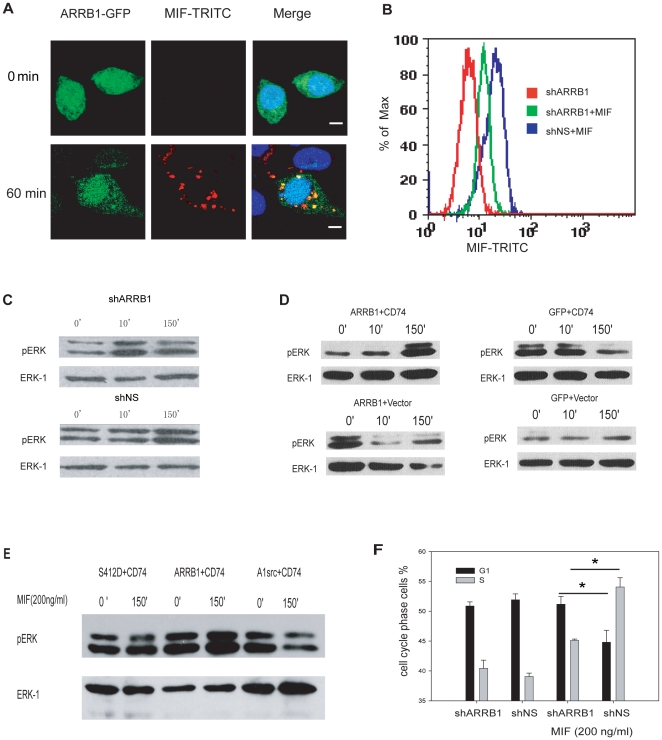
Macrophage migration inhibitory factor (MIF) is a pleiotropic cytokine, regulating inflammatory and immune responses. MIF binds to cell surface receptor CD74, resulting in both rapid and sustained ERK activation. It was reported that MIF-induced rapid ERK activation requires its co-receptor CD44. But the exact mechanism underlying sustained ERK activation is not well understood. In the current study, we described a detailed mechanism of MIF mediated sustained ERK activation. We found that β-arrestin1, a scaffold protein involved in the activation of the MAPK cascade, interacts with CD74 upon MIF stimulation, resulting in CD74-mediated MIF endocytosis in a chlorpromazine (CPZ)-sensitive manner. β-arrestin1 is also involved in endocytotic MIF signaling, leading to sustained ERK activation. Therefore β-arrestin1 plays a central role in coupling MIF endocytosis to sustained ERK activation.
巨噬细胞移动抑制因子(MIF)是一种多功能细胞因子,调节炎症和免疫反应。MIF 与细胞表面受体 CD74 结合,导致 ERK 的快速和持续激活。据报道,MIF 诱导的快速 ERK 激活需要其共受体 CD44。但是,持续 ERK 激活的确切机制尚不清楚。在本研究中,我们描述了 MIF 介导的持续 ERK 激活的详细机制。我们发现,β-arrestin1 是一种参与 MAPK 级联激活的支架蛋白,在 MIF 刺激下与 CD74 相互作用,导致以氯丙嗪(CPZ)敏感的方式进行 CD74 介导的 MIF 内吞作用。β-arrestin1 还参与内吞 MIF 信号转导,导致持续的 ERK 激活。因此,β-arrestin1 在将 MIF 内吞作用与持续的 ERK 激活偶联中起核心作用。