Division of Parasitic Diseases, Centers for Disease Control and Prevention, Atlanta, Georgia, United States of America.
PLoS Negl Trop Dis. 2011 Jan 25;5(1):e951. doi: 10.1371/journal.pntd.0000951.
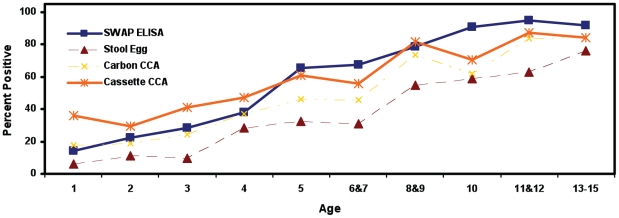
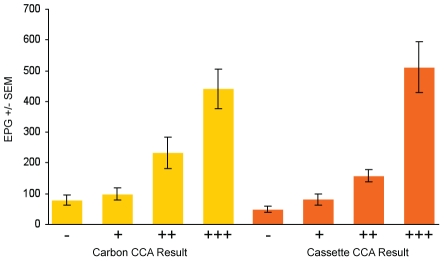
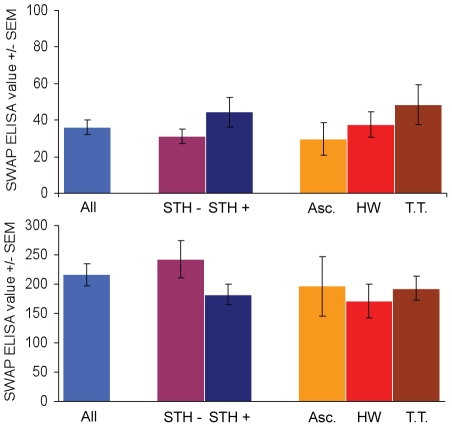
Although accurate assessment of the prevalence of Schistosoma mansoni is important for the design and evaluation of control programs, the most widely used tools for diagnosis are limited by suboptimal sensitivity, slow turn-around-time, or inability to distinguish current from former infections. Recently, two tests that detect circulating cathodic antigen (CCA) in urine of patients with schistosomiasis became commercially available. As part of a larger study on schistosomiasis prevalence in young children, we evaluated the performance and diagnostic accuracy of these tests--the carbon test strip designed for use in the laboratory and the cassette format test intended for field use. In comparison to 6 Kato-Katz exams, the carbon and cassette CCA tests had sensitivities of 88.4% and 94.2% and specificities of 70.9% and 59.4%, respectively. However, because of the known limitations of the Kato-Katz assay, we also utilized latent class analysis (LCA) incorporating the CCA, Kato-Katz, and schistosome-specific antibody results to determine their sensitivities and specificities. The laboratory-based CCA test had a sensitivity of 91.7% and a specificity of 89.4% by LCA while the cassette test had a sensitivity of 96.3% and a specificity of 74.7%. The intensity of the reaction in both urine CCA tests reflected stool egg burden and their performance was not affected by the presence of soil transmitted helminth infections. Our results suggest that urine-based assays for CCA may be valuable in screening for S. mansoni infections.
虽然准确评估曼氏血吸虫病的流行率对于设计和评估控制计划非常重要,但用于诊断的最广泛使用的工具受到敏感性不理想、周转时间慢或无法区分当前和既往感染的限制。最近,两种检测尿液中曼氏血吸虫病患者循环阴极抗原(CCA)的检测方法已在商业上可用。作为一项关于儿童期血吸虫病流行率的更大研究的一部分,我们评估了这些检测方法的性能和诊断准确性——设计用于实验室的碳测试条和用于现场使用的盒式格式测试。与 6 次加藤厚涂片检查相比,碳和盒式 CCA 检测的敏感性分别为 88.4%和 94.2%,特异性分别为 70.9%和 59.4%。然而,由于加藤厚涂片检查的已知局限性,我们还利用了包含 CCA、加藤厚涂片和血吸虫特异性抗体结果的潜在类别分析(LCA)来确定它们的敏感性和特异性。基于实验室的 CCA 检测的敏感性为 91.7%,特异性为 89.4%,而盒式检测的敏感性为 96.3%,特异性为 74.7%。两种尿液 CCA 检测的反应强度均反映了粪便虫卵负担,其性能不受土壤传播性蠕虫感染的影响。我们的结果表明,基于尿液的 CCA 检测可能对筛查曼氏血吸虫病感染具有重要价值。