• 文献检索
  • 文档翻译
  • 深度研究
  • 学术资讯
  • Suppr Zotero 插件Zotero 插件
  • 邀请有礼
  • 套餐&价格
  • 历史记录
应用&插件
Suppr Zotero 插件Zotero 插件浏览器插件Mac 客户端Windows 客户端微信小程序
定价
高级版会员购买积分包购买API积分包
服务
文献检索文档翻译深度研究API 文档MCP 服务
关于我们
关于 Suppr公司介绍联系我们用户协议隐私条款
关注我们

Suppr 超能文献

核心技术专利:CN118964589B侵权必究
粤ICP备2023148730 号-1Suppr @ 2026

文献检索

告别复杂PubMed语法,用中文像聊天一样搜索,搜遍4000万医学文献。AI智能推荐,让科研检索更轻松。

立即免费搜索

文件翻译

保留排版,准确专业,支持PDF/Word/PPT等文件格式,支持 12+语言互译。

免费翻译文档

深度研究

AI帮你快速写综述,25分钟生成高质量综述,智能提取关键信息,辅助科研写作。

立即免费体验

韩国一家三级医院 26 年新生儿败血症流行病学趋势分析:1980-2005 年的纵向研究。

Trends in epidemiology of neonatal sepsis in a tertiary center in Korea: a 26-year longitudinal analysis, 1980-2005.

机构信息

Department of Pediatrics, Inje University Sanggye Paik Hospital, Seoul, Korea.

出版信息

J Korean Med Sci. 2011 Feb;26(2):284-9. doi: 10.3346/jkms.2011.26.2.284. Epub 2011 Jan 24.

DOI:10.3346/jkms.2011.26.2.284
PMID:21286023
原文链接:https://pmc.ncbi.nlm.nih.gov/articles/PMC3031016/
Abstract

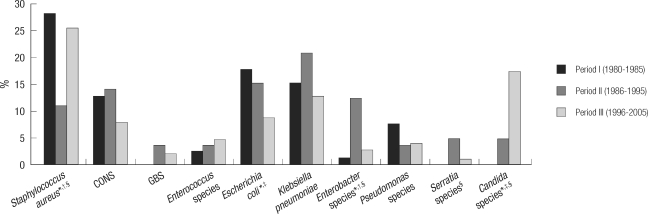
There were many reports of longitudinal changes in the causative organisms of neonatal sepsis in Western countries but few in Asia. We aimed to study longitudinal trends in the epidemiology of neonatal sepsis at Seoul National University Children's Hospital (SNUCH), a tertiary center in Korea, and compared the results to previous studies of Western countries. The medical records of all of the neonates who were hospitalized at SNUCH from 1996 to 2005 with positive blood cultures were reviewed. We also compared the findings to previous 16-yr (1980-1995). One hundred and forty-nine organisms were identified in 147 episodes from 134 infants. In comparison with the previous 16-yr studies, there was a decrease in the number of Escherichia coli infections (16.2% vs 8.7%: odds ratio [OR] 0.495; 95% confidence interval [CI], 0.255-0.962; P = 0.035), but an increase in Staphylococcus aureus (16.6% vs 25.5%: OR 1.720; 95% CI, 1.043-2.839; P = 0.033) and fungal infections (3.3% vs 18.7%: OR 6.740; 95% CI, 2.981-15.239; P < 0.001), predominantly caused by Candida species. In conclusion, the incidence of sepsis caused by E. coli decreases, but S. aureus and fungal sepsis increases significantly. Compared with Western studies, the incidence of sepsis caused by S. aureus and fungus has remarkably increased.

摘要

有许多关于西方国家新生儿败血症的病原体纵向变化的报道,但亚洲的报道很少。我们旨在研究韩国首尔国立大学儿童医院(SNUCH)新生儿败血症的流行病学的纵向趋势,并将结果与西方国家的以往研究进行比较。我们回顾了 1996 年至 2005 年在 SNUCH 住院且血培养阳性的所有新生儿的病历。我们还将这些发现与之前的 16 年(1980-1995 年)进行了比较。在 134 名婴儿的 147 例中,从 149 种病原体中鉴定出 149 种病原体。与之前的 16 年研究相比,大肠杆菌感染的数量减少(16.2%比 8.7%:比值比[OR]0.495;95%置信区间[CI],0.255-0.962;P=0.035),而金黄色葡萄球菌(16.6%比 25.5%:OR1.720;95%CI,1.043-2.839;P=0.033)和真菌感染(3.3%比 18.7%:OR6.740;95%CI,2.981-15.239;P<0.001)的数量增加,主要由念珠菌引起。总之,大肠杆菌引起的败血症发病率下降,但金黄色葡萄球菌和真菌性败血症显著增加。与西方研究相比,金黄色葡萄球菌和真菌感染引起的败血症的发病率显著增加。
https://cdn.ncbi.nlm.nih.gov/pmc/blobs/9547/3031016/922683f4f0a1/jkms-26-284-g002.jpg
https://cdn.ncbi.nlm.nih.gov/pmc/blobs/9547/3031016/4f2163e396a8/jkms-26-284-g001.jpg
https://cdn.ncbi.nlm.nih.gov/pmc/blobs/9547/3031016/922683f4f0a1/jkms-26-284-g002.jpg
https://cdn.ncbi.nlm.nih.gov/pmc/blobs/9547/3031016/4f2163e396a8/jkms-26-284-g001.jpg
https://cdn.ncbi.nlm.nih.gov/pmc/blobs/9547/3031016/922683f4f0a1/jkms-26-284-g002.jpg

相似文献

1
Trends in epidemiology of neonatal sepsis in a tertiary center in Korea: a 26-year longitudinal analysis, 1980-2005.韩国一家三级医院 26 年新生儿败血症流行病学趋势分析:1980-2005 年的纵向研究。
J Korean Med Sci. 2011 Feb;26(2):284-9. doi: 10.3346/jkms.2011.26.2.284. Epub 2011 Jan 24.
2
Neonatal sepsis: a 6-year analysis in a neonatal care unit in Taiwan.新生儿败血症:台湾某新生儿重症监护病房的6年分析
Pediatr Neonatol. 2009 Jun;50(3):88-95. doi: 10.1016/S1875-9572(09)60042-5.
3
Late onset sepsis: comparison between coagulase-negative staphylococci and other bacteria in the neonatal intensive care unit.晚发型败血症:新生儿重症监护病房凝固酶阴性葡萄球菌与其他细菌的比较。
Infect Dis (Lond). 2018 Oct;50(10):764-770. doi: 10.1080/23744235.2018.1487075. Epub 2018 Jul 3.
4
Aetiology, risk factors and immediate outcome of bacteriologically confirmed neonatal septicaemia in Mulago hospital, Uganda.乌干达穆拉戈医院细菌学确诊的新生儿败血症的病因、危险因素及近期转归
Afr Health Sci. 2006 Jun;6(2):120-6. doi: 10.5555/afhs.2006.6.2.120.
5
The Spanish National Network "Grupo Castrillo": 22 Years of Nationwide Neonatal Infection Surveillance.西班牙国家网络“卡斯特里略小组”:22 年全国新生儿感染监测。
Am J Perinatol. 2020 Sep;37(S 02):S71-S75. doi: 10.1055/s-0040-1714256. Epub 2020 Sep 8.
6
Neonatal infections in Asia.亚洲的新生儿感染
Arch Dis Child Fetal Neonatal Ed. 2009 Mar;94(2):F144-8. doi: 10.1136/adc.2008.139865. Epub 2008 Sep 19.
7
Increasing incidence of neonatal septicemia: causative organism and predisposing risk factors.新生儿败血症发病率上升:致病微生物及易感风险因素
Acta Paediatr Scand. 1981 Mar;70(2):207-10. doi: 10.1111/j.1651-2227.1981.tb05543.x.
8
Neonatal sepsis bacterial isolates and antibiotic susceptibility patterns at a NICU in a tertiary care hospital in western Nepal: a retrospective analysis.尼泊尔西部一家三级护理医院新生儿重症监护病房的新生儿败血症细菌分离株及抗生素敏感性模式:一项回顾性分析。
Kathmandu Univ Med J (KUMJ). 2007 Apr-Jun;5(2):153-60.
9
Multidrug-resistant organisms in neonatal sepsis in two tertiary neonatal ICUs, Egypt.埃及两家三级新生儿重症监护病房中新生儿败血症的多重耐药菌
J Egypt Public Health Assoc. 2016 Mar;91(1):31-8. doi: 10.1097/01.EPX.0000482038.76692.3.
10
Healthcare-associated bloodstream infections in a neonatal intensive care unit over a 20-year period (1992-2011): trends in incidence, pathogens, and mortality.一家新生儿重症监护病房20年期间(1992 - 2011年)的医疗保健相关血流感染:发病率、病原体及死亡率的变化趋势
Infect Control Hosp Epidemiol. 2014 May;35(5):511-8. doi: 10.1086/675836. Epub 2014 Mar 17.

引用本文的文献

1
Characteristics of Neonates with Sepsis Associated with Antimicrobial Resistance and Mortality in a Tertiary Hospital in Mexico: A Retrospective Observational Study.墨西哥一家三级医院中与抗菌药物耐药性及死亡率相关的脓毒症新生儿的特征:一项回顾性观察研究
Pathogens. 2025 Jun 14;14(6):588. doi: 10.3390/pathogens14060588.
2
Group B Detection Rate and Clindamycin Resistance Among Reproductive-Age Women in Korea During 2003-2022.B组:2003年至2022年韩国育龄妇女中的检出率及克林霉素耐药性
J Korean Med Sci. 2025 Apr 21;40(15):e29. doi: 10.3346/jkms.2025.40.e29.
3
Understanding the Difficulties in Diagnosing Neonatal Sepsis: Assessing the Role of Sepsis Biomarkers.

本文引用的文献

1
Long-term trends in the epidemiology of neonatal sepsis and antibiotic susceptibility of causative agents.新生儿败血症的流行病学和病原体抗生素敏感性的长期趋势。
Neonatology. 2010;97(1):22-8. doi: 10.1159/000226604. Epub 2009 Jul 2.
2
Prevention and treatment of invasive fungal infection in very low birthweight infants.极低出生体重儿侵袭性真菌感染的防治
Arch Dis Child Fetal Neonatal Ed. 2009 Jan;94(1):F65-9. doi: 10.1136/adc.2007.133769. Epub 2008 Oct 6.
3
A multicenter, randomized trial of prophylactic fluconazole in preterm neonates.
了解新生儿败血症诊断中的困难:评估败血症生物标志物的作用。
J Crit Care Med (Targu Mures). 2024 Oct 31;10(4):316-328. doi: 10.2478/jccm-2024-0039. eCollection 2024 Oct.
4
Investigating the Association between Serum and Hematological Biomarkers and Neonatal Sepsis in Newborns with Premature Rupture of Membranes: A Retrospective Study.胎膜早破新生儿血清及血液生物标志物与新生儿败血症之间的关联研究:一项回顾性研究
Children (Basel). 2024 Jan 18;11(1):124. doi: 10.3390/children11010124.
5
Multidrug-Resistant Sepsis: A Critical Healthcare Challenge.多重耐药性脓毒症:一项严峻的医疗保健挑战。
Antibiotics (Basel). 2024 Jan 4;13(1):46. doi: 10.3390/antibiotics13010046.
6
Predictors of adverse short-term outcomes in late preterm infants.预测晚期早产儿不良短期结局的因素。
BMC Pediatr. 2023 Jun 17;23(1):298. doi: 10.1186/s12887-023-04112-z.
7
Clinical Prediction Model Development and Validation for the Detection of Newborn Sepsis, Diagnostic Research Protocol.用于新生儿败血症检测的临床预测模型开发与验证,诊断研究方案。
Int J Gen Med. 2022 Nov 2;15:8025-8031. doi: 10.2147/IJGM.S388120. eCollection 2022.
8
A longitudinal analysis of nosocomial bloodstream infections among preterm neonates.早产儿医院血流感染的纵向分析。
Eur J Clin Microbiol Infect Dis. 2022 Nov;41(11):1327-1336. doi: 10.1007/s10096-022-04502-8. Epub 2022 Sep 30.
9
Neonatal sepsis-causing bacterial pathogens and outcome of trends of their antimicrobial susceptibility a 20-year period at a neonatal intensive care unit.新生儿重症监护病房20年间引起新生儿败血症的细菌病原体及其抗菌药物敏感性趋势的结果
Clin Exp Pediatr. 2022 Jul;65(7):350-357. doi: 10.3345/cep.2021.00668. Epub 2021 Dec 9.
10
Emerging Threat of Multidrug Resistant Pathogens From Neonatal Sepsis.新生儿败血症中多重耐药病原体的新出现威胁。
Front Cell Infect Microbiol. 2021 Jul 12;11:694093. doi: 10.3389/fcimb.2021.694093. eCollection 2021.
一项针对早产儿预防性使用氟康唑的多中心随机试验。
N Engl J Med. 2007 Jun 14;356(24):2483-95. doi: 10.1056/NEJMoa065733.
4
Changing incidence of Candida bloodstream infections among NICU patients in the United States: 1995-2004.1995 - 2004年美国新生儿重症监护病房(NICU)患者念珠菌血流感染发病率的变化情况
Pediatrics. 2006 May;117(5):1680-7. doi: 10.1542/peds.2005-1996.
5
Seventy-five years of neonatal sepsis at Yale: 1928-2003.耶鲁大学75年的新生儿败血症研究:1928 - 2003年
Pediatrics. 2005 Sep;116(3):595-602. doi: 10.1542/peds.2005-0552.
6
The efficacy of clinical strategies to reduce nosocomial sepsis in extremely low birth weight infants.降低极低出生体重儿医院感染性败血症临床策略的疗效
J Korean Med Sci. 2005 Apr;20(2):177-81. doi: 10.3346/jkms.2005.20.2.177.
7
Infections in VLBW infants: studies from the NICHD Neonatal Research Network.极低出生体重儿感染:美国国立儿童健康与人类发展研究所新生儿研究网络的研究
Semin Perinatol. 2003 Aug;27(4):293-301. doi: 10.1016/s0146-0005(03)00046-6.
8
Septicaemia and meningitis in neonates and during early infancy in the Göteborg area of Sweden.瑞典哥德堡地区新生儿及婴儿早期的败血症和脑膜炎
Acta Paediatr. 2002;91(10):1087-92. doi: 10.1080/080352502760311593.
9
Late-onset sepsis in very low birth weight neonates: the experience of the NICHD Neonatal Research Network.极低出生体重儿晚发性败血症:美国国立儿童健康与人类发展研究所新生儿研究网络的经验
Pediatrics. 2002 Aug;110(2 Pt 1):285-91. doi: 10.1542/peds.110.2.285.
10
Risk factors for invasive fungal infection in neonates.新生儿侵袭性真菌感染的危险因素
Acta Paediatr. 2002;91(2):198-202. doi: 10.1080/080352502317285216.