Public Health and Environment, London School of Hygiene and Tropical Medicine, Keppel Street, London, UK.
Trials. 2011 Feb 3;12:31. doi: 10.1186/1745-6215-12-31.
All sectors of the economy, including the health research sector, must reduce their carbon emissions. The UK National Institute for Health Research has recently prepared guidelines on how to minimize the carbon footprint of research. We compare the carbon emissions from two international clinical trials in order to identify where emissions reductions can be made.
We conducted a carbon audit of two clinical trials (the CRASH-1 and CRASH-2 trials), quantifying the carbon dioxide emissions produced over a one-year audit period. Carbon emissions arising from the coordination centre, freight delivery, trial-related travel and commuting were calculated and compared.
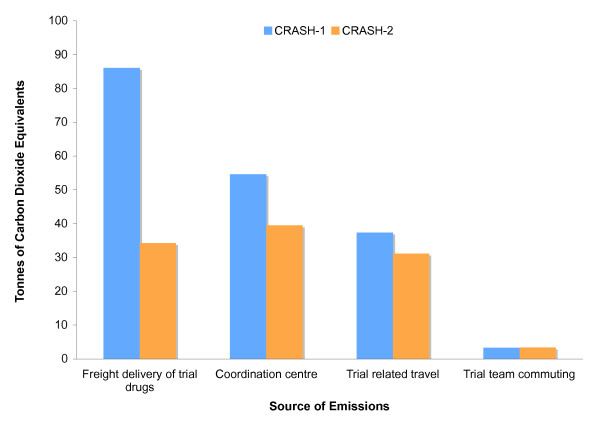
The total emissions in carbon dioxide equivalents during the one-year audit period were 181.3 tonnes for CRASH-1 and 108.2 tonnes for CRASH-2. In total, CRASH-1 emitted 924.6 tonnes of carbon dioxide equivalents compared with 508.5 tonnes for CRASH-2. The CRASH-1 trial recruited 10,008 patients over 5.1 years, corresponding to 92 kg of carbon dioxide per randomized patient. The CRASH-2 trial recruited 20,211 patients over 4.7 years, corresponding to 25 kg of carbon dioxide per randomized patient. The largest contributor to emissions in CRASH-1 was freight delivery of trial materials (86.0 tonnes, 48% of total emissions), whereas the largest contributor in CRASH-2 was energy use by the trial coordination centre (54.6 tonnes, 30% of total emissions).
Faster patient recruitment in the CRASH-2 trial largely accounted for its greatly increased carbon efficiency in terms of emissions per randomized patient. Lighter trial materials and web-based data entry also contributed to the overall lower carbon emissions in CRASH-2 as compared to CRASH-1.
CRASH-1: ISRCTN74459797CRASH-2: ISRCTN86750102.
包括卫生研究部门在内的所有经济领域都必须减少碳排放。英国国家卫生研究院最近制定了如何将研究的碳足迹最小化的指南。我们比较了两项国际临床试验的碳排放量,以确定可以在何处减少排放量。
我们对两项临床试验(CRASH-1 和 CRASH-2 试验)进行了碳审计,量化了在一年审计期间产生的二氧化碳排放量。计算并比较了协调中心、货运、与试验相关的旅行和通勤产生的碳排放。
在一年的审计期间,CRASH-1 的二氧化碳当量总排放量为 181.3 吨,CRASH-2 为 108.2 吨。总的来说,CRASH-1 排放了 924.6 吨二氧化碳当量,而 CRASH-2 为 508.5 吨。CRASH-1 试验在 5.1 年内招募了 10008 名患者,相当于每位随机患者 92 公斤二氧化碳。CRASH-2 试验在 4.7 年内招募了 20211 名患者,相当于每位随机患者 25 公斤二氧化碳。CRASH-1 试验中排放量最大的是试验材料的货运(86.0 吨,占总排放量的 48%),而 CRASH-2 试验中排放量最大的是试验协调中心的能源使用(54.6 吨,占总排放量的 30%)。
CRASH-2 试验中更快的患者招募在每位随机患者的排放方面大大提高了其碳效率。较轻的试验材料和基于网络的数据录入也有助于 CRASH-2 相对于 CRASH-1 整体减少碳排放。
CRASH-1:ISRCTN74459797CRASH-2:ISRCTN86750102。