Department of Primary Care and Population Health, UCL Medical School, London, UK.
BMC Med Educ. 2011 Feb 3;11:6. doi: 10.1186/1472-6920-11-6.
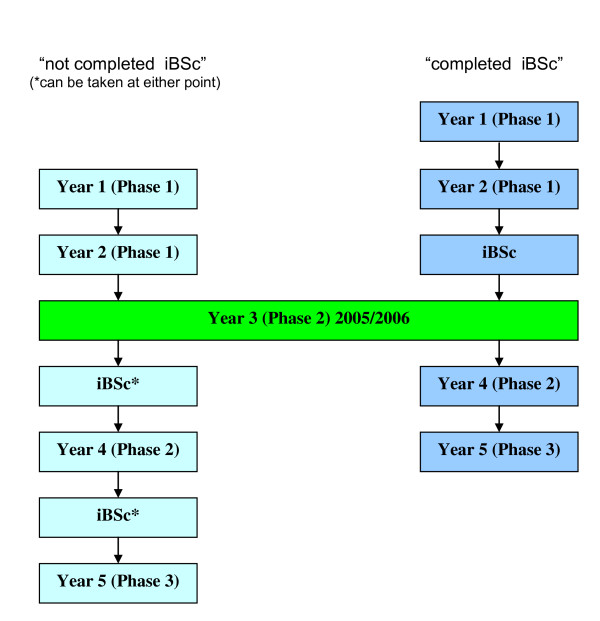
Intercalated BScs (iBScs) are an optional part of the medical school curriculum in many Universities. Does undertaking an iBSc influence subsequent student performance? Previous studies addressing this question have been flawed by iBSc students being highly selected. This study looks at data from medical students where there is a compulsory iBSc for non-graduates. Our aim was to see whether there was any difference in performance between students who took an iBSc before or after their third year (first clinical year) exams.
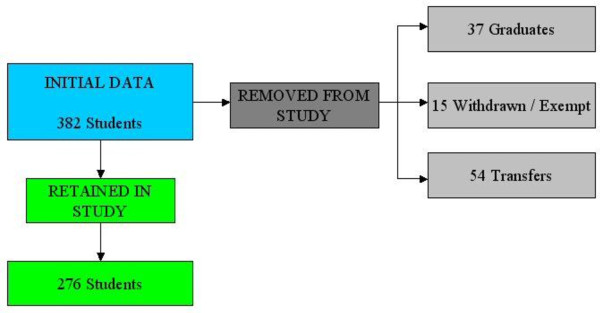
A multivariable analysis was performed to compare the third year results of students at one London medical school who had or had not completed their iBSc by the start of this year (n = 276). A general linear model was applied to adjust for differences between the two groups in terms of potential confounders (age, sex, nationality and baseline performance).
The results of third year summative exams for 276 students were analysed (184 students with an iBSc and 92 without). Unadjusted analysis showed students who took an iBSc before their third year achieved significantly higher end of year marks than those who did not with a mean score difference of 4.4 (0.9 to 7.9 95% CI, p = 0.01). (overall mean score 238.4 "completed iBSc" students versus 234.0 "not completed", range 145.2 - 272.3 out of 300). There was however a significant difference between the two groups in their prior second year exam marks with those choosing to intercalate before their third year having higher marks. Adjusting for this, the difference in overall exam scores was no longer significant with a mean score difference of 1.4 (-4.9 to +7.7 95% CI, p = 0.66). (overall mean score 238.0 " completed iBSc" students versus 236.5 "not completed").
Once possible confounders are controlled for (age, sex, previous academic performance) undertaking an iBSc does not influence third year exam results. One explanation for this confounding in unadjusted results is that students who do better in their second year exams are more likely to take an iBSc before their third year.
在许多大学,插班本科(iBSc)是医学课程的可选部分。攻读 iBSc 是否会影响学生后续的表现?以前的研究因 iBSc 学生的高度选择性而存在缺陷。本研究着眼于医学生的数据,这些学生在非毕业生中必须参加 iBSc。我们的目的是观察在第三年(第一年临床考试)考试之前或之后参加 iBSc 的学生之间的表现是否存在差异。
对伦敦一所医学院的 276 名学生的第三年成绩进行了多变量分析,这些学生在今年开始时已经或尚未完成 iBSc(n = 276)。应用一般线性模型来调整两组之间的差异,包括潜在的混杂因素(年龄、性别、国籍和基线表现)。
分析了 276 名学生的第三年总结性考试结果(184 名学生有 iBSc,92 名没有)。未调整分析显示,在第三年前参加 iBSc 的学生的年终成绩明显高于未参加的学生,平均分数差为 4.4(95%CI 为 0.9 至 7.9,p = 0.01)。(总体平均分数为 238.4,“完成 iBSc”学生与“未完成”学生的分数分别为 234.0,范围为 145.2 至 272.3 分,满分为 300 分)。然而,两组学生在第二年前的考试成绩之间存在显著差异,选择在第三年前插班的学生成绩更高。在考虑到这一点后,整体考试成绩的差异不再显著,平均分数差为 1.4(95%CI 为-4.9 至 7.7,p = 0.66)。(总体平均分数为 238.0,“完成 iBSc”学生与“未完成”学生的分数分别为 236.5)。
在控制了可能的混杂因素(年龄、性别、先前的学业成绩)后,攻读 iBSc 并不影响第三年的考试成绩。在未调整的结果中,这种混杂的一个解释是,在第二年考试中表现较好的学生更有可能在第三年前参加 iBSc。