School of Medicine, Guy's Campus, King's College London, London, UK.
BMC Med Educ. 2011 Oct 3;11:76. doi: 10.1186/1472-6920-11-76.
The choice of whether to undertake an intercalated Bachelor of Science (BSc) degree is one of the most important decisions that students must make during their time at medical school. An effect on exam performance would improve a student's academic ranking, giving them a competitive edge when applying for foundation posts.
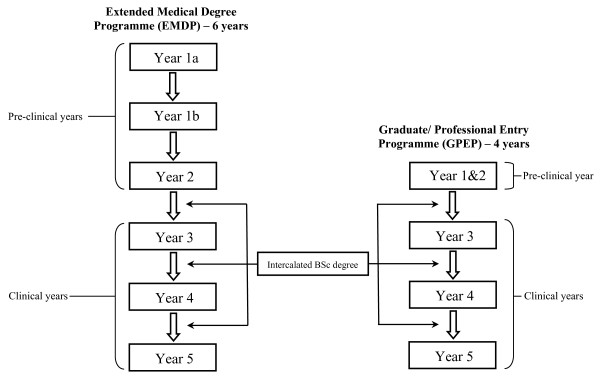
Retrospective data analysis of anonymised student records. The effects of intercalating on final year exam results, Foundation Programme score, application form score (from white-space questions), quartile rank score, and success with securing Foundation School of choice were assessed using linear and ordered logistic regression models, adjusted for course type, year of graduation, graduate status and baseline (Year 1) performance.
The study included 1158 students, with 54% choosing to do an intercalated BSc, and 9.8% opting to do so at an external institution. Doing an intercalated BSc was significantly associated with improved outcome in Year 5 exams (P = 0.004). This was irrespective of the year students chose to intercalate, with no significant difference between those that intercalated after years 2, 3 and 4 (p = 0.3096). There were also higher foundation application scores (P < 0.0001), academic quartile scores (P = 0.0003) and resultant overall foundation scores (P < 0.0001) in intercalated students. These students also had improved success with securing their first choice Foundation School (p = 0.0220). Participants who remained at the institution to intercalate in general performed better than those that opted to intercalate elsewhere.
Doing an intercalated BSc leads to an improvement in subsequent exam results and develops the skills necessary to produce a strong foundation programme application. It also leads to greater success with securing preferred Foundation School posts in students. Differences between internally- and externally-intercalating students may be due to varying course structures or greater challenge in adjusting to a new study environment.
是否选择攻读插读式理科学士(BSc)学位是学生在医学院期间必须做出的最重要决定之一。对考试成绩的影响将提高学生的学术排名,使他们在申请基础职位时具有竞争优势。
对匿名学生记录进行回顾性数据分析。使用线性和有序逻辑回归模型评估插读对最后一年考试成绩、基础计划评分、申请表评分(来自空白问题)、四分位排名评分以及选择基础学校成功的影响,调整课程类型、毕业年份、研究生身份和基线(第 1 年)表现。
该研究包括 1158 名学生,其中 54%选择攻读插读式 BSc,9.8%选择在外部机构攻读。攻读插读式 BSc 与第 5 年考试成绩提高显著相关(P=0.004)。这与学生选择插读的年份无关,在第 2、3 和 4 年插读的学生之间没有显著差异(p=0.3096)。插读学生的基础申请评分也更高(P<0.0001)、学术四分位评分(P=0.0003)和整体基础评分(P<0.0001)。这些学生也提高了获得首选基础学校的成功率(p=0.0220)。选择在机构内插读的学生总体表现优于选择在其他地方插读的学生。
攻读插读式 BSc 可提高后续考试成绩,并培养编写强有力基础计划申请所需的技能。它还使学生在获得首选基础学校职位方面取得更大成功。内部和外部插读学生之间的差异可能是由于课程结构不同或适应新学习环境的挑战更大所致。