Wang Yunjiao, Paszek Pawel, Horton Caroline A, Kell Douglas B, White Michael Rh, Broomhead David S, Muldoon Mark R
Mathematical Biosciences Institute, The Ohio State University, Jennings Hall, Columbus, Ohio 43210, USA.
BMC Syst Biol. 2011 Feb 3;5:23. doi: 10.1186/1752-0509-5-23.
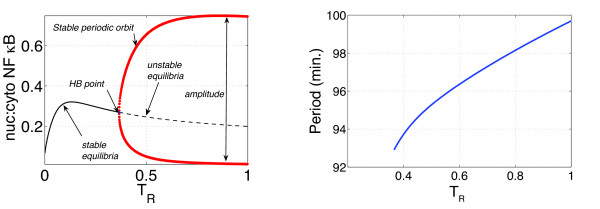
Sustained stimulation with tumour necrosis factor alpha (TNF-alpha) induces substantial oscillations--observed at both the single cell and population levels--in the nuclear factor kappa B (NF-kappa B) system. Although the mechanism has not yet been elucidated fully, a core system has been identified consisting of a negative feedback loop involving NF-kappa B (RelA:p50 hetero-dimer) and its inhibitor I-kappa B-alpha. Many authors have suggested that this core oscillator should couple to other oscillatory pathways.
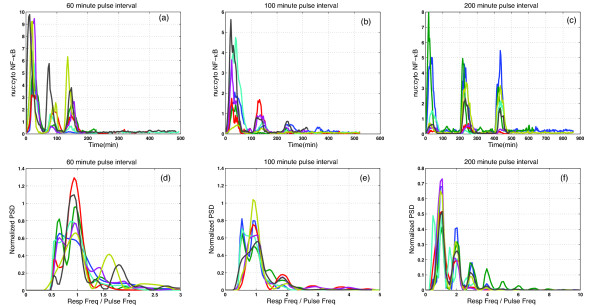
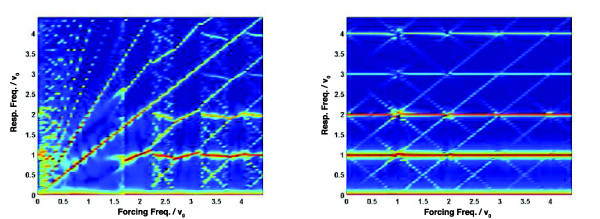
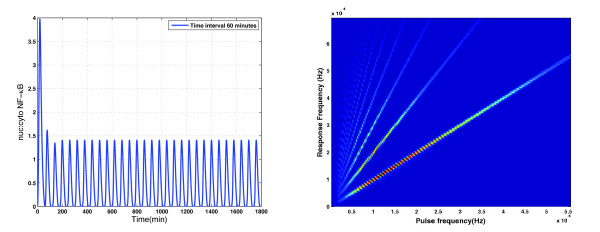
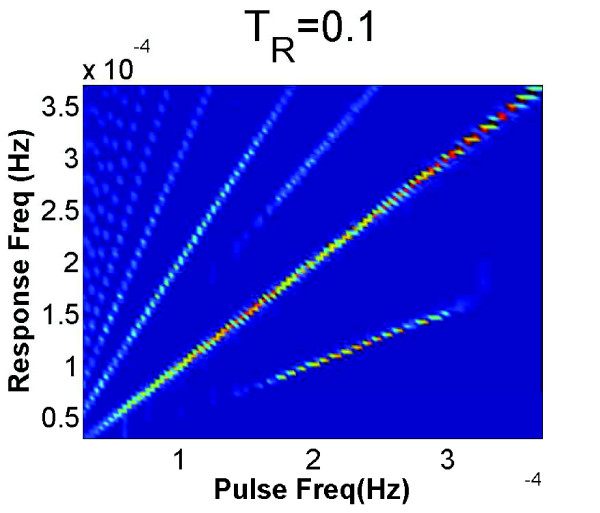
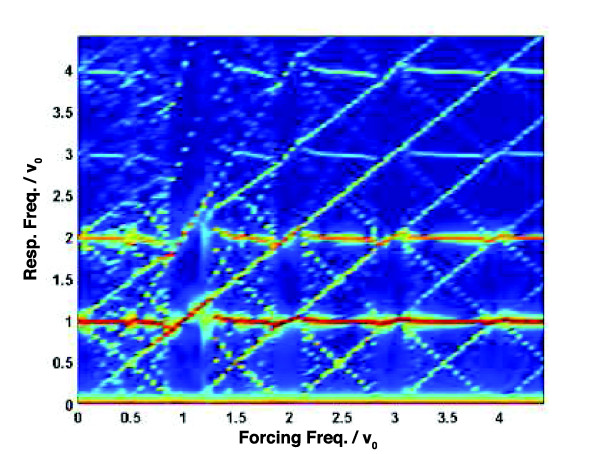
First we analyse single-cell data from experiments in which the NF-kappa B system is forced by short trains of strong pulses of TNF-alpha. Power spectra of the ratio of nuclear-to-cytoplasmic concentration of NF-kappa B suggest that the cells' responses are entrained by the pulsing frequency. Using a recent model of the NF-kappa B system due to Caroline Horton, we carried out extensive numerical simulations to analyze the response frequencies induced by trains of pulses of TNF-alpha stimulation having a wide range of frequencies and amplitudes. These studies suggest that for sufficiently weak stimulation, various nonlinear resonances should be observable. To explore further the possibility of probing alternative feedback mechanisms, we also coupled the model to sinusoidal signals with a wide range of strengths and frequencies. Our results show that, at least in simulation, frequencies other than those of the forcing and the main NF-kappa B oscillator can be excited via sub- and superharmonic resonance, producing quasiperiodic and even chaotic dynamics.
Our numerical results suggest that the entrainment phenomena observed in pulse-stimulated experiments is a consequence of the high intensity of the stimulation. Computational studies based on current models suggest that resonant interactions between periodic pulsatile forcing and the system's natural frequencies may become evident for sufficiently weak stimulation. Further simulations suggest that the nonlinearities of the NF-kappa B feedback oscillator mean that even sinusoidally modulated forcing can induce a rich variety of nonlinear interactions.
用肿瘤坏死因子α(TNF-α)持续刺激会在核因子κB(NF-κB)系统中诱导出显著的振荡——在单细胞和群体水平均能观察到。尽管其机制尚未完全阐明,但已确定一个核心系统,该系统由涉及NF-κB(RelA:p50异二聚体)及其抑制剂I-κB-α的负反馈回路组成。许多作者认为这个核心振荡器应与其他振荡途径耦合。
首先,我们分析了来自实验的单细胞数据,在这些实验中,NF-κB系统受到短串强TNF-α脉冲的驱动。NF-κB核质浓度比的功率谱表明细胞反应被脉冲频率所夹带。使用卡罗琳·霍顿最近提出的NF-κB系统模型,我们进行了广泛的数值模拟,以分析具有广泛频率和幅度的TNF-α刺激脉冲串所诱导的反应频率。这些研究表明,对于足够弱的刺激,各种非线性共振应该是可观察到的。为了进一步探索探究替代反馈机制的可能性,我们还将该模型与具有广泛强度和频率的正弦信号耦合。我们的结果表明,至少在模拟中,除了驱动频率和主要的NF-κB振荡器频率之外的其他频率可以通过次谐波和超谐波共振被激发,从而产生准周期甚至混沌动力学。
我们的数值结果表明,在脉冲刺激实验中观察到的夹带现象是刺激强度高的结果。基于当前模型的计算研究表明,对于足够弱的刺激,周期性脉动驱动与系统固有频率之间的共振相互作用可能会变得明显。进一步的模拟表明,NF-κB反馈振荡器的非线性意味着即使是正弦调制的驱动也能诱导出丰富多样的非线性相互作用。