Department of Preventive Medicine, USC Keck School of Medicine, Los Angeles, CA 90033, USA.
Hum Genet. 2011 Jun;129(6):617-27. doi: 10.1007/s00439-011-0963-3. Epub 2011 Feb 4.
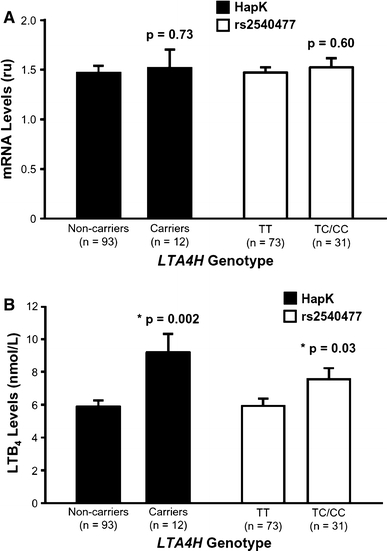
We evaluated the genetic contribution of the leukotriene (LT) pathway to risk of coronary artery disease (CAD) in 4,512 Caucasian and African American subjects ascertained through elective cardiac evaluation. Of the three previously associated variants, the shorter "3" and "4" alleles of a promoter repeat polymorphism in ALOX5 increased risk of CAD in African Americans (OR = 1.4, 95% CI 1.0-1.9; p = 0.04), whereas a haplotype of LTA4H (HapK) was associated with CAD in Caucasians (OR = 1.2, 95% CI 1.01-1.4; p = 0.03). In Caucasians, first-stage analysis of 254 haplotype-tagging SNPs in 15 LT pathway genes with follow-up of 19 variants in stage 2 revealed an LTA4H SNP (rs2540477) that increased risk of CAD (OR = 1.2, 95% CI 1.1-1.5; p = 0.003) and a PLA2G4A SNP (rs12746200) that decreased risk of CAD (OR = 0.7, 95% CI 0.6-0.9; p = 0.0007). The PLA2G4A rs12746200 variant also decreased risk of experiencing a major adverse cardiac event (MACE = myocardial infarction, stroke, or death) over 3 years of follow-up (HR = 0.7, 95% CI 0.5-0.9; p = 0.01), consistent with its cardioprotective effect. Functional experiments demonstrated that stimulated monocytes from carriers of LTA4H variants HapK or rs2540477 had 50% (p = 0.002) and 33% (p = 0.03) higher LTB(4) production, respectively, compared to non-carriers. These ex vivo results are consistent with LTB(4) being the direct product of the reaction catalyzed by LTA4H and its role in promoting monocyte chemotaxis to sites of inflammation, including the artery wall of atherosclerotic lesions. Taken together, this study provides additional evidence that functional genetic variation of the LT pathway can mediate atherogenic processes and the risk of CAD in humans.
我们评估了白细胞三烯(LT)通路的遗传贡献,以确定 4512 名白种人和非裔美国人的冠心病(CAD)风险,这些人是通过选择性心脏评估确定的。在三个先前相关的变异中,位于 ALOX5 启动子重复多态性中的较短的“3”和“4”等位基因增加了非裔美国人 CAD 的风险(OR=1.4,95%CI 1.0-1.9;p=0.04),而 LTA4H(HapK)的单体型与白种人 CAD 相关(OR=1.2,95%CI 1.01-1.4;p=0.03)。在白种人中,对 15 个 LT 通路基因中的 254 个单体型标签 SNP 进行的第一阶段分析,以及在第二阶段对 19 个变体进行的后续分析,显示 LTA4H SNP(rs2540477)增加了 CAD 的风险(OR=1.2,95%CI 1.1-1.5;p=0.003),PLA2G4A SNP(rs12746200)降低了 CAD 的风险(OR=0.7,95%CI 0.6-0.9;p=0.0007)。PLA2G4A rs12746200 变体还降低了 3 年随访期间经历重大不良心脏事件(MACE=心肌梗死、中风或死亡)的风险(HR=0.7,95%CI 0.5-0.9;p=0.01),这与其心脏保护作用一致。功能实验表明,携带 LTA4H 变体 HapK 或 rs2540477 的刺激单核细胞产生的 LTB(4)分别增加了 50%(p=0.002)和 33%(p=0.03),而非携带者则没有。这些体外实验结果与 LTB(4)是 LTA4H 催化反应的直接产物及其在促进单核细胞向炎症部位趋化,包括动脉粥样硬化病变的动脉壁相一致。总之,这项研究提供了额外的证据,表明白细胞三烯通路的功能遗传变异可以介导动脉粥样硬化过程和人类 CAD 的风险。