Kai Yutaka, Watanabe Masaki, Morioka Motohiro, Hirano Teruyuki, Yano Shigetoshi, Ohmori Yuki, Kawano Takayuki, Hamada Jun-Ichiro, Kuratsu Jun-Ichi
Department of Neurosurgery, Graduate School of Medicine, Kumamoto University, Kumamoto, Japan.
Surg Neurol Int. 2011 Jan 24;2:8. doi: 10.4103/2152-7806.76145.
To evaluate the effectiveness of cilostazol in patients with intracranial arterial stenosis, we used magnetic resonance angiography (MRA). The drug's effect on the cerebral blood flow (CBF) was examined by single photon emission computed tomography (SPECT).
In this retrospective study, we evaluated the clinical outcomes of 20 patients with stenosis in the M1 segment of the middle cerebral artery (MCA) who had suffered ischemic stroke within 12 weeks or manifested asymptomatic stenosis exceeding 50%. All patients received cilostazol (100 mg twice daily). MRA and SPECT (at rest and after acetazolamide challenge) studies were performed before and 6 and 12 months after the start of cilostazol treatment.
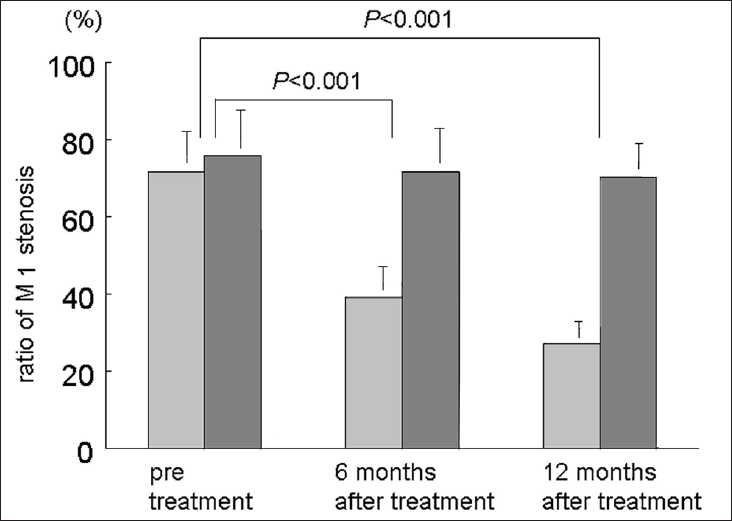
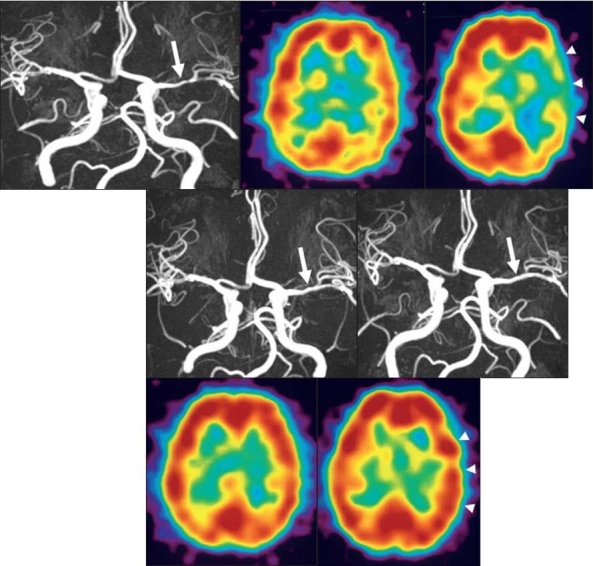
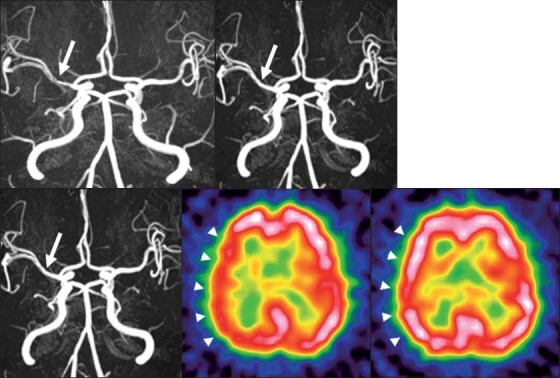
In 5 patients the stenotic lesion showed improvement on MRA. Mean stenosis before cilostazol therapy was 71.7 ± 4.9%, which improved to 39.0 ± 3.2% at 6 months and to 27.2 ± 2.8% at 12 months. SPECT study showed that CBF was improved in 3 patients; in one there was improvement at rest and the other 2 manifested improvement upon acetazolamide challenge.
Cilostazol had a remodeling effect on stenotic lesions due to arteriosclerotic changes and improved CBF in some patients.
为评估西洛他唑对颅内动脉狭窄患者的疗效,我们采用了磁共振血管造影(MRA)。通过单光子发射计算机断层扫描(SPECT)检查了该药物对脑血流量(CBF)的影响。
在这项回顾性研究中,我们评估了20例大脑中动脉(MCA)M1段狭窄的患者的临床结局,这些患者在12周内发生了缺血性卒中或表现为无症状狭窄超过50%。所有患者均接受西洛他唑治疗(每日两次,每次100 mg)。在开始西洛他唑治疗前以及治疗开始后6个月和12个月进行MRA和SPECT(静息状态和乙酰唑胺激发后)检查。
5例患者的狭窄病变在MRA上显示改善。西洛他唑治疗前平均狭窄率为71.7±4.9%,6个月时改善至39.0±3.2%,12个月时改善至27.2±2.8%。SPECT研究显示,3例患者的CBF有所改善;1例在静息状态下改善,另外2例在乙酰唑胺激发后改善。
西洛他唑对动脉硬化性狭窄病变具有重塑作用,并在部分患者中改善了CBF。