
微小 RNA 谱可预测米兰标准范围内肝癌切除术后的复发。
MicroRNA profile predicts recurrence after resection in patients with hepatocellular carcinoma within the Milan Criteria.
机构信息
Department of Nanobio Drug Discovery, Graduate School of Pharmaceutical Sciences, Kyoto University, Kyoto, Japan.
出版信息
PLoS One. 2011 Jan 27;6(1):e16435. doi: 10.1371/journal.pone.0016435.
OBJECTIVE
Hepatocellular carcinoma (HCC) is difficult to manage due to the high frequency of post-surgical recurrence. Early detection of the HCC recurrence after liver resection is important in making further therapeutic options, such as salvage liver transplantation. In this study, we utilized microRNA expression profiling to assess the risk of HCC recurrence after liver resection.
METHODS
We examined microRNA expression profiling in paired tumor and non-tumor liver tissues from 73 HCC patients who satisfied the Milan Criteria. We constructed prediction models of recurrence-free survival using the Cox proportional hazard model and principal component analysis. The prediction efficiency was assessed by the leave-one-out cross-validation method, and the time-averaged area under the ROC curve (ta-AUROC).
RESULTS
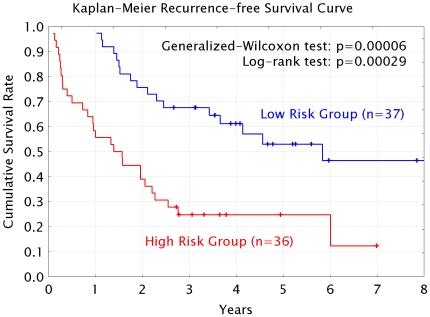
The univariate Cox analysis identified 13 and 56 recurrence-related microRNAs in the tumor and non-tumor tissues, such as miR-96. The number of recurrence-related microRNAs was significantly larger in the non-tumor-derived microRNAs (N-miRs) than in the tumor-derived microRNAs (T-miRs, P<0.0001). The best ta-AUROC using the whole dataset, T-miRs, N-miRs, and clinicopathological dataset were 0.8281, 0.7530, 0.7152, and 0.6835, respectively. The recurrence-free survival curve of the low-risk group stratified by the best model was significantly better than that of the high-risk group (Log-rank: P = 0.00029). The T-miRs tend to predict early recurrence better than late recurrence, whereas N-miRs tend to predict late recurrence better (P<0.0001). This finding supports the concept of early recurrence by the dissemination of primary tumor cells and multicentric late recurrence by the 'field effect'.
CONCLUSION
MicroRNA profiling can predict HCC recurrence in Milan criteria cases.
目的
由于肝癌(HCC)术后复发率高,因此难以治疗。早期发现肝切除术后 HCC 的复发对于制定进一步的治疗选择(如挽救性肝移植)非常重要。在这项研究中,我们利用 microRNA 表达谱来评估肝切除术后 HCC 复发的风险。
方法
我们检查了 73 例符合米兰标准的 HCC 患者的配对肿瘤和非肿瘤肝组织中的 microRNA 表达谱。我们使用 Cox 比例风险模型和主成分分析构建了无复发生存预测模型。通过留一法交叉验证和时间平均 ROC 曲线下面积(ta-AUROC)评估预测效率。
结果
单因素 Cox 分析在肿瘤和非肿瘤组织中分别确定了 13 个和 56 个与复发相关的 microRNA,如 miR-96。非肿瘤来源的 microRNAs(N-miRs)中的与复发相关的 microRNA 数量明显多于肿瘤来源的 microRNAs(T-miRs,P<0.0001)。使用整个数据集、T-miRs、N-miRs 和临床病理数据集的最佳 ta-AUROC 分别为 0.8281、0.7530、0.7152 和 0.6835。根据最佳模型分层的低风险组的无复发生存曲线明显优于高风险组(Log-rank:P=0.00029)。T-miRs 倾向于更好地预测早期复发,而 N-miRs 倾向于更好地预测晚期复发(P<0.0001)。这一发现支持了原发性肿瘤细胞播散导致早期复发和“场效应”导致多中心晚期复发的概念。
结论
microRNA 谱分析可以预测米兰标准病例中 HCC 的复发。



 Zotero 插件