UMR-CNRS 6552 Ethologie animale et humaine, Université Rennes 1, Rennes, France.
PLoS One. 2011 Jan 27;6(1):e14604. doi: 10.1371/journal.pone.0014604.
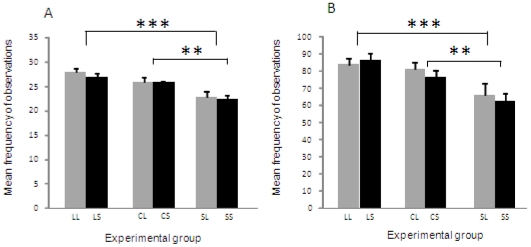
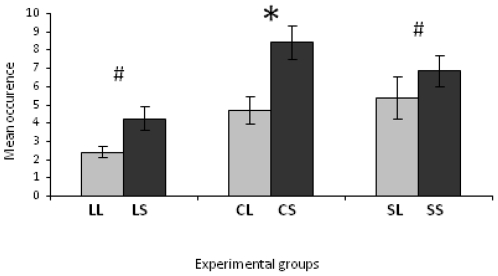
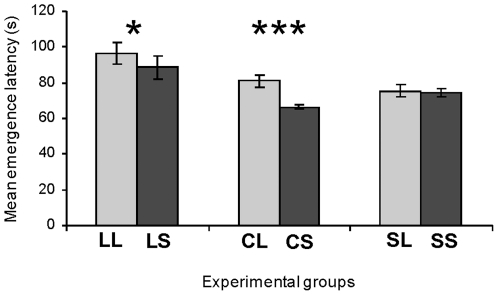
The development of fearfulness and the capacity of animals to cope with stressful events are particularly sensitive to early experience with mothers in a wide range of species. However, intrinsic characteristics of young animals can modulate maternal influence. This study evaluated the effect of intrinsic fearfulness on non-genetic maternal influence. Quail chicks, divergently selected for either higher (LTI) or lower fearfulness (STI) and from a control line (C), were cross-fostered by LTI or STI mothers. Behavioural tests estimated the chicks' emotional profiles after separation from the mother. Whatever their genotype, the fearfulness of chicks adopted by LTI mothers was higher than that of chicks adopted by STI mothers. However, genetic background affected the strength of maternal effects: the least emotional chicks (STI) were the least affected by early experience with mothers. We demonstrated that young animal's intrinsic fearfulness affects strongly their sensitivity to non-genetic maternal influences. A young animal's behavioural characteristics play a fundamental role in its own behavioural development processes.
动物的恐惧发展和应对压力事件的能力对其在广泛物种中的母亲早期经验特别敏感。然而,幼小动物的内在特征可以调节母性影响。本研究评估了内在恐惧对非遗传母性影响的作用。鹌鹑雏鸡,通过对更高(LTI)或更低恐惧(STI)的选择,以及来自对照系(C)的选择,被 LTI 或 STI 母亲交叉养育。在与母亲分离后,行为测试估计了雏鸡的情绪特征。无论其基因型如何,被 LTI 母亲收养的雏鸡的恐惧程度都高于被 STI 母亲收养的雏鸡。然而,遗传背景影响了母性影响的强度:最不情绪化的雏鸡(STI)受早期与母亲相处经历的影响最小。我们证明,幼小动物的内在恐惧强烈影响其对非遗传母性影响的敏感性。幼小动物的行为特征在其自身的行为发展过程中起着至关重要的作用。