Consejo Nacional de Investigaciones Científicas y Técnicas, Museo Paleontológico Egidio Feruglio, Trelew, Argentina.
PLoS One. 2011 Jan 26;6(1):e14572. doi: 10.1371/journal.pone.0014572.
The origin of sauropod dinosaurs is one of the major landmarks of dinosaur evolution but is still poorly understood. This drastic transformation involved major skeletal modifications, including a shift from the small and gracile condition of primitive sauropodomorphs to the gigantic and quadrupedal condition of sauropods. Recent findings in the Late Triassic-Early Jurassic of Gondwana provide critical evidence to understand the origin and early evolution of sauropods.
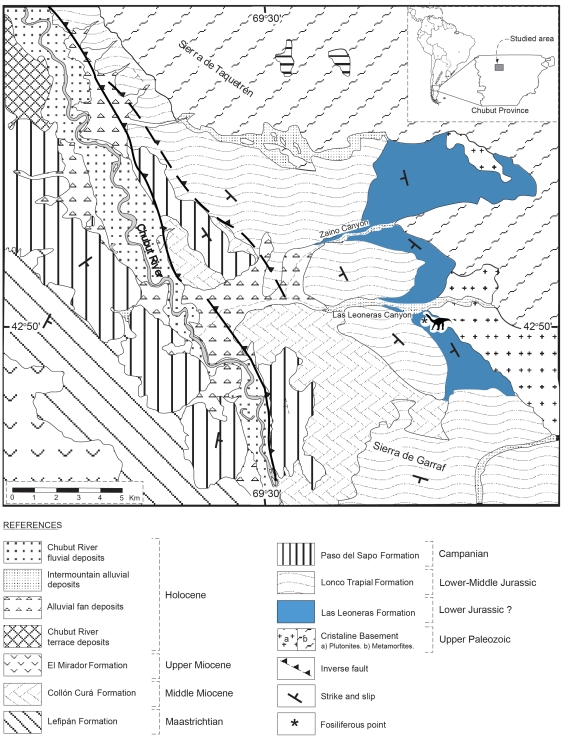
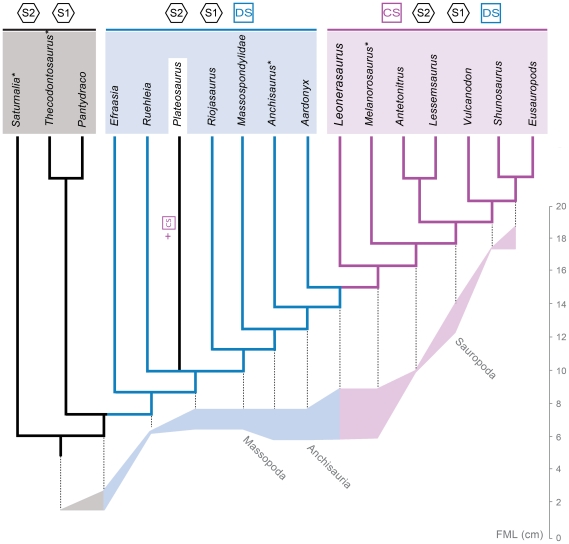
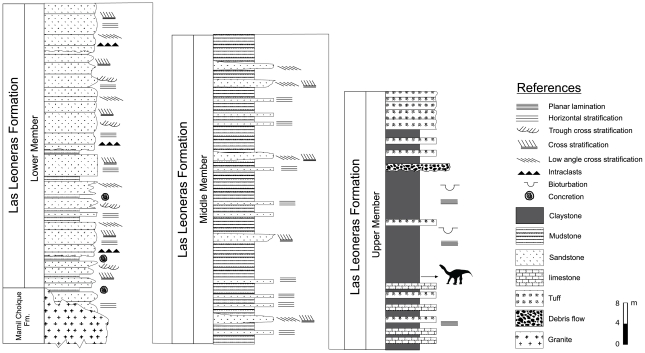
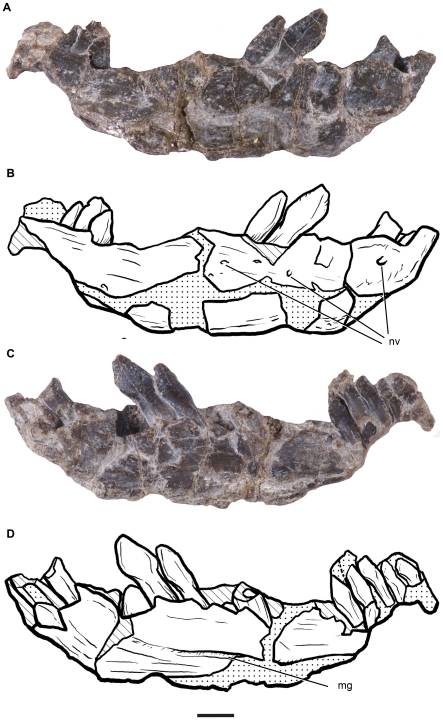
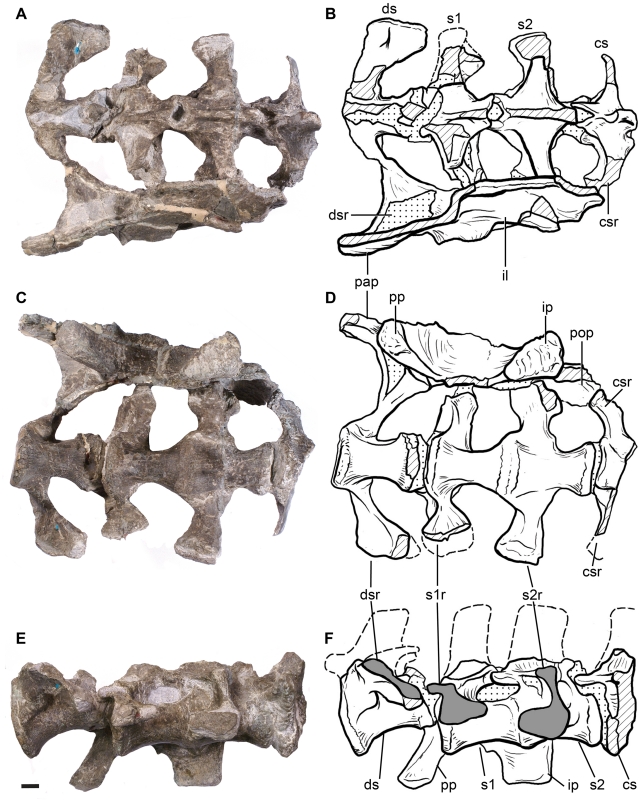
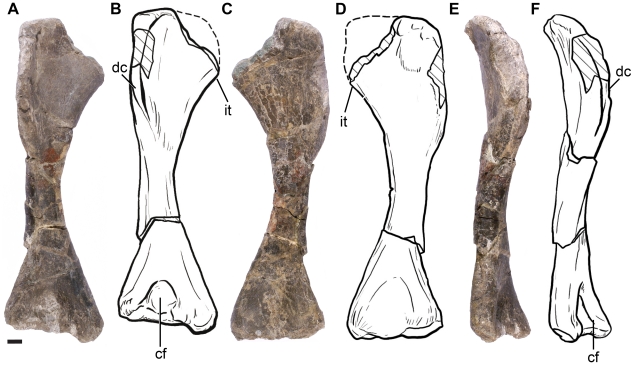
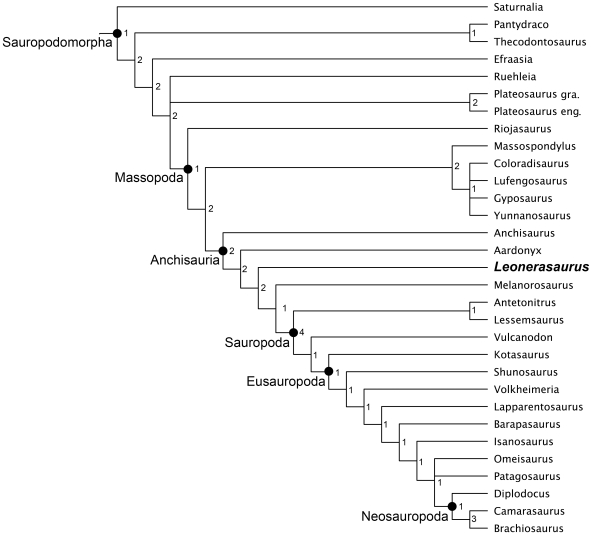
METHODOLOGY/PRINCIPAL FINDINGS: A new sauropodomorph dinosaur, Leonerasaurus taquetrensis gen. et sp. nov., is described from the Las Leoneras Formation of Central Patagonia (Argentina). The new taxon is diagnosed by the presence of anterior unserrated teeth with a low spoon-shaped crown, amphicoelous and acamerate vertebral centra, four sacral vertebrae, and humeral deltopectoral crest low and medially deflected along its distal half. The phylogenetic analysis depicts Leonerasaurus as one of the closest outgroups of Sauropoda, being the sister taxon of a clade of large bodied taxa composed of Melanorosaurus and Sauropoda.
CONCLUSIONS/SIGNIFICANCE: The dental and postcranial anatomy of Leonerasaurus supports its close affinities with basal sauropods. Despite the small size and plesiomorphic skeletal anatomy of Leonerasaurus, the four vertebrae that compose its sacrum resemble that of the large-bodied primitive sauropods. This shows that the appearance of the sauropod-type of sacrum predated the marked increase in body size that characterizes the origins of sauropods, rejecting a causal explanation and evolutionary linkage between this sacral configuration and body size. Alternative phylogenetic placements of Leonerasaurus as a basal anchisaurian imply a convergent acquisition of the sauropod-type sacrum in the new small-bodied taxon, also rejecting an evolutionary dependence of sacral configuration and body size in sauropodomorphs. This and other recent discoveries are showing that the characteristic sauropod body plan evolved gradually, with a step-wise pattern of character appearance.
蜥脚类恐龙的起源是恐龙进化的主要里程碑之一,但仍知之甚少。这种剧烈的转变涉及到主要的骨骼改造,包括从小而纤细的原始蜥脚形亚目状态向蜥脚类的巨大四足状态的转变。冈瓦纳大陆晚三叠世至早侏罗世的最新发现为理解蜥脚类恐龙的起源和早期进化提供了关键证据。
方法/主要发现:一种新的蜥脚形亚目恐龙,Leonerasaurus taquetrensis 属和种,是从阿根廷中部拉斯莱昂纳斯组描述的。新分类单元的特征是前牙无锯齿,冠呈低勺形,椎体为鞍背形和无腔,有四个荐椎,肱骨肩胛冈低,沿远端的一半向内侧偏斜。系统发育分析表明,Leonerasaurus 是蜥脚类的最接近外群之一,是由大型类群组成的一个分支的姐妹分类单元,该分支由 Melanorosaurus 和蜥脚类组成。
结论/意义:Leonerasaurus 的牙齿和后躯解剖结构支持它与基础蜥脚类的密切亲缘关系。尽管 Leonerasaurus 的体型较小,骨骼解剖结构原始,但它的四个荐椎与大型原始蜥脚类相似。这表明蜥脚类类型的荐骨的出现早于标志着蜥脚类起源的体型的显著增加,否定了这种荐骨结构和体型之间的因果关系和进化联系。Leonerasaurus 的替代系统发育位置作为一个基础的原蜥脚类动物,意味着在新的小体型分类单元中,蜥脚类类型的荐骨是一种趋同进化的结果,也否定了蜥脚形亚目动物的荐骨结构和体型之间的进化依赖性。这和其他最近的发现表明,蜥脚类的典型身体计划是逐渐进化的,具有特征出现的逐步模式。