Department of Pharmacology, College of Medicine, University of Saskatchewan, Saskatoon, Canada.
Diabetes. 2011 Mar;60(3):899-908. doi: 10.2337/db10-0627. Epub 2011 Feb 7.
The incidence of high dietary carbohydrate-induced type 2 diabetes is increasing worldwide. Methylglyoxal (MG) is a reactive glucose metabolite and a major precursor of advanced glycation end products (AGEs). MG levels are elevated in diabetic patients. We investigated the effects of chronic administration of MG on glucose tolerance and β-cell insulin secreting mechanism in 12-week-old male Sprague-Dawley rats.
MG (60 mg/kg/day) or 0.9% saline was administered by continuous infusion with a minipump for 28 days. We performed glucose and insulin tolerance tests and measured adipose tissue glucose uptake and insulin secretion from isolated pancreatic islets. We also used cultured INS-1E cells, a pancreatic β-cell line, for molecular studies. Western blotting, quantitative PCR, immunohistochemistry, and transferase-mediated dUTP nick-end labeling (TUNEL) assay were performed.
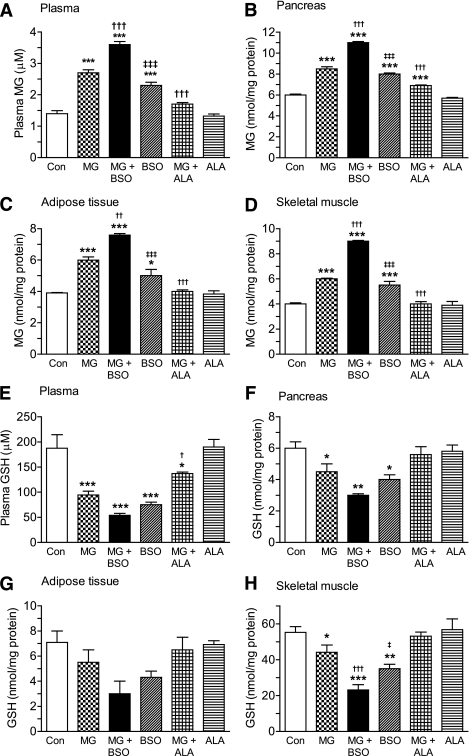
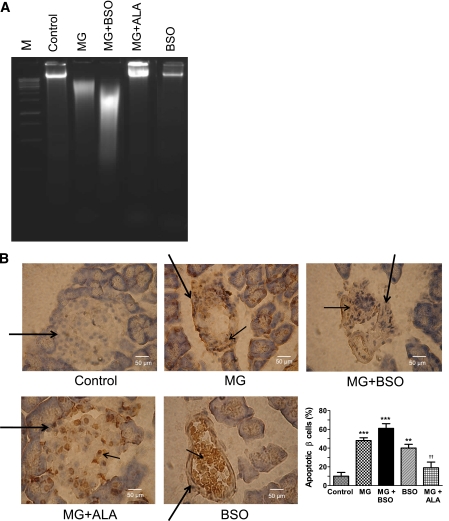
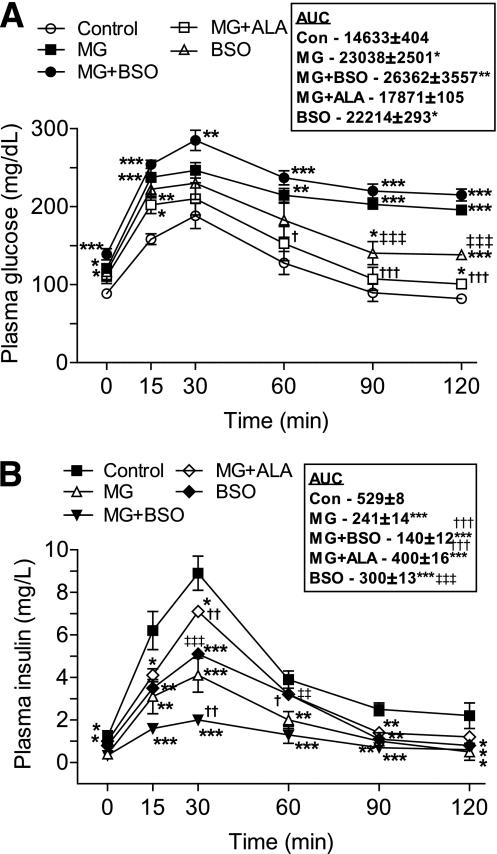
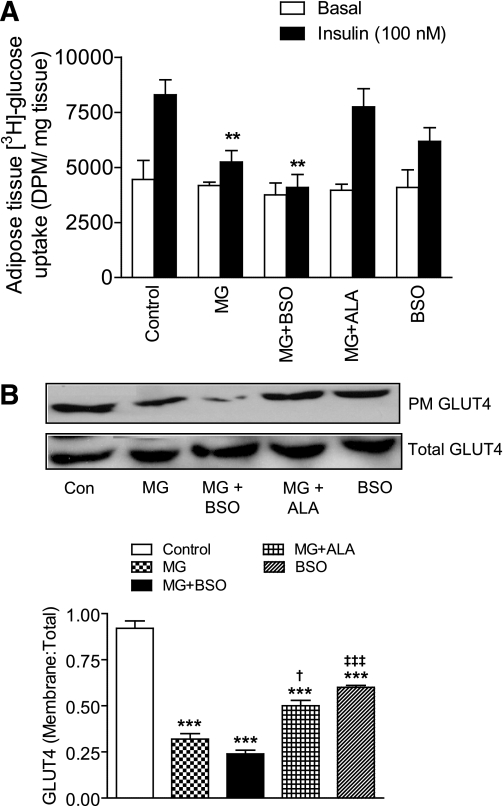
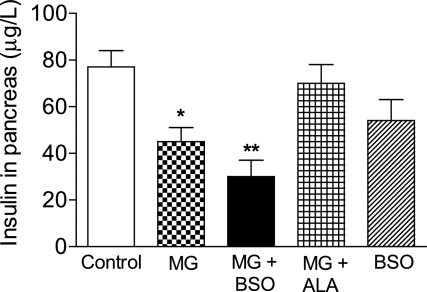
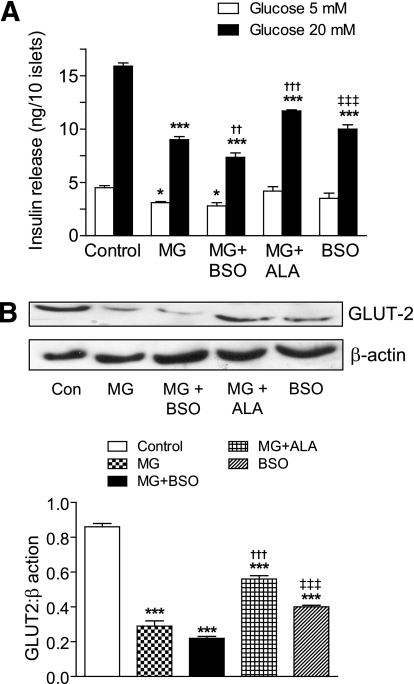
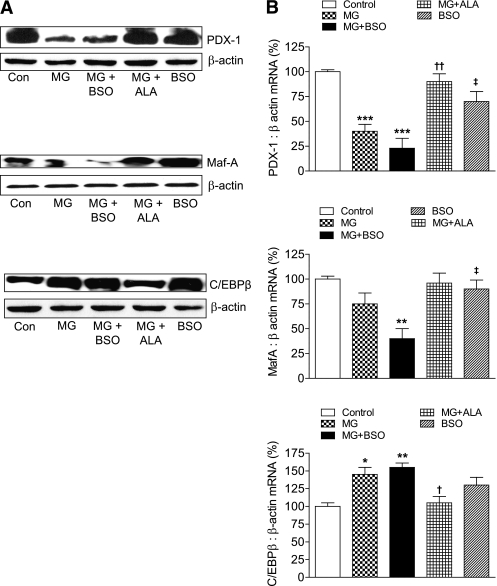
In rats treated with MG and MG + l-buthionine sulfoximine (BSO), MG levels were significantly elevated in plasma, pancreas, adipose tissue, and skeletal muscle; fasting plasma glucose was elevated, whereas insulin and glutathione were reduced. These two groups also had impaired glucose tolerance, reduced GLUT-4, phosphoinositide-3-kinase activity, and insulin-stimulated glucose uptake in adipose tissue. In the pancreatic β-cells, MG and MG + BSO reduced insulin secretion, pancreatic duodenal homeobox-1, MafA, GLUT-2, and glucokinase expression; increased C/EBPβ, nuclear factor-κB, MG-induced AGE, N(ε)-carboxymeythyllysine, and receptor for AGEs expression; and caused apoptosis. Alagebrium, an MG scavenger and an AGE-breaking compound, attenuated the effects of MG.
Chronic MG induces biochemical and molecular abnormalities characteristic of type 2 diabetes and is a possible mediator of high carbohydrate-induced type 2 diabetes.
高膳食碳水化合物引起的 2 型糖尿病的发病率在全球范围内正在增加。甲基乙二醛(MG)是一种反应性葡萄糖代谢物,也是晚期糖基化终产物(AGEs)的主要前体。糖尿病患者的 MG 水平升高。我们研究了慢性给予 MG 对 12 周龄雄性 Sprague-Dawley 大鼠葡萄糖耐量和β细胞胰岛素分泌机制的影响。
MG(60mg/kg/天)或 0.9%生理盐水通过微量泵持续输注 28 天。我们进行了葡萄糖和胰岛素耐量试验,并测量了从分离的胰岛中摄取的脂肪组织葡萄糖和胰岛素分泌。我们还使用了胰岛β细胞系 INS-1E 细胞进行分子研究。进行了 Western 印迹、定量 PCR、免疫组织化学和转移酶介导的 dUTP 缺口末端标记(TUNEL)测定。
在给予 MG 和 MG+L-丁硫氨酸亚砜(BSO)的大鼠中,MG 水平在血浆、胰腺、脂肪组织和骨骼肌中显著升高;空腹血糖升高,而胰岛素和谷胱甘肽减少。这两组还存在葡萄糖耐量受损、GLUT-4、磷酸肌醇 3-激酶活性和脂肪组织中胰岛素刺激的葡萄糖摄取减少。在胰岛β细胞中,MG 和 MG+BSO 降低了胰岛素分泌、胰腺十二指肠同源盒-1、MAFA、GLUT-2 和葡萄糖激酶的表达;增加了 C/EBPβ、核因子-κB、MG 诱导的 AGE、N(ε)-羧甲基赖氨酸和 AGE 受体的表达;并导致细胞凋亡。MG 清除剂和 AGE 断裂化合物 Alagebrium 减轻了 MG 的作用。
慢性 MG 引起了 2 型糖尿病的生化和分子异常,可能是高碳水化合物引起 2 型糖尿病的介质。