Division of Gynaecological Oncology, Department of Obstetrics and Gynaecology, Universitaire Ziekenhuizen Leuven, Katholieke Universiteit Leuven, Herestraat 49, 3000 Leuven, Belgium.
Br J Cancer. 2011 Mar 1;104(5):863-70. doi: 10.1038/sj.bjc.6606092. Epub 2011 Feb 8.
Recently, a Risk of Ovarian Malignancy Algorithm (ROMA) utilising human epididymis secretory protein 4 (HE4) and CA125 successfully classified patients as presenting a high or low risk for epithelial ovarian cancer (EOC). We validated this algorithm in an independent prospective study.
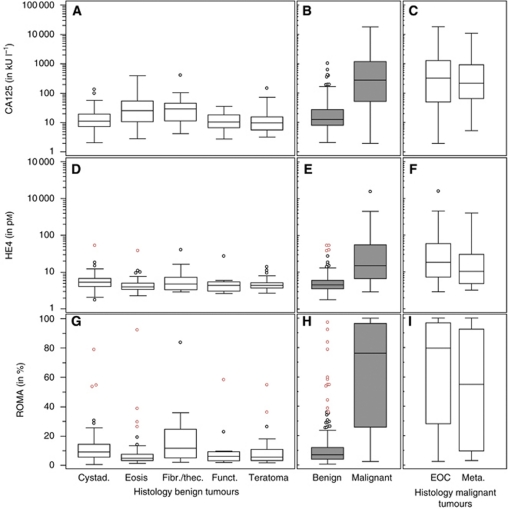
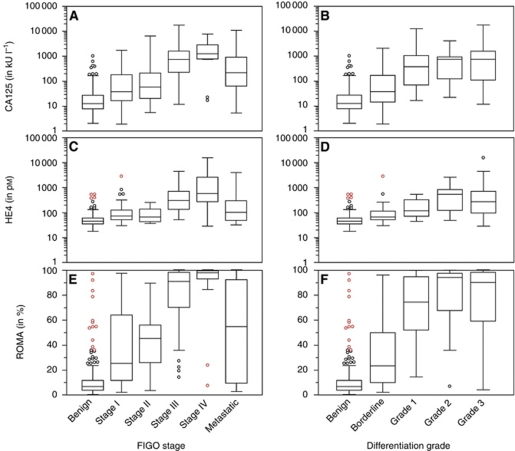
Women with a pelvic mass, who were scheduled to have surgery, were enrolled in a prospective study. Preoperative serum levels of HE4 and CA125 were measured in 389 patients. The performance of each of the markers, as well as that of ROMA, was analysed.
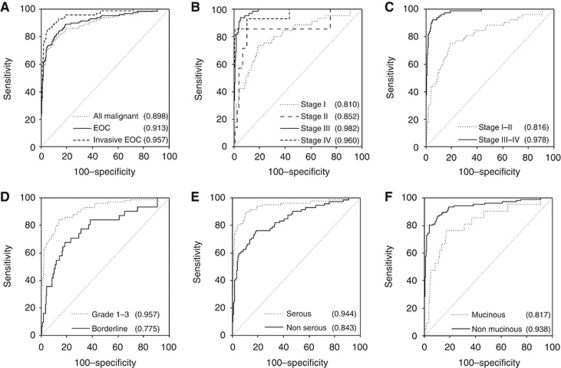
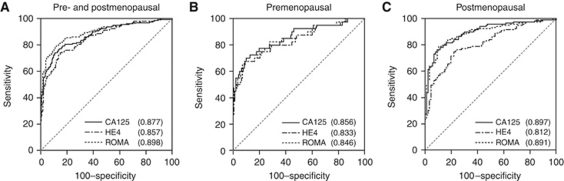
When all malignant tumours were included, ROMA (receiver operator characteristic (ROC)-area under curve (AUC)=0.898) and HE4 (ROC-AUC)=0.857) did not perform significantly better than CA125 alone (ROC-AUC=0.877). Using a cutoff for ROMA of 12.5% for pre-menopausal patients, the test had a sensitivity of 67.5% and a specificity of 87.9%. With a cutoff of 14.4% for post-menopausal patients, the test had a sensitivity of 90.8% and a specificity of 66.3%. For EOC vs benign disease, the ROC-AUC of ROMA increased to 0.913 and for invasive EOC vs benign disease to 0.957.
This independent validation study demonstrated similar performance indices to those recently published. However, in this study, HE4 and ROMA did not increase the detection of malignant disease compared with CA125 alone. Although the initial reports were promising, measurement of HE4 serum levels does not contribute to the diagnosis of ovarian cancer.
最近,一种利用人附睾蛋白 4(HE4)和 CA125 的卵巢恶性肿瘤风险算法(ROMA)成功地将患者分为高风险或低风险的上皮性卵巢癌(EOC)。我们在一项独立的前瞻性研究中验证了该算法。
对计划接受手术的盆腔肿块女性进行前瞻性研究。对 389 例患者进行术前血清 HE4 和 CA125 水平检测。分析了每个标志物以及 ROMA 的性能。
当包括所有恶性肿瘤时,ROMA(受试者工作特征(ROC)-曲线下面积(AUC)=0.898)和 HE4(ROC-AUC=0.857)的性能并不优于单独的 CA125(ROC-AUC=0.877)。对于绝经前患者,ROMA 截断值为 12.5%时,该检测的敏感性为 67.5%,特异性为 87.9%。对于绝经后患者,截断值为 14.4%时,该检测的敏感性为 90.8%,特异性为 66.3%。对于 EOC 与良性疾病,ROMA 的 ROC-AUC 增加至 0.913,对于侵袭性 EOC 与良性疾病,ROC-AUC 增加至 0.957。
这项独立验证研究显示了与最近发表的研究相似的性能指标。然而,在这项研究中,与单独的 CA125 相比,HE4 和 ROMA 并没有增加恶性疾病的检出率。尽管最初的报告很有希望,但血清 HE4 水平的测量对卵巢癌的诊断没有帮助。